
A carnival game rental for a Squamish fair should give a visitor a quick way into the gathering. Plan how guests will choose a station, take a turn and move on. Ask BC Event Makers to confirm service to the actual Squamish date and venue before using its catalogue choices in publicity.
BC Event Makers lists a range of carnival games. Ask about availability and delivery feasibility for the proposed Squamish site. Choose a mix of game formats that works for the participant group and the space you can allocate.
1. Give the carnival game rental a place in the station mix

Treasure Chest uses a disc throwing challenge, while Rattlesnake Roundup uses rubber snakes aimed through a target. Soccer Darts offers a kicking activity. These differences let you compare the physical actions and themes rather than selecting several games that feel similar.
Ask about the requirements and playing area for each chosen game. A target challenge needs space for its actual play format as well as people watching. Do not assume that all carnival games can be placed directly beside one another.
2. Explain the participation system before the line
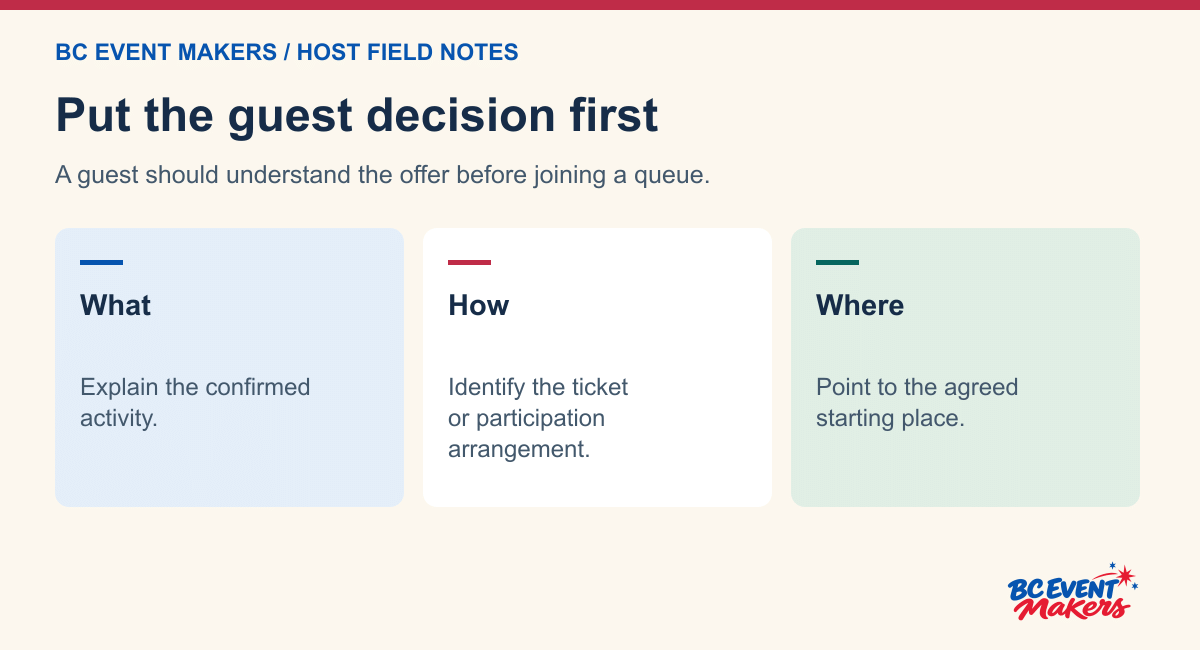
Decide whether guests will use event tickets or simply take turns. Put that information at the entrance and repeat it at the stations. If prizes are part of the plan, explain who provides them and how they are awarded.
Confirm any relevant fundraising or prize requirements before advertising the fair. Keep the station instructions consistent so volunteers do not each invent a different process. A guest moving between games should understand what stays the same and what changes.
3. Review the guest route and service to the site
Draw the guest route and place waiting areas outside the activity spaces. Keep ball or disc retrieval within the planned game arrangement. Ask the supplier to review how neighbouring stations interact, especially where participants face toward a target.
Leave room for guests who are deciding what to try and for companions who are watching. Put food service where its queue has its own space. An event route should remain usable even when a popular station attracts a group.
4. Give game station helpers a complete handoff
Assign the supervision and operating roles required for the equipment. Give helpers the confirmed instructions and a clear contact for questions. Plan handovers so a station is not left unmanaged when someone takes a break.
Browse the carnival and games catalogue and send your Squamish enquiry. Include the venue, participant mix and proposed station layout. Ask for delivery and equipment requirements before publishing a list of confirmed games.
Draw a five-minute visit and a half-hour visit
Some visitors come to a Squamish fair between other plans. They have time for one game and a quick look around. Others want to spend half an hour exploring with family. A useful station mix gives both groups a way to enjoy the event. Start by drawing those two visits on the same sheet before deciding which carnival game rental belongs in each position.
For the five-minute visit, mark the entrance, the point where a guest understands the participation arrangement, one easy-to-find game station and a clear way back to the wider event. For the longer visit, add a shared activity, a place to watch and a meeting point for people who split up. Where do the two paths meet? If every guest has to return through the entrance queue after every turn, the route needs another look.
Tell the supplier which experience matters most. A quick-turn booth, a shared tabletop game and an attraction that draws spectators have different implications for waiting, resetting and volunteer attention. Ask about actual equipment, space and staffing for the selected option. BC Event Makers’ core area is the Lower Mainland, so start by requesting a written service answer for the specific Squamish date and address.
Give the stations different jobs
A collection of equipment can still give visitors four versions of the same experience. Label each proposed game station by the guest decision it supports. Can a newcomer try something quickly? Can two friends stay and play together? Can a guest watch from outside the playing area? Does the last station lead naturally back to lunch or the main gathering?
| Guest visit | Useful station role | What to ask before choosing equipment |
|---|---|---|
| One quick try | A short explanation and a clear exit after the turn. | What does a turn involve and who resets the game? |
| Family activity | Something people can enjoy at different paces. | Which participant groups suit the actual item? |
| Watch and meet | A public space outside the waiting line and playing area. | Where can friends regroup without crossing another station? |
| Explore several booths | A route that gives visitors an obvious next choice. | How will queues, supplies and volunteer relief work together? |
Giant Jenga is a catalogue example the committee can discuss when comparing shared games. A product name is a starting point for the conversation. Ask about the actual setup, oversight and use for the intended participants, then compare it with the other games and guest routes in the proposal.
Decide how guests find out what a turn means
The organiser can choose free play, general tickets, station-specific tickets or another approved arrangement. Write the actual offer in one sentence and ask a volunteer to explain it to someone seeing the game station for the first time. If they have to qualify every word, simplify the offer or make the exception clearer before the fair opens.
Put the public wording at the point where a guest chooses whether to join the queue. The station host can answer a straightforward question, but a busy host should know which lead handles a payment exception, a closed booth or a dispute about the offer. Keep any records and private contact details within the organising body’s agreed process.
If prizes or a separate draw are being proposed, the responsible organisation should review those arrangements independently before advertising them. Give volunteers the approved game instructions and guest offer for their station. Avoid letting an ordinary carnival game rental become a promise about a different prize promotion that nobody has confirmed.
Example. A family has time for one game
A parent sees a large sign for tickets but has only a few minutes before they need to leave. The family wants to know whether one ticket buys a turn at any open station and where a quick option is available. If the welcome volunteer can answer only the price, the guest still has to join another line to decide whether the ticket is useful.
Give the welcome point a current station list and the approved offer. A phrase such as “These stations are open; ask this host about the next available turn” is more reliable than guaranteeing a short wait. Direct the family to the appropriate guest route and tell them where they can meet after the turn. Let a visitor who prefers to watch take part in the wider gathering without buying something they do not want.
When a game station pauses, update the station list and ticket point together. The family arriving late should receive the current options rather than a promise copied from the morning programme. If someone already has a ticket, direct individual questions to the authorised organiser instead of asking a queue volunteer to invent an exception.
Example. The line forms on the wrong side of a booth
The diagram places a waiting line beside a game, but new guests naturally walk up from the other direction. A few people stand there, more follow and the informal queue starts to block the route to refreshments. This is useful evidence about how visitors read the space; simply asking the volunteer to speak louder may not solve it.
Review the proposed waiting direction with the venue contact and supplier. Can visitors see the start of the line from their actual approach? Does the sign face the place where they make the decision? Can other guests pass without walking through play? Change the map and volunteer instructions together once the responsible contacts approve a workable arrangement.
Walk the new route as a first-time visitor. If a person still has to cross a line to read the sign, move the useful information closer to the decision point. A guest route should work for a family with a stroller, companions walking together and someone heading straight to the food area. Ask the property contact about any access needs or restrictions on that exact site.
Example. The preferred rental is unavailable for Squamish
The committee has selected a game it likes from a supplier catalogue, but the supplier cannot confirm travel or availability for the intended date. Keep the guest goal and reopen the equipment choice. If the original aim was a quick first turn, ask a local supplier for a confirmed activity that serves that purpose. If the aim was a shared game, compare how friends would actually join and finish at the alternative.
Request the replacement item’s own setup and host responsibilities. An activity with a similar theme can need a different queue, reset task or site arrangement. Ask the venue contact to review the revised position, particularly if the change affects the guest route or a supplier delivery window.
Update the public material before it is shared. A photograph of an unavailable game can create a stronger expectation than a carefully qualified sentence about the event. Use approved artwork for what is confirmed. The fair can still announce its date, purpose and available activities while another rental is under review.
Review the actual Squamish property
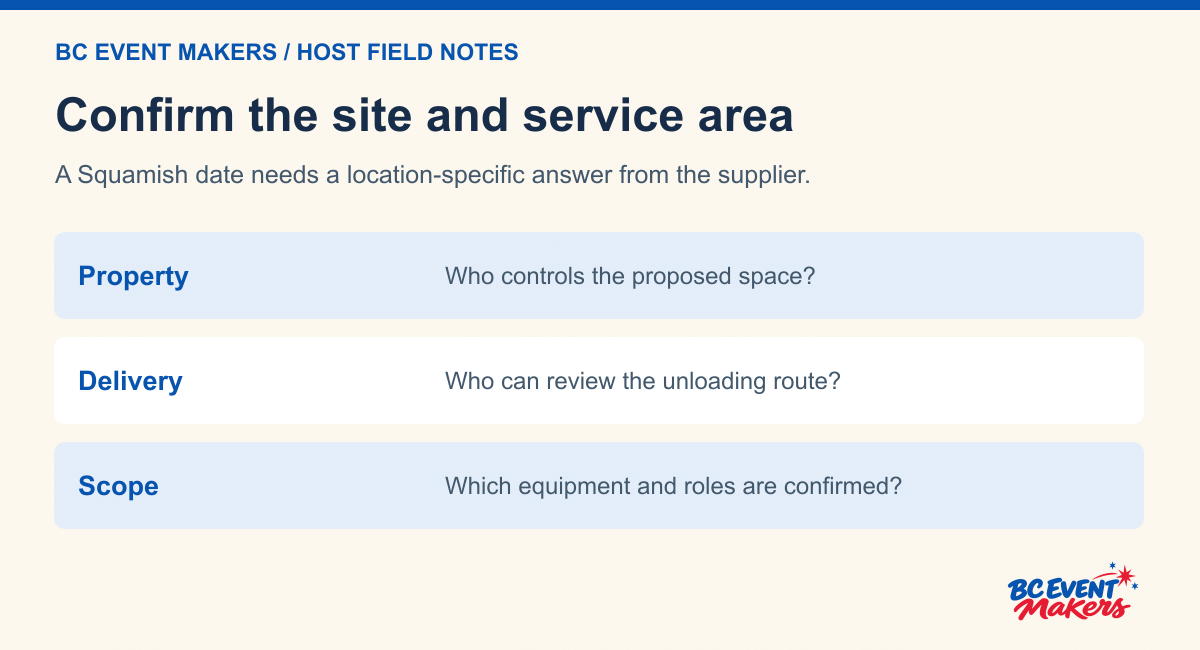
For an event on municipal property, the District of Squamish’s event-hosting information identifies the local process to discuss. Give the site contact the actual equipment, event hours and proposed uses. A school, club or private venue has its own administrator. Ask that person which access windows and property arrangements apply to the event.
Send the supplier the exact address and photographs from the unloading point to the proposed game station. Note gates, turns, surface changes and any shared route you know about. Include the time when the venue will grant access for collection. Request confirmation from the supplier for the particular date and location rather than assuming that an item listed online can travel there.
Draw the site after the other event elements are in place. A food counter can create a queue; a seating area can change the path to a game; an information tent can become a popular meeting point. The supplier and venue can give a more useful answer when they see the public paths and surrounding uses as well as the equipment position.
Prepare a shift handoff
Give every station helper a brief with the confirmed public turn, the waiting place, the supplies appropriate to their role and the name of the event lead. Ask the supplier which setup, reset or operating duties belong to it and which can be assigned to the host. Avoid handing a volunteer an equipment task just because it looks simple on the map.
Let the incoming helper watch one complete turn before the outgoing person leaves. Ask where the queue naturally forms, which question guests keep asking and whether any station detail has changed. A real handoff takes a little time. Put it on the timetable rather than assuming two people can swap roles instantly during the busiest part of the fair.
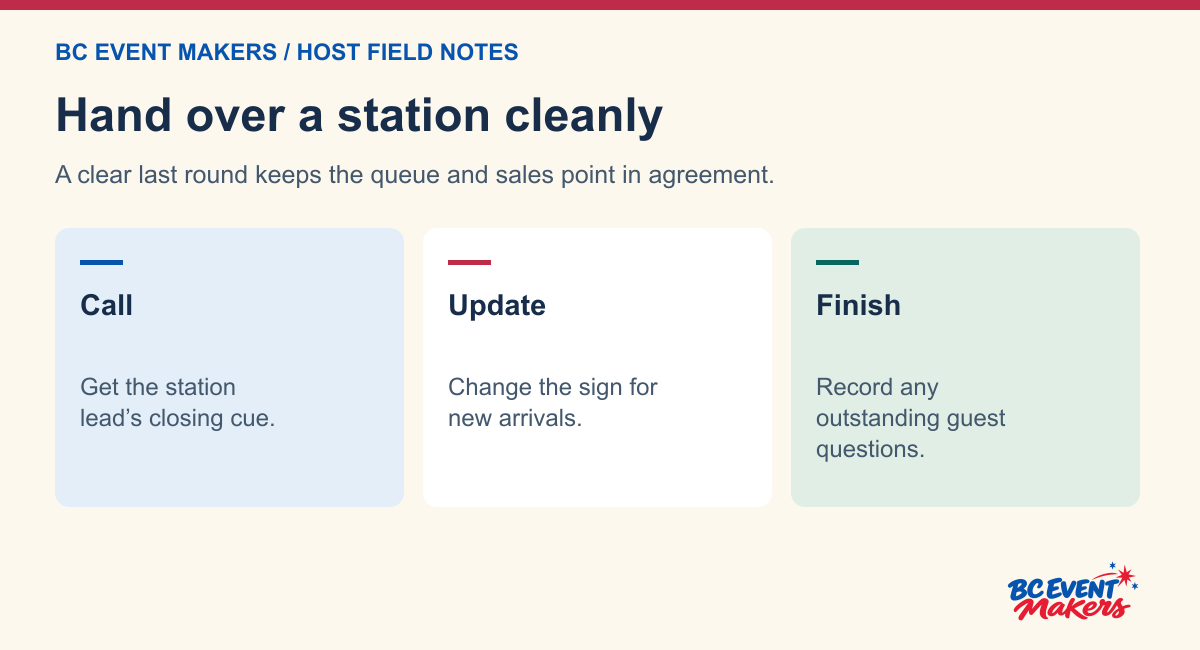
At the closing cue, tell the ticket point and nearby stations what is happening. Guests using a general ticket may need another open option, while someone waiting at a particular booth may need the organiser’s answer about an outstanding turn. Give the last arrival the same clear information as someone who heard the earlier announcement.
A brief for a supplier or local operator
We are planning a Squamish fair at [address] on [date]. Guests will arrive [pattern] and we want a carnival game rental to support [quick turn, shared activity or another purpose]. The site contact has confirmed [details]. Attached are the delivery route, the guest route and nearby activities. Can you confirm service to this address, the specific item and what the organising team would need to provide?
Include the point when the committee needs to approve the final station list. If the location or access changes after the initial response, send a revised brief and ask what must be reviewed again. Keep equipment availability, travel and venue approval as separate answers in the event file.
Take one observation home from each booth
Ask the station host to name the point where guests needed the most help. Was the issue choosing a first game, understanding the ticket, knowing where to wait or finding friends afterwards? Each answer leads to a different improvement. A better guest sign will not clear a route that has two queues crossing in the same opening.
Keep the observation attached to the actual location on a dated map. A future committee can then decide whether to adjust the layout, change the volunteer briefing or choose a different kind of game. Use the previous fair as evidence while obtaining fresh confirmation for the next property, date and equipment.
What if one volunteer is covering two booths?
Put the two stations on the map and write down the tasks that fall at the same time. One game may need a person welcoming the next guest while the other needs a supply handoff or a decision about closing. A single volunteer cannot reliably give both stations their attention just because the tables are close together. Ask the supplier and organiser to confirm the required roles for each chosen activity.
If the team cannot cover both stations, consider opening them during different windows or selecting a simpler confirmed programme. Explain the actual hours on the sign and tell the ticket point which game station is available. One well-run booth with a clear guest route can be a better experience than two open-looking booths whose host is constantly moving between them.
Rehearse the changeover with the incoming volunteer. Where will the last waiting family go? Who updates the sign? Which person confirms that the next station is ready to open? Put the answers beside the rotation time on the staff sheet. This small rehearsal also identifies whether the supplier needs access to the space while the public is still moving through the fair.
When the committee reviews the result, record the actual busy period rather than assuming the same staffing plan will work next time. A different start time, a new nearby activity or a larger family group can change the pattern substantially. Use the observation to build the next volunteer rota, then confirm it against the equipment and site for that event.
Review the carnival game collection and send the event brief for confirmation of the date, equipment and address.