
For a water slide in New Westminster, the difference between “there’s a tap” and “the venue has approved water play” is worth sorting out before the invitations go out. Ask three people three different questions: the venue approves the use of the space, the supplier reviews the exact unit, and the host plans where wet guests will go.
Here’s how to make a choice without guessing. Start with the venue decision, compare two activity styles, work through the wet and dry routes, and prepare a message for guests.
1. Will the venue approve a water slide in New Westminster?
If you’re using a City facility, identify the correct booking contact on New Westminster’s facilities and parks booking page. Describe the proposed equipment, site, date and water use when you ask. A facility reservation is not a promise that an inflatable, a water connection or a particular drainage arrangement will be approved.
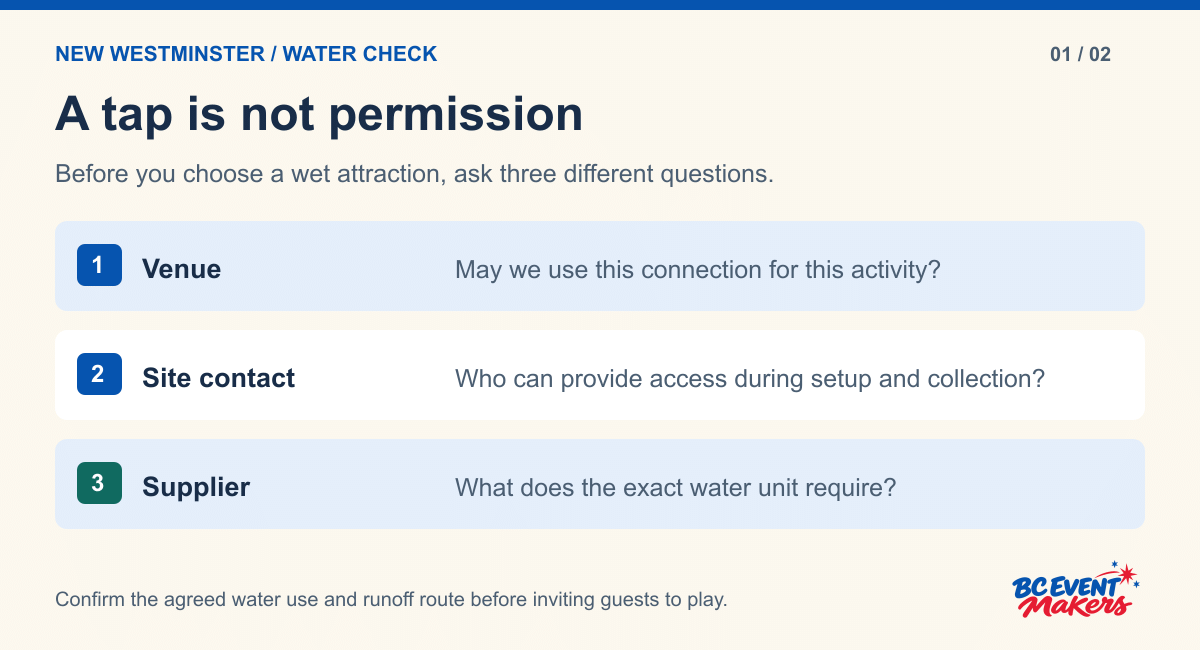
At a school, rented hall or private garden, speak to the person responsible for that property. Ask who can open the connection during setup, what route the supply can take and where water is allowed to drain. If the answer is “the caretaker knows”, get the caretaker’s decision before describing water play to guests. An available tap on the far side of a building may not solve the access question.
Make a small site brief with the street address, surface, entrance route and photographs. Note which details the venue has confirmed and which still need review. Report a narrow gate, change in level or overhead issue instead of deciding for yourself whether it rules equipment in or out. The supplier needs the route from unloading to setup, not just the area visible from the patio.
2. Water slide or Slip and Slide: which fits the programme?
Two water activities can look similar in an inventory list and produce a different experience at the event. A taller wet slide has a climb and a descent. A Slip and Slide uses a long playing route. Those differences affect where people wait and where they finish; they do not establish that either activity will fit the site you have in mind.

Open the Giant 24-foot Water Slide listing and the Slip and Slide listing when preparing your shortlist. Send the date and participant age range, and say whether guests arrive in one rush or throughout the afternoon. Ask about suitability, current availability, the supply and supervision. Do not assume the unit pictured is reserved or that an age group is suitable from the photograph alone.

When water is not an option: ask for a dry alternative intended for dry use. The BC Event Makers rental FAQ explains why a hose cannot be added to a unit that was not designed for water. A dry slide is a different equipment choice, not an instruction to change how a wet unit operates. Equipment and site approval still need to match.
3. Where do towels, food and the waiting group belong?
Draw one line from the activity exit to the towels. Draw another from the main seating to lunch or the washrooms. If both routes pass through a single gate, ask whether you can place the towels closer to the activity or move the food service away from the crossing. Keep the operator’s required space clear and ask the venue to review the final arrangement.
Picture a school event with pizza delivered halfway through the programme. The van needs the service entrance just when a class is due at the slide. If the two activities use the same gate, changing the delivery time or choosing a different meeting point for the class may be simpler than moving equipment. Put that handoff on the run sheet before volunteers arrive.
Guests who never take a turn still need a good way through the site. Is there a dry route to the washrooms? Can someone watch without standing at the slide exit? Can a family collect its belongings without joining the queue? Getting those answers right often improves the party more than adding another attraction.
4. What should families know about the water slide before they arrive?
Once the wet activity is confirmed, tell families what to bring and where to put it. List the start and end of the guest programme; keep the supplier’s private delivery instructions on the staff copy. If guests can also take part without getting wet, give them one clear example. “Come for lunch and lawn games even if you skip the slide” is useful when lunch and lawn games really are on the plan.
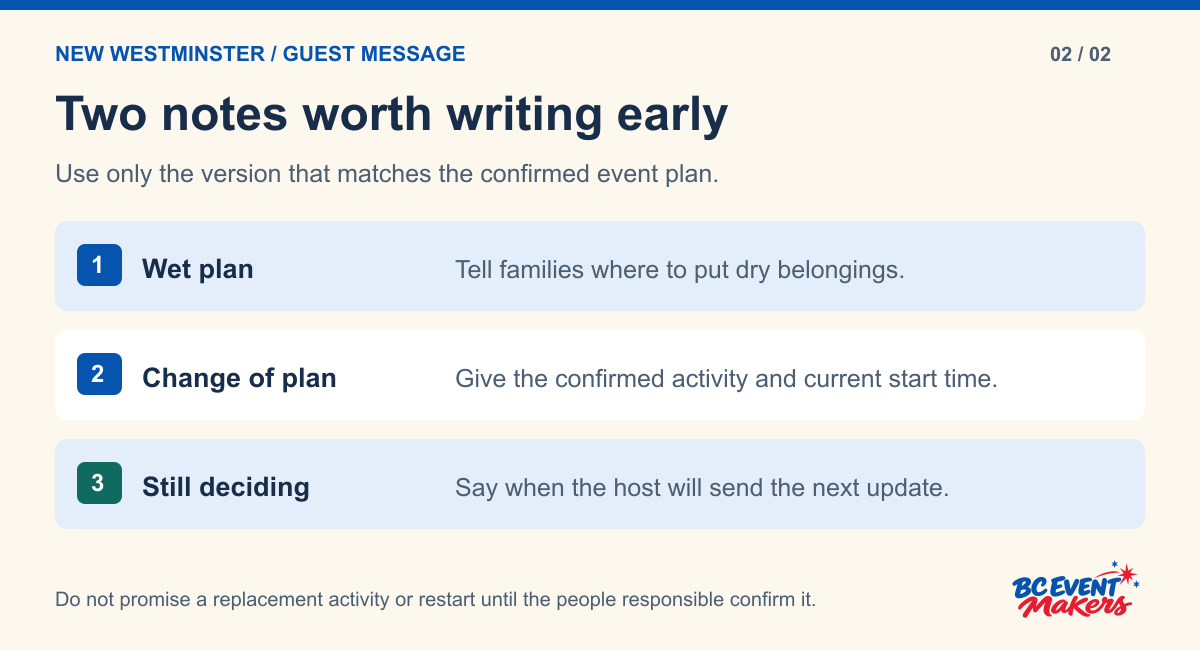
If conditions change: ask the appropriate venue and supplier contacts for the decision and applicable terms. A forecast, a friend’s past booking or an empty indoor room is not confirmation of a replacement. Let guests know who is handling the update. If the start time or address changes, put that change in the first sentence of the message.
If you are still waiting for a decision: “We’re checking the site with the venue and rental team. We’ll send the next update by [time]. The confirmed part of the programme is [details].” Set a time you can actually meet rather than guessing when play will resume.
The venue call: water connection, access and runoff
If you’ve already settled the first four questions, you can send the enquiry below. If the venue or water connection is still uncertain, use this workbook at your next planning meeting. It follows three examples: a school with a locked tap, a family celebration in a hired space and a company picnic with an alternative activity. None is a claim that a particular New Westminster site accepts water slides.
Who can open the school’s water connection?
Imagine the school has agreed that the proposed water activity can be reviewed. The event team takes a photograph of an outdoor tap and assumes that water supply is settled. On the run sheet the rental team arrives at eight; the caretaker who controls access to the connection arrives at nine-thirty. The missing detail is not a longer hose. It is a person with authorised access during the actual setup window.
Ask the school who can provide access and when that person will be on site. Ask the supplier what it needs to check before the activity opens. Put the two answers side by side. If the window does not work, change the plan with both parties. Do not ask a volunteer to open a locked connection or use a different facility simply to stay on schedule.
When sending the updated site brief, state exactly what changed. “The authorised keyholder can meet the team at the east entrance at [confirmed time]” is useful. “Water sorted” leaves the next person to guess whether that means permission, supply, access, or all three. A host arranging a water slide in New Westminster may deal with the venue and supplier on different days; record the answers in language that will still be clear at the next meeting.
A hired venue can host the gathering but has not approved runoff
Suppose a room has been hired for a family celebration and there is an adjacent outdoor area. The booking coordinator is happy to discuss a water slide, but no one has yet identified where water may drain. That is a real unanswered question, not a small detail to leave for the delivery crew. The room reservation, outdoor use and proposed runoff arrangement need to describe the same event.
Draw the water connection, proposed activity and nearest shared guest route. Ask the property contact to identify what use is permitted and what needs further review. If a neighbouring doorway, accessible path or another tenant’s space lies in the proposed route, tell the site contact. Do not build a drainage solution yourself or assume a route is appropriate just because water flowed that way at a different property.
If the venue says water use will not be approved, close the wet option and ask about a dry slide or another activity designed for the site. The question then becomes “Which dry activity suits these participants and this footprint?” instead of “How can we still use the wet slide?” A dry alternative has its own setup and operating requirements. Update the guest message before anyone packs for an activity that has been ruled out.
A company picnic wants one activity for every employee’s family
A tall water slide, a Slip and Slide and a dry slide are three different experiences. No single option is automatically right for everyone at a company picnic. Ask what a guest who doesn’t want to get wet can do at the same gathering and where they can comfortably watch a child. A good party has more than one enjoyable route through the afternoon.
One host might place an agreed seating area near the activity while keeping lunch on a dry guest route. Another might offer the water activity during a specific part of the programme, leaving the shared welcome and lunch open to everyone. Confirm the timing and equipment arrangement before printing it. There is no need to frame someone who skips the slide as sitting out of the picnic.
For a group with staggered shifts, tell the supplier when guests are likely to arrive. “Most families will show up after the staff barbecue ends” may explain the demand better than an all-day headcount. Ask how the actual activity should be introduced to a group arriving together. Never promise every child a fixed number of turns merely because the picnic has a certain length.
Compare the proposals by what the host will actually do
Put the water slide proposal and the backup proposal beside the same venue sketch. Read them as the person responsible for opening the gate and greeting families. Which facts have been checked? What does the organiser need to provide? Which part of the programme is still provisional? If a supplier needs information you don’t yet have, tell them that instead of borrowing it from another event.
| Question | What a useful answer identifies |
|---|---|
| Which exact unit is being discussed? | Model name, date, intended use and whether availability has actually been confirmed. A catalogue photo is a reference, not a reservation. |
| Does the setup fit the venue’s access window? | Entry point, keyholder, any restrictions on delivery and the time the venue expects the site returned. |
| How will the water supply and runoff be reviewed? | The confirmed venue contact and supplier requirements for the exact unit. If the activity is dry, note that water use is not part of that proposal. |
| What does the guest route look like? | Entrance to queue, exit to belongings and a separate way to reach seats, lunch and washrooms. |
| Who handles an interruption? | Responsibilities agreed in writing, the contact for a programme change and the applicable booking terms. |
A proposal with a bigger attraction is not automatically a better fit. For a narrow arrival window, the practical question may be whether the equipment can be delivered and collected without disrupting the surrounding programme. For a family event, the deciding factor may be whether wet and dry guests can reach the same shared lunch without crossing the waiting area.
A short staff handoff for opening and closing
Before guests arrive: the host confirms that the venue contact is present at the correct entrance, checks whether any part of the agreed site has changed, and passes that information to the supplier. The team responsible for the equipment confirms the operating arrangement. The host then puts the guest sign in the location approved for it. A temporary sign or table must not change the agreed operating area.
While the activity is open: the host can direct a family to towels, explain which dry activities are available, or help the next group find the agreed waiting area. Questions about operating limits, suitability or a pause go to the person responsible under the booking. If someone asks to use the water slide differently, the host should not improvise an answer.
When play ends: tell guests where they can collect their things and where the rest of the programme continues. Keep the collection route available to the supplier and the venue contact. Don’t send guests through an area the team is using for removal. Confirm who will hand the site back to the property manager and who should report a concern about the site’s condition.
What a useful “plan changed” message sounds like
Give people the change first, then the detail they can act on. For example: “The venue has confirmed we won’t be running the water activity. The picnic is still at [location] at [time]. We’ll have [confirmed activity] instead; there’s no need to bring towels for the slide.” If the replacement has not been confirmed, leave that sentence out. A clear message about what remains scheduled is better than a promise that has to be corrected twice.
For an event still being reviewed, use one channel for the next confirmed update. If the person at the door, the invitation and the staff chat all give different information, guests have to solve a problem the planning team could have resolved. Keep the final message short enough that the host can read it out loud and put the same words on the sign.
Which photographs answer a question the address cannot?
Send one view from the unloading point towards the proposed setup area. If the route turns, take another from the turn looking towards the destination. A third view should show the space after the tents, tables and guest queue have been allowed for. For a water slide, add a photograph that puts the approved water connection in context. A close-up of the tap alone does not show whether the route crosses the guest entrance or where the venue has agreed runoff may go.
Label each image with what it shows and what still needs an answer. “West gate, looking in; caretaker to confirm opening time” is more useful than a file called “event photo”. Use the site and route photographs needed for review; there is no need to include private guest information. If a different venue is proposed later, send new photos instead of asking the supplier to rely on the old set.
Send enough information for a useful answer
We’re comparing a water slide in New Westminster with a dry option for [event] on [date]. The site is [address]. Guests arrive [how and when], and participants are [age range]. The venue has confirmed [water use, access and runoff details]. We still need to check [questions]. I’ve attached photos of the entrance, surface and water connection. What else do you need to recommend an appropriate unit?
Use the BC Event Makers quote form. If you are still comparing locations, say so. A useful proposal identifies which facts apply to the confirmed venue and which will need another review if the address changes.