
Obstacle course rentals in North Vancouver begin with a question that a catalogue cannot answer: does the person who manages the site allow the proposed inflatable? A park shelter reservation, permission to hold a school fair and approval for an obstacle course are three different things.
Use these four checks before inviting guests to race: get the site decision, compare the equipment, walk the guest route and agree on the handover. There’s a sample site enquiry at the end.
1. Who can approve obstacle course rentals at this site?
For a City or District of North Vancouver park, start with the North Vancouver Recreation and Culture Commission’s park booking guidance. It says organised groups using these spaces need a park use permit and inflatable devices require special permission. A booking application is a request, not a decision. Name the proposed activity when you speak with the booking team.
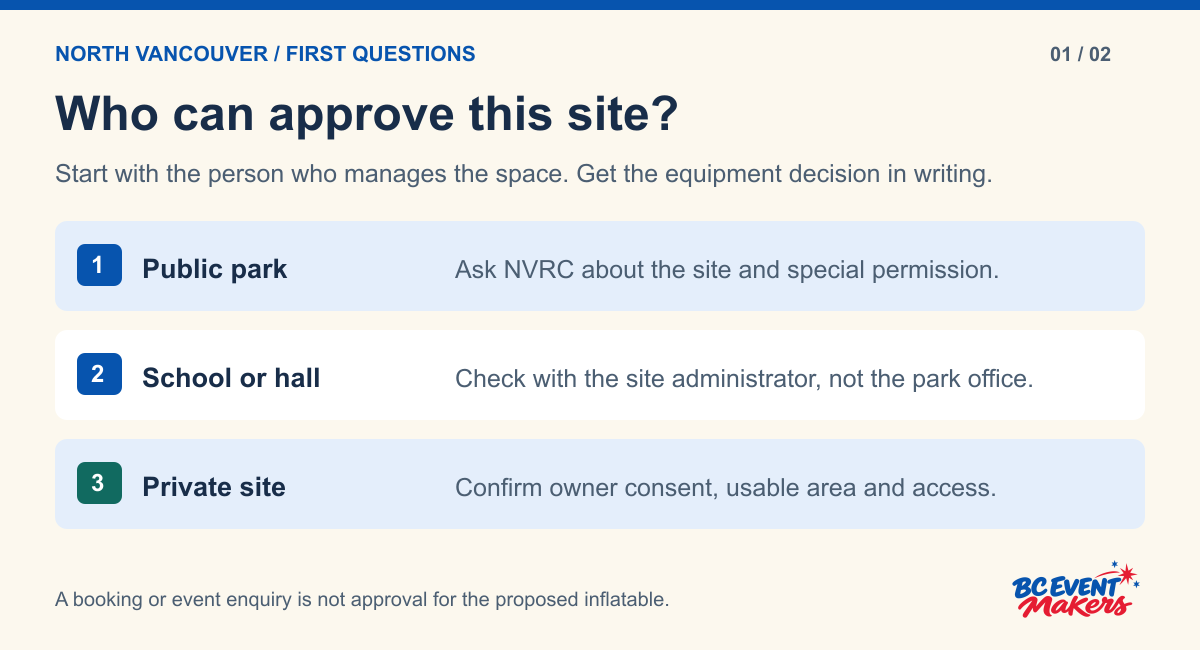
If the site is a school, ask the person authorised to approve outside equipment on that property. An enthusiastic teacher may know the best spot on the field but may not be the person who can approve access before school starts. At a private home or business, ask the property owner about the actual surface, route and restrictions. Pass the confirmed information to the supplier; a venue decision does not replace equipment-specific review.
Mark each answer in one of three ways: confirmed in writing, requested, or not permitted. “We sent an email” belongs in the middle column. If the park use permit or special permission is outstanding when you send a save-the-date, announce the gathering without promising the obstacle course.
2. What turns an equipment shortlist into a workable choice?
Start with the way guests will take part. Will classes arrive in waves? Will families come and go? Would you like an activity someone can try once, watch, then try again? A model name alone cannot tell you how the queue, staffing or supervision will work for your group.
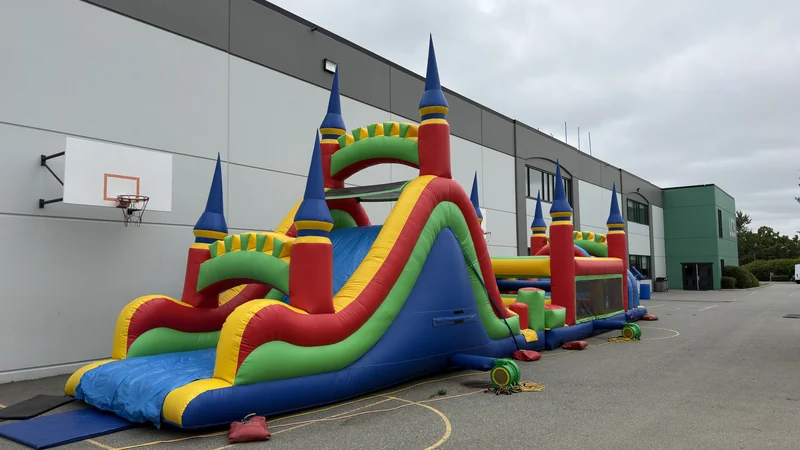
Compare the Castle Obstacle Course and the Ninja Challenge Obstacle Course & Slide as examples of different layouts. Send the age range and how guests arrive along with your shortlist. Ask which model is appropriate, what operating space is required and whether the proposed delivery route works. Availability, suitability and the written quote depend on the actual date and address.

One useful comparison has four columns: model, entry and exit arrangement, site details still needed, and who must confirm each one. Leave dimensions or capacity blank until you have the correct information for that model. Copying assumptions from another obstacle course makes a neat-looking plan less reliable.
3. Where will the next group wait?
Sketch the people outside the equipment. Where does a class assemble? Where can a guest watch a friend finish? Where will the participant who just finished go to meet their family? If all three answers point to the same narrow opening, discuss a different waiting spot before choosing the equipment position.
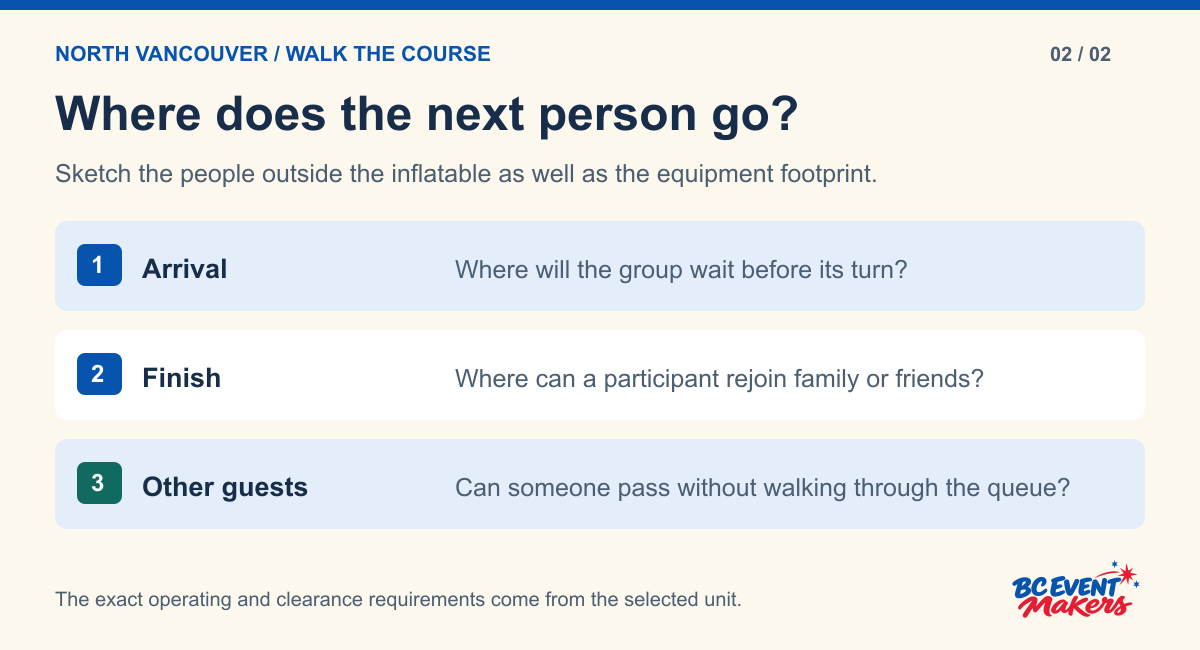
For a school fair, a volunteer can direct the next class to an agreed waiting point without making operating decisions. For an open community event, someone arriving alone needs to be able to find the start and see where the line ends. Give people who choose not to participate a good view from outside the working area.
Try this walk: start at the guest entrance, follow the route to the queue, then walk from the finish to the seating or meeting point. Finally walk past the activity as someone who is not taking a turn. Mark any crossing between the three routes. The operator or supplier must confirm required clearances and arrangements for the selected unit; this sketch is a conversation starter, not an operating plan.
4. What does the event team do if something changes?
Give the supplier the unloading point, the narrowest gate or turn and the proposed setup surface. Include the time a keyholder is actually available, not just the time printed on the invitation. It helps to send two photos of a tight corner, one facing into it and one looking back towards the delivery entrance.
For outdoor events, agree who will discuss weather or site concerns and how guests will hear about a pause. If the preferred field cannot be used, a gym is not an automatic substitute. Its access, ceiling, usable area and venue rules need a fresh review. An unconfirmed alternative should stay off the public programme.
Keep the roles distinct: the site contact opens the approved route; the host directs arriving guests and communicates programme changes; the supplier confirms operating arrangements and responsibilities for the booking. Assigning a parent to welcome a class is not the same as assigning that parent to operate an inflatable.
Two situations worth rehearsing
The school has approved the fair but the activity is still under review. Tell the committee what is confirmed: the date, the location and the programme elements the school has accepted. Put the obstacle course in the pending column. Share the site sketch, proposed equipment and access window with the person making that decision, and ask when the team should check back.
The queue starts filling the route to lunch. The host should speak with the operator and venue contact before changing the queue. Move the waiting group only to a location that has been agreed. Direct people who want to return later to the current programme; do not promise that a particular number of turns will be available before lunch.
The committee workbook: three decisions to take to your meeting
If you already know which activity you like, use this part to find the missing decision. It is written for the organiser doing the booking, not for someone operating the equipment. In each example the same obstacle course can have a different answer because the venue, access window or guest route has changed.
Example one: the neighbourhood picnic
The organising committee has reserved a picnic shelter and wants to add an obstacle course on nearby grass. The event invitation is due to go out on Friday. A committee member suggests putting the course on the invitation now because the park booking is already in the calendar. Before doing that, look at what was requested. Was the application for a picnic, or did it identify an inflatable, its proposed site and the public guest route?
Send the booking contact the equipment name, a site sketch and the proposed hours, including setup and collection. Ask which park use permit or special permission applies to this activity at this location, and what documents the application needs. If a requirement applies to the operator, ask the supplier to provide the relevant information rather than filling the operator’s part from memory. The park office’s reply and the supplier’s site review are separate answers; keep both in the event file.
If Friday arrives without a decision, you can still publish a useful invitation. Announce the picnic and the activities that are confirmed. Leave out the obstacle course until you can give guests an accurate answer. The disappointment is usually greater when an advertised attraction disappears than when a confirmed activity is added later. One person on the committee should own the follow-up date so that “pending” does not quietly turn into “booked”.
Example two: two classes are due at the same time
A teacher has arranged for two classes to visit the obstacle course just before recess. The ordinary plan says that one class takes a turn while the other watches. On the guest route sketch, however, the waiting class stands across the space needed by participants finishing their turn. Nothing about the unit has changed, but the plan is already asking the same space to do two jobs.
Ask the school to choose a meeting point for the next class outside the working area. Agree on a cue for the teacher to bring the group forward once the operator is ready for them. If the first class takes longer than expected, the second class needs to know where to wait and what to do. A teacher can keep children together without deciding how many people should be on the unit or when to start a turn.
Write that distinction on the volunteer sheet. “Meet Class B by the agreed classroom door and wait for the call” gives a volunteer a specific task. “Keep the course moving” leaves them to interpret an operating decision. Use the model’s instructions and the responsibilities confirmed by the supplier, and leave room for a participant to watch rather than join a race.
Example three: a venue offers another field at the last minute
Suppose the originally approved area is unavailable and a contact points to another piece of grass. The replacement may be the same size on a map. It could also have a narrower gate, a longer route from the vehicle, a different surface or a guest route that crosses a public path. The old permission and the old sketch describe the old location. Ask what can transfer and what must be reviewed again.
Take a photograph from the unloading point, one from the tightest turn and one looking across the new setup area. Add the access timings and identify the exact contact who can open the new route. Send these as a single update with the venue decision. Avoid sending a close-up photograph of the grass on its own: it does not show how the equipment would reach the proposed spot.
If the new area cannot be confirmed before guests arrive, choose a programme element already approved for that location. Make the announcement about what is happening now and when the host will next update the group. Do not promise a restart or move equipment to make a timetable work. A change to the programme is the host’s responsibility; a change to how equipment operates is not.
Use a one-page decision sheet instead of a chain of screenshots
The person reviewing the site may not have attended the committee meeting. Give them a short record that separates a known fact from a request. The sample below shows the information to collect, not the answers a particular North Vancouver venue will give.
| Decision | Useful evidence | Who can answer |
|---|---|---|
| Permission for this equipment, not just the gathering | Written venue response describing the location and any applicable conditions. | The authority for this exact site. |
| Delivery access and collection | Photos from vehicle to setup, measured gate opening and actual keyholder times. | Venue contact and supplier together. |
| Participant and spectator routes | A sketch distinguishing waiting, finish, seating and through-route. | Host, venue and operator for their respective roles. |
| Programme change | Named contact, decision time and approved alternative if one exists. | The host communicates the confirmed decision. |
Use the word “unknown” where it belongs. A supplier can ask the right follow-up question about an unknown gate width. A wrong measurement copied from another venue is harder to spot. If the owner has given permission by phone, ask them how they want the agreement recorded and where event conditions can be found. Do not treat the decision sheet itself as a permit, site approval or contract.
Compare two obstacle course proposals on the same question
Two obstacle course rentals may both be described as suitable for a fair without answering the same booking question. One proposal might name the unit and access period; another might say something about staffing but leave the model open. Before choosing, ask each supplier to describe the expected participant experience and what they need from the venue. Compare those answers against the event you are actually hosting.
Arrival pattern: give the suppliers the real pattern, not just the headcount. A class arriving together creates a different waiting problem from the same number of people dropping in across an afternoon. Ask how the selected format would fit that pattern without asking for a guaranteed number of turns that has not been assessed.
Responsibilities: ask what is included, which operating roles are provided and which host tasks remain. Who briefs a volunteer who manages a queue? Who can pause play? Who updates the venue if the access window changes? If the answer to a question belongs to the operator, get it from the operator rather than improvising a rule for your volunteer handbook.
Space after the finish: compare the exit location against the rest of the event. An obstacle course that ends beside the food line may need a different guest route from one that finishes towards the meeting point. Ask the venue and supplier to review the layout after tents, food stations and accessible paths are drawn in. A photo of the unit on an empty lawn does not include any of those people.
What if someone asks about operating permits?
For the provincial perspective, Technical Safety BC has a guide for people renting an inflatable device for an event. Use it to prepare questions for the operator about the exact device and setting. That discussion is different from applying to use a municipal park. Do not assume a park use permit establishes that a particular piece of equipment meets its operating requirements, or vice versa.
What if a guest cannot or does not want to run the course?
Offer an alternative with a clear purpose. Watching from an agreed spot, joining friends at the picnic tables or helping cheer on a class can all be part of the gathering without being treated as a consolation prize. Give families enough information to choose; avoid language implying that everyone is expected to participate. If a guest asks about requirements for the actual equipment, put them in touch with the agreed contact rather than guessing.
What should appear on the guest sign?
Keep the public sign shorter than the staff brief. It can identify the activity, point to the agreed waiting place and tell guests where to ask a question. Keep the detailed operating instructions and private contact numbers with the appropriate staff. If the activity pauses, change the sign as well as making an announcement; the next family through the gate will not have heard what was said ten minutes ago. Give the next update time only if someone is responsible for meeting it.
What to send with your North Vancouver enquiry
We’re comparing obstacle course rentals for [date] in North Vancouver. The address is [site]. The venue contact has confirmed [details] and is still checking [questions]. Guests will arrive [in waves / throughout the event]. Their ages are [range]. We’ve attached the delivery route, setup area and proposed guest route. Which equipment should we consider, and what information do you need before confirming the plan?
Use the BC Event Makers quote form to share the details, or browse the slides and obstacle course collection to choose examples for the conversation. You do not need to settle on a model before asking about the site.