
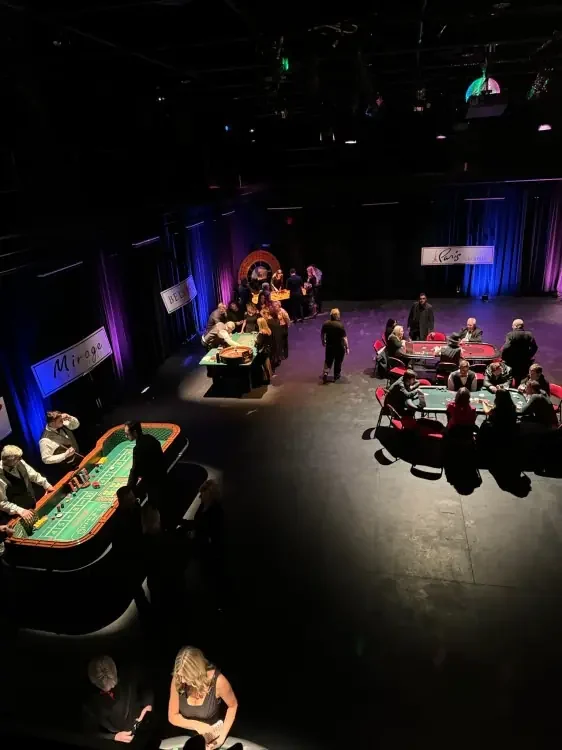
Quick answer: Choose a casino party format around your guests and programme. Casual play suits an evening where people can mix, talk and try the activity at their own pace. A tournament suits a team that wants a shared competition with a defined start and finish. Discuss chip arrangements after you choose the overall flow.
Start with the purpose of the staff party
A holiday celebration, team appreciation evening and departmental gathering can all use casino entertainment, but the host may want a different experience at each one. Ask what matters most: easy conversation, trying something new together or a friendly competitive focus.
There is no need to choose a tournament simply because prizes sound appealing, or casual play simply because some guests are beginners. Our trained dealers teach beginners as they play. Think first about the structure your team will enjoy and how much shared attention your programme can support.
When casual play fits the evening
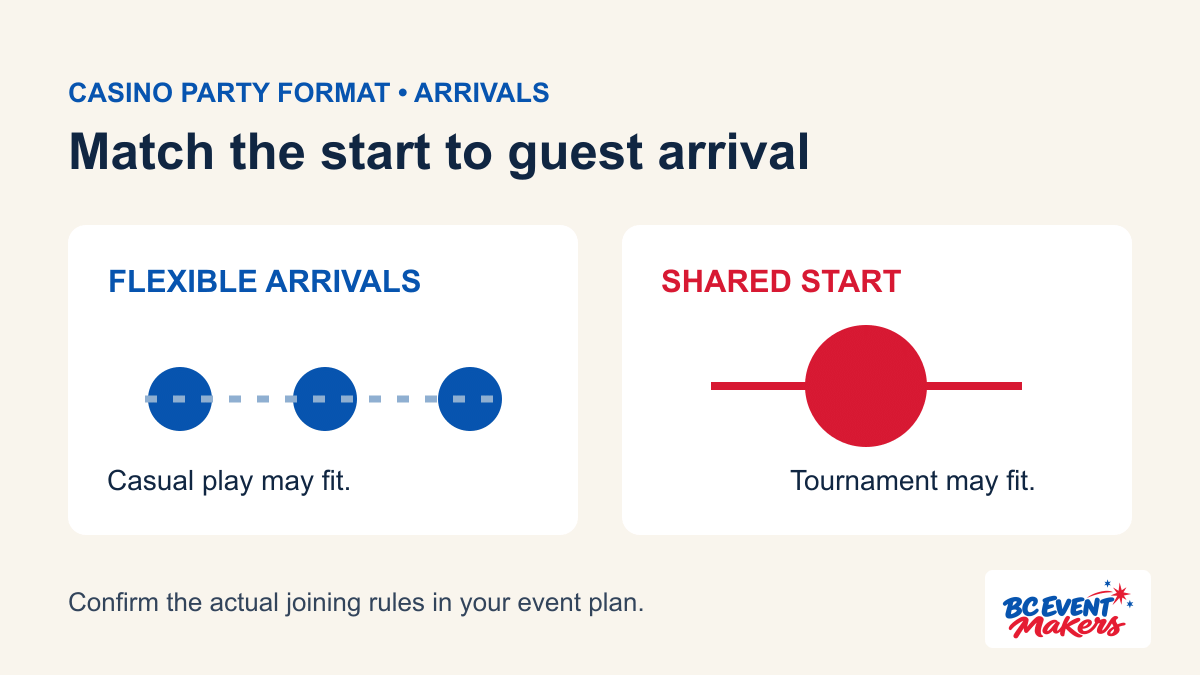
Casual play is worth considering when conversation and social time are central to the party. It gives the host a way to introduce casino entertainment without making a competition the main organizing feature of the evening.
It may also fit an event where guests arrive at different points or have several activities to choose from. Discuss the actual flow with us, including how people will be introduced to the tables. Casual depleted chips can be reset to 1,000 play chips, so explain that arrangement clearly when you welcome guests. Our guide to how play chips work can help with the guest briefing.
When a tournament fits the evening
A tournament is worth considering when guests can gather for a shared start and your team wants a defined competitive activity. It gives the host a reason to communicate the structure before play and bring everyone back to a planned finish.
The allocation is fixed, with no buy-ins. If you want prizes, your team supplies them and should confirm the award arrangements with us in advance. Avoid writing your own scoring or winner-selection rules before discussing the event format. If you also plan a separate raffle or prize draw, review the Province of B.C.’s gaming event licence guidance before advertising that separate activity.
Compare the decision points
| Your planning priority | Casual play | Tournament |
|---|---|---|
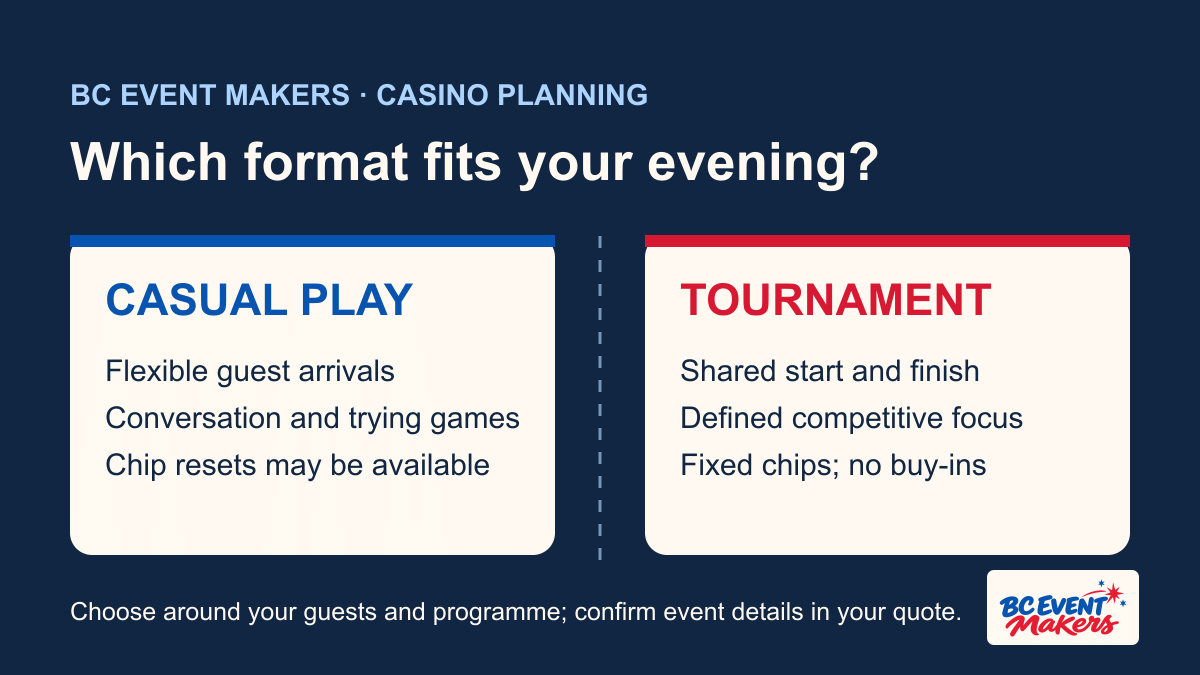
| Main emphasis | Trying the activity alongside socializing. | A shared competitive focus. |
| Guest arrivals | Discuss how play fits a flexible arrival pattern. | Plan for guests to understand and attend the shared start. |
| Programme | Consider how play sits beside other party activities. | Protect the agreed sequence through its finish. |
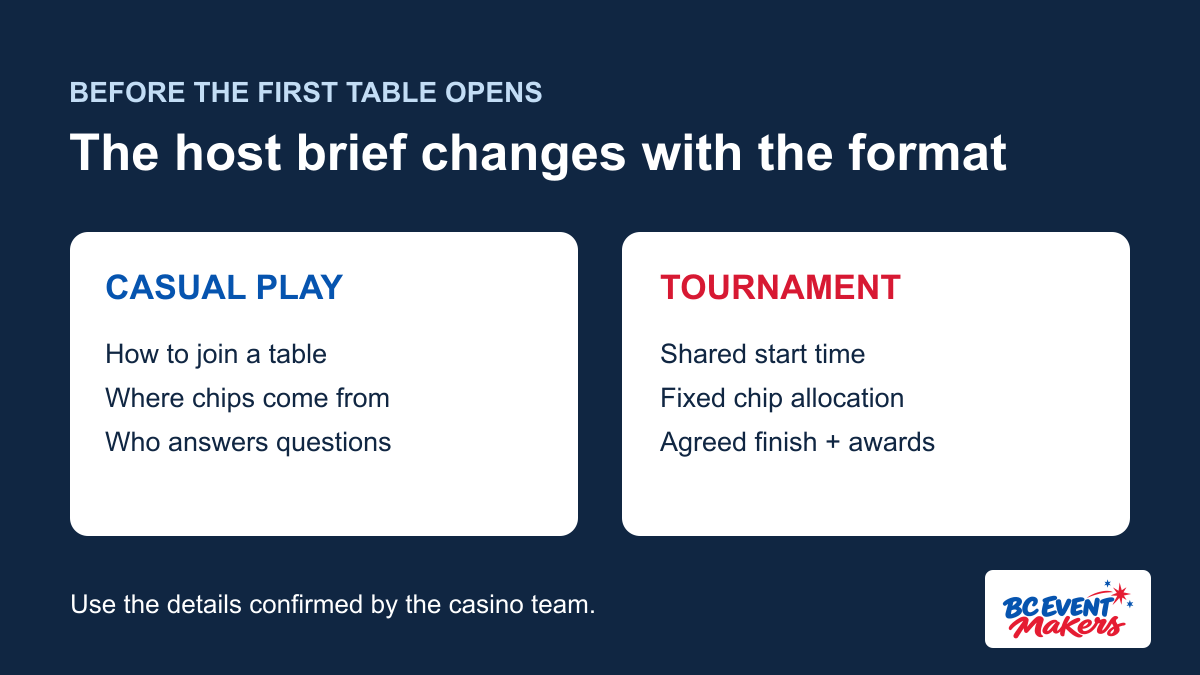
| Host briefing | Explain how guests join and receive chips. | Explain the agreed structure and starting instructions. |
| Prizes, if wanted | Discuss the intended approach before announcing it. | Confirm award arrangements and schedule the presentation. |
Three questions for choosing a casino party format
- Will most guests be ready to start together, or does the event need a flexible flow?
- Do we want competition to be a main feature, or do we mainly want another way for colleagues to socialize?
- Can our dinner, speeches and closing plans support the structure we are considering?
If your answers point in different directions, send us your event outline. For example, a team may enjoy competition while the programme leaves little room for a shared finish. Resolving that tension early is more useful than choosing a label and trying to make the rest of the evening fit it.
Questions about choosing a format
Can beginners join a tournament?
Our dealers teach beginners as they play. Share your team’s experience level and discuss the tournament arrangements before choosing the format.
Does either format involve real-money wagering?
No. Both use play chips. A tournament has a fixed allocation with no buy-ins; casual depleted chips can be reset to 1,000.
Do we have to decide before enquiring?
No. Tell us what you want the evening to feel like and which parts of the programme are already set. You can include format questions in your enquiry.
Discuss the right fit for your corporate party
Explore our casino night service, then send your date, location and event outline. We serve Metro Vancouver and the Fraser Valley through Chilliwack, with further destinations by arrangement. Confirm your exact event inclusions in the written quote.
Test the format against a real running order
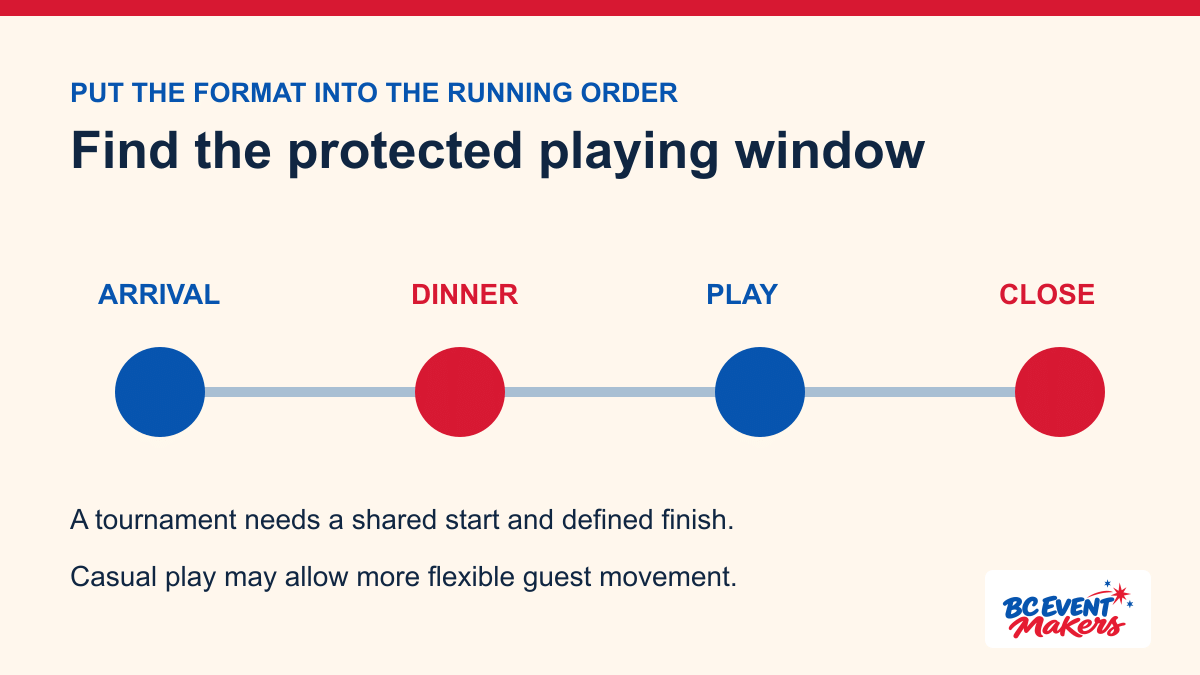
Write the event in four stages: arrivals, dinner or speeches, playing time and close. Mark which times are fixed by the venue and which can move. A tournament needs guests to hear the shared start and follow its agreed finish. If dinner timing or speeches often shift, ask how a delayed start would affect the proposed dealer period and the awards moment.
For casual play, ask when tables can open, how guests receive chips and how someone joining late is welcomed. A flexible guest flow still needs an agreed final round and removal time. The venue should confirm when equipment can enter and when the room must be clear.
Keep the host briefing short and specific. For casual play, explain where to get chips, how to join a table and whom to ask for help. For a tournament, add the shared start time, fixed allocation and the agreed closing and award process. In both cases, make it clear that this is recreational play with no real-money wagering.
What to ask before confirming a change
If the event outline points one way but the guest list points another, ask the casino team to walk through the tradeoff using your actual schedule. For example, a team may want a shared competition while many guests will arrive after dinner. The team can explain which confirmed options work with those constraints; the host can then make an informed choice before invitations go out.
Confirm the table mix, staff coverage, chip arrangement and guest instructions in the written quote. A programme change after that point should update the run sheet and the invitation together. This keeps the casino party format the host describes aligned with the one that will actually run.
Three event outlines to test the choice
A rolling reception before dinner
People arrive at different times, find colleagues and move between a drink, conversation and activities. Casual play may suit this pattern because the host can explain how to join during the agreed opening window. Ask the casino team how newcomers receive chips and how tables will close when dinner begins. If the venue wants every guest seated at a fixed dinner time, put that pause in the running order rather than leaving tables to empty unpredictably.
A team celebration with one shared activity
When most guests can gather at a known time and the host wants a clear group focus, a tournament may be the better starting discussion. The invitation should state the actual shared start, and the host should reserve time for its agreed finish and any award moment. Ask what happens if a speaker runs late or several guests arrive after play begins. The casino team should confirm the event-specific rules before the host announces them.
A mixed programme with dinner, speeches and games
In a room used for more than one purpose, the question is where the games fit without disrupting food service or the presentations. Casual play might run during an early reception or after speeches; a tournament needs a protected stretch. Draw the sequence with the venue: access, setup, guest play, any room change and removal. Confirm that the proposed dealer coverage matches the available time, not just the total event duration.
Check the guest message before sending it
Whichever casino party format you choose, tell guests that the activity is recreational and uses play chips rather than real-money wagering. State when play begins, how a newcomer joins and whether watching is fine. For a tournament, include the confirmed shared start and any arrival guidance. For casual play, explain the chip handout and when tables close. Avoid describing an award or prize arrangement until that detail is actually approved and confirmed.
Review the message against the final quote. If the table mix, format or playing window changes, update the host briefing and invitation together. This avoids a mismatch between what guests expect and what the team at the venue is prepared to deliver.
Decision checklist for the organiser
- Can most guests attend a shared start, or will arrival be spread across the evening?
- Is the main purpose a social activity guests can enter and leave, or a defined group competition?
- Where do dinner, speeches and any room change sit relative to the proposed playing window?
- Who distributes play chips, gives the welcome and explains the last round?
- What equipment and staffing are actually included in the written quote?
Bring these answers to the supplier even if you have a preferred format. A clear, event-specific discussion can reveal a timing or room constraint while it is still easy to adjust the plan. The chosen format should support the real guest list and programme, with final details confirmed before invitations are sent.
Put the choice into a one-page event brief
A useful brief lets the casino team evaluate the format against the event you are actually holding. Start with the date, city, venue, guest count and the purpose of the gathering. Add the arrival pattern: are most people expected at once, or will they come over a longer reception? Name the fixed parts of the programme, including food service, speeches, awards and room access. Then identify the playing window you hope to protect and any latest time the venue needs the room cleared.
Next, say what you want guests to experience. Would a guest be comfortable watching before trying a game? Is a group competition central to the celebration? Do you want the activity to be one of several options or the shared focus of a particular hour? These answers are more useful than a bare request for “casino night” because they guide the proposed format, table mix and staffing discussion.
Finally, ask for the proposed chip arrangement, start and finish instructions, dealer coverage and table list to be written into the quote. If something remains open, mark it as a question rather than presenting it as a confirmed event feature. Give the same current brief to the venue contact so room access and equipment setup can be checked alongside the guest programme.
Walk through two likely schedule changes
When dinner ends later than planned
The host should first identify who can approve a change to the playing window. The venue may still require the room cleared at the same time, and the casino team may have a quoted operating period that cannot simply move. For a tournament, a delayed shared start could compress the competitive activity and any awards. Ask the supplier what a revised sequence would mean before announcing a new start. For casual play, there may be more flexibility in guest movement, but the tables still have an agreed closing time and staffed period.
Once a new schedule is confirmed, tell the host, venue and casino team together. The guest announcement should describe the updated opening and closing times, not just say that play will “start soon.” If a separate raffle or prize presentation is planned, reassess its timing independently.
When more guests arrive late than expected
At casual tables, ask how late guests can receive chips and get a short introduction. The welcome point needs a person or sign that explains where to join without interrupting other guests. At a tournament, confirm the event-specific late-entry rule before invitations go out. The host should not make up a rule at the door. If the expected arrival pattern has changed substantially, revisit the format choice with the casino team while there is still time to adjust the booking.
Keep beginners in the plan
Our trained dealers teach beginners as they play, but the wider event still needs a clear welcome. The host can explain that play chips have no cash value and that guests may watch, ask a question or join a table according to the agreed format. A casual evening should make the chip handout and table access easy to find. A tournament should make the shared start and instructions clear enough that a new player knows where to be and when.
Leave space for people who would rather talk than play. A table layout with no clear spectator area can make a beginner feel they are interrupting; a room with only tables leaves little alternative for guests who want conversation. Show the proposed circulation and seating on the venue plan and confirm that the game areas remain accessible without blocking food service or required routes.
Use precise language for prizes and chips
A tournament’s fixed play-chip allocation is part of its structure, with no buy-ins. Casual depleted chips can be reset to 1,000 under the arrangement BC Event Makers described for that format. Those are distinct rules. Explain only the one that applies to the booked event, and ask the supplier to confirm exactly how chips will be handed out and counted. An invitation that promises “unlimited chips” or “cash prizes” would describe something different and should not be used.
If the organiser wants to supply prizes, confirm the award method and presentation time with the casino team before telling guests. A separate raffle, draw or fundraising activity may have different requirements; the B.C. government resource linked above is the place to begin checking that distinct plan. The supplier’s entertainment quote does not replace the organiser’s responsibility to verify the separate arrangement.
Before the final invitation
Read the quote and event brief side by side. Are the games named in the invitation the same games listed in the proposal? Does the announced start match the venue’s setup time and the dealer schedule? Does the host know how guests receive chips, and who explains any tournament rules? Is the finish time clear enough to coordinate with speeches, prizes and removal? If the answer to any question is still unknown, keep that detail out of public copy until it is confirmed.
Take a final look at the room plan with the venue and supplier. Tables need operating space and guests need room to watch, circulate and reach food or seating. The decision between casual play and a tournament should survive this practical check. If the room or programme forces a different structure, discuss the change while the quote and guest communication can still be updated together.
Use the linked sections above as a working checklist with your organiser and venue contact. Start with the guest experience you want, then test whether the real running order and room can support it. A good casino party format is one that the host can explain clearly, the team can run within the agreed window and guests can join comfortably at their own pace. Keep the confirmed schedule and quote together so everyone uses the same current plan.