
A carnival game rental for a Kelowna fair begins with a written service check. BC Event Makers’ core area is the Lower Mainland. Ask about the exact date and Kelowna address, then build the booth plan around the visitor’s route through the event. An activity shortlist can stay useful even if the committee needs a local supplier.
Begin with the venue plan and the ages you expect. A collection of throwing games creates a different atmosphere from activities that involve climbing or riding. Decide how much of the event should be casual participation and how much should feel like a competition. That decision will guide your game choices and the instructions volunteers need.
1. Give each carnival game rental a purpose

Choose games with different actions so visitors have a reason to explore. BC Event Makers’ catalogue includes names such as Peanut Pitch and Bull’s Eye, along with Treasure Chest. Review the current rental catalogue for the options you are considering, then ask about suitability for your audience and venue. Confirm participation requirements and operating space for each selected game.
Write a short explanation for each booth: where to stand, how a turn works and when to hand the game to the next person. Ask the supplier which instructions belong to the equipment itself. Keep your event rules consistent with those instructions rather than making up a faster version to shorten a queue.
2. Trace the waiting area and guest route
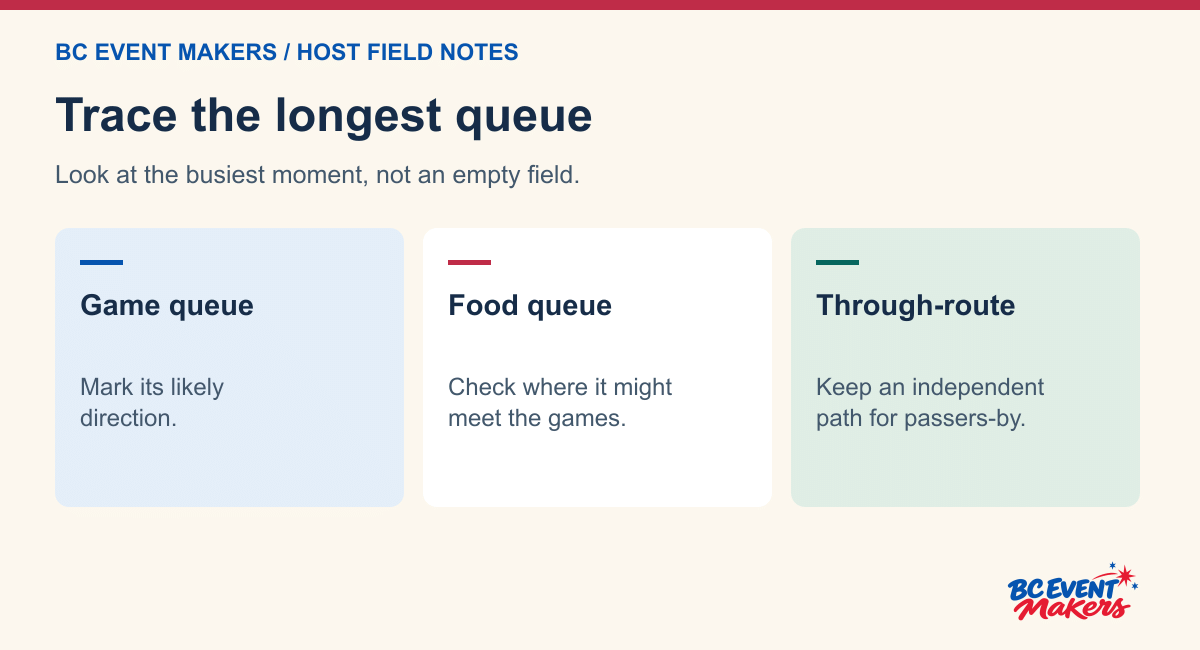
On your site sketch, show where guests approach a booth and where they leave. Allow room for spectators without blocking another activity or an emergency route. Throwing games need particular attention to the direction of play and the position of nearby visitors.
Place refreshments where people can step away from the games to eat. If you use prizes, decide where they will be collected before the fair opens. A separate prize point may suit your plan, but it also needs someone to manage it and somewhere for its own queue.
3. Put a complete brief at each game booth
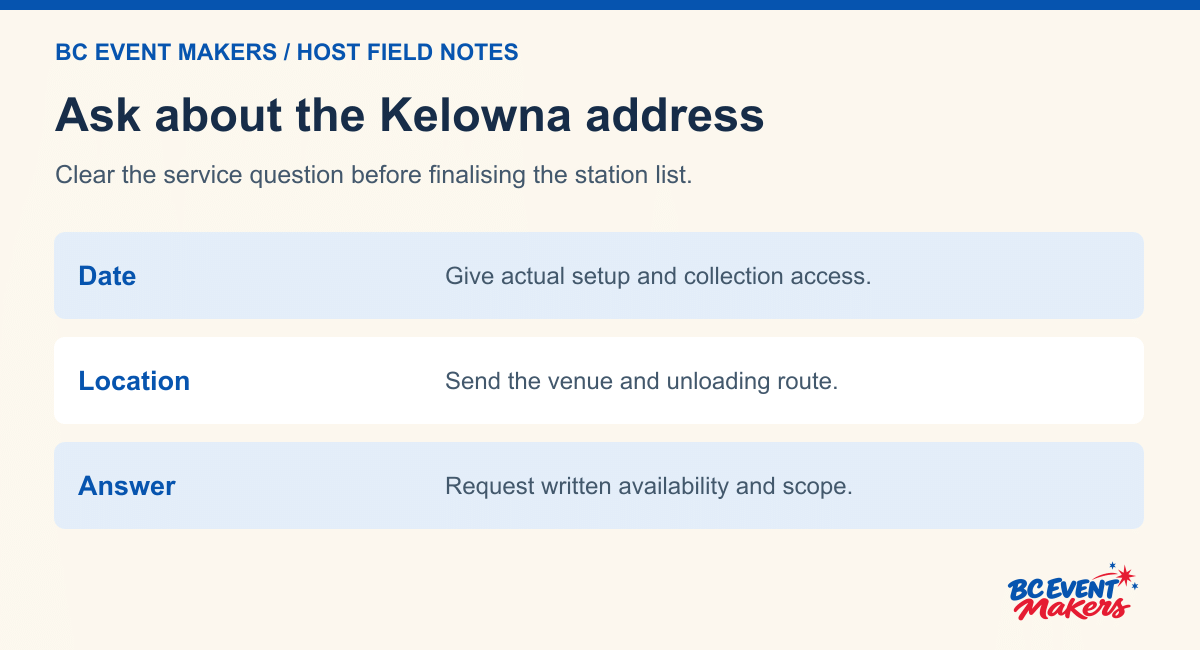
Give each volunteer a written role and a named event contact. Explain how to pause a game when there is a concern and who can resolve it. Plan breaks and handovers so a booth does not become unattended when someone leaves to get water or check another task.
If guests will buy tickets, settle the payment arrangement before choosing signs. Keep the rental quote separate from your fundraising assumptions; it should be clear who supplies prizes and who handles event proceeds.
4. Confirm Kelowna service before advertising the activity
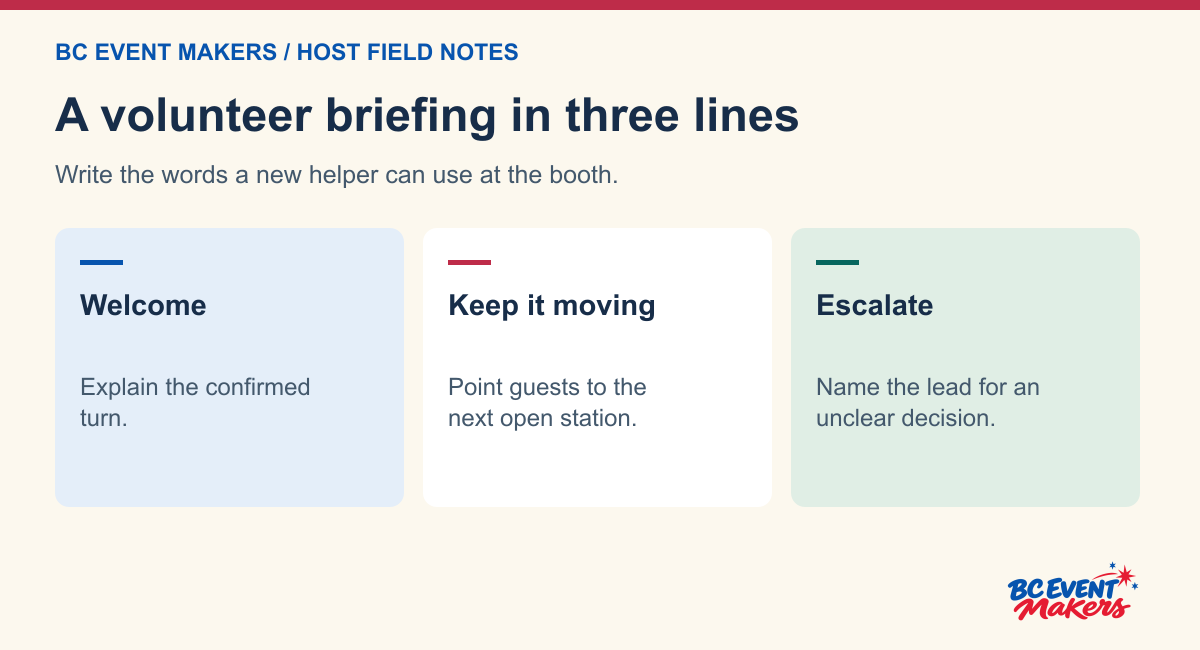
Send BC Event Makers your Kelowna venue address and event date with your proposed games. Ask whether delivery can be arranged and what travel, access and collection arrangements would apply. Confirm the booking scope in writing before advertising particular attractions. A useful quote request includes the opening hours, expected attendance and a sketch of the proposed game area.
Plan the first ten minutes of a visitor’s fair
Imagine a family arriving at your Kelowna event with no idea how the game booths work. Where do they get information? Can they try something soon after arriving? Will they know which queue is for a game and which is for food? A carnival game rental can be a welcoming part of the fair when these first few decisions are easy.
Give the entrance a modest job. It can explain the participation arrangement, point out a quick first activity and identify a place for families to regroup. Keep a more involved game away from the point where everyone is still trying to understand the site. If the entrance is also the ticket sales point, sketch its queue as carefully as the most popular game booth’s queue.
Ask the organiser what remains possible if the preferred equipment cannot reach the Kelowna address. BC Event Makers’ usual service area is the Lower Mainland. Use the catalogue as a way to identify examples for an enquiry and request a written service answer before relying on those items. A local supplier or another confirmed activity mix may meet the same guest goal.
A three-station planning exercise
Put three station descriptions on a blank map. One should give a newcomer a quick turn. One should invite a family or pair of friends to stay a little longer. One should give people who prefer watching an enjoyable place to gather. These are roles in the programme; the supplier and venue still need to confirm the actual equipment for each role.
| Programme role | Guest question | Choice for the organising team |
|---|---|---|
| First-turn booth | Can I understand the activity before a queue forms behind me? | Use a clear instruction and an agreed starting place. |
| Shared game booth | Can two friends enjoy this at their own pace? | Leave enough space for waiting and regrouping. |
| Spectator or meeting place | Where can I watch or catch up without joining a line? | Identify an approved public space with its own guest route. |
For example, the Golf Challenge listing gives the committee a specific option to discuss. Ask the supplier how the game is played, what space it needs, who resets it between turns and who handles any scoring. A catalogue photograph can help people recognise a game; it cannot establish the available equipment or delivery for a particular Kelowna date.
Describe the crowd you actually expect
Give the supplier a guest total and a short description of the busiest arrival. “Three groups will leave the welcome ceremony together” tells the organiser more about the first rush than the all-day attendance figure alone. Ask where those groups can wait and which booths can welcome people without competing for the same patch of public space.
At a drop-in fair, the rush may happen after lunch rather than at opening. A school event may release classes on a bell. A company gathering may bring adults and children together after a shared meal. Mark that timing on the site map and identify the other activities guests are likely to visit at the same moment.
Use the field as it will look during the event
A clean field photograph can be misleading when tents, game booths, sound equipment and catering vehicles have yet to arrive. Put those confirmed uses on the plan before drawing the guest route. Include the supplier’s unloading point and the route it will use during collection. A public path that is clear at eight in the morning may be very busy at the end of the fair.
If the proposed site is public, start with Kelowna’s outdoor event planning information and describe your event to the appropriate City contact. For a school or private venue, use the person responsible for that property. Ask which arrangements apply to the specific location, equipment and public activities.
Walk the guest route four times. First be a family looking for a game. Then be a fair volunteer carrying replacement supplies to the farthest booth. Next be a guest trying to reach the washrooms without taking part. Finally be someone meeting friends after the last turn. Mark every crossing where two different groups would reasonably expect the same space.
Example. A popular booth grows towards the welcome desk
Suppose the organiser puts the most visible game near the entrance so guests immediately see an activity. The idea works, but the queue grows directly across the information desk. New arrivals can see the booth and still have no way to learn how the fair runs. Moving a volunteer closer to the crossing may help with a few guests but does not by itself resolve the layout.
Bring the issue to the venue and the people responsible for the game booth. Review a different waiting direction or another station position. Once the arrangement is confirmed, put the same direction on the entry sign and volunteer brief. Check the revised map as a person coming from outside the field, not only as someone already at the booth.
If both positions remain plausible, compare them in words. Position A offers visibility but puts the queue near the welcome desk. Position B needs a clearer entrance sign but allows a separate guest route past the activity. That comparison gives the committee a genuine decision instead of leaving it to choose whichever booth looks best on a drawing.
Example. A sponsor wants a prize station beside the food queue
A sponsor may reasonably want a visible presence. Ask what experience visitors should have there and when the sponsor expects its busiest moment. If the prize station will gather a crowd immediately after a draw or announcement, do not place that crowd on the assumed food or washroom route without discussing it with the venue.
Separate any prize or draw arrangement from the ordinary game turn. The responsible organiser should confirm the applicable rules and approved offer before printing a sign. Volunteers need a simple guest explanation and a named person who can answer an exception. A carnival game rental does not establish approval for a separate prize promotion.
Check whether the sponsor needs access during public hours to deliver materials or take items away. A station that looks fine for guests can still conflict with the service route. Give the sponsor an approved access window and point of contact instead of expecting a volunteer to find an improvised route during the busiest part of the fair.
Example. A volunteer relief shift starts during the after-lunch rush
The first host knows the game well and the incoming volunteer has only read the schedule. Give them a short overlap at the booth. Ask the outgoing host to demonstrate the agreed turn, point out where waiting guests stand and explain which question goes to the event lead. An incoming volunteer can then welcome the next family without inventing a new rule.
Write the handoff in three lines. “Explain the turn in these words. Direct waiting guests to this point. Call this lead if the game pauses or a guest has a ticket question.” Add the actual approved details for the chosen game. Keep equipment handling or operation with the person assigned that responsibility under the supplier agreement.
Have the relief volunteer repeat the directions from the public side of the booth. This often exposes a hidden problem: an instruction that makes sense from behind the table can be confusing to someone walking up to the sign. Change the sign or handoff once the organiser has reviewed the wording, then give the same update to the rest of the volunteer team.
Compare a travelling proposal with a local option
Ask BC Event Makers whether it can serve the exact Kelowna venue, date, access period and selected carnival game rental. Ask a local provider the same questions about its actual equipment. Do not treat a positive answer for one town, date or game as a general service promise. Keep the written answers together so the committee can compare the work involved in each option.
Read each proposal as the person who must open the gate, welcome players, restock a game booth and hand the venue back. Which roles does the supplier provide? Which remain with the organiser? Does the equipment list match the proposed participant groups? Does the proposal include the site’s real collection window? Place an open question next to any item that needs a supplier or venue response.
If one proposal offers more games, ask whether the host can actually staff and position them. An extra game booth creates another queue, another relief shift and another close. A smaller programme with distinct roles can be easier for visitors to explore than a larger collection that all asks guests to do the same thing.
A one-page request for a fair quote
We are planning a Kelowna fair at [exact address] on [date]. Guests are expected to arrive [pattern], and the busiest period is likely to be [reason]. We are interested in a carnival game rental for [first-turn, shared play or other goal]. Venue access is [times]. Attached are the unloading route, proposed booths, waiting areas and guest route. Can you confirm service to this address and identify the information needed for a workable proposal?
Include the date the committee needs to make its decision. If a sponsor or school notice depends on a named attraction, identify the first publication deadline. Keep proposed equipment off that guest-facing notice until the supplier and property decisions support it. The fair can announce confirmed activities while another choice is being assessed.
Close the game booths in a planned order
Agree with the event lead when new guests may join the final queue and how a booth will signal closure. If general fair tickets are in use, the sales desk needs the same information as the game booth. A family who buys a ticket near closing should understand what remains open under the organisation’s actual arrangement.
Keep the supplier’s collection path available while directing guests towards confirmed activities that continue. Name the venue contact who will accept the field and the organiser who records any outstanding volunteer or guest question. Private financial or contact details belong in the appropriate staff record rather than on the guest sign.
At the debrief, ask each booth lead to identify the question guests asked most often. “Where do I stand for my turn?” points to a sign or layout issue. “Can the same ticket be used here?” points to a participation-offer issue. “Where do I meet my family afterwards?” points to the guest route. Those are different observations and deserve different changes at the next fair.
Keep one dated map with the notes and identify the exact place each issue arose. A future organiser can use the record to ask better questions without assuming that the site, supplier or service availability will be the same next year. Review the new event on its own date, address and equipment proposal.
What to do with a second choice
If the preferred carnival game rental cannot be supplied, write down why it was on the shortlist. Was it meant to offer a quick turn, give two people something to do together or create a station spectators could enjoy? Give that purpose to the next provider. A replacement may meet the guest need while requiring a different layout, volunteer task or access window.
Ask the fair volunteer responsible for that station to review the revised instructions before opening. Update the guest sign, map and supplier list together. A booth labelled with yesterday’s game can send families looking for an activity that never arrived, even when the replacement itself is a good choice. The most useful second option is one the organiser has time to review, explain and deliver well.
Review the carnival game collection and send the event brief for confirmation of the date, equipment and address.