
A dunk tank rental in Richmond needs agreement on the water supply, the throwing line and what happens to the water at closing time. Get those answers before putting a volunteer’s name on the poster. A host can start with four decisions and use the site worksheet below when the venue or supplier calls back.
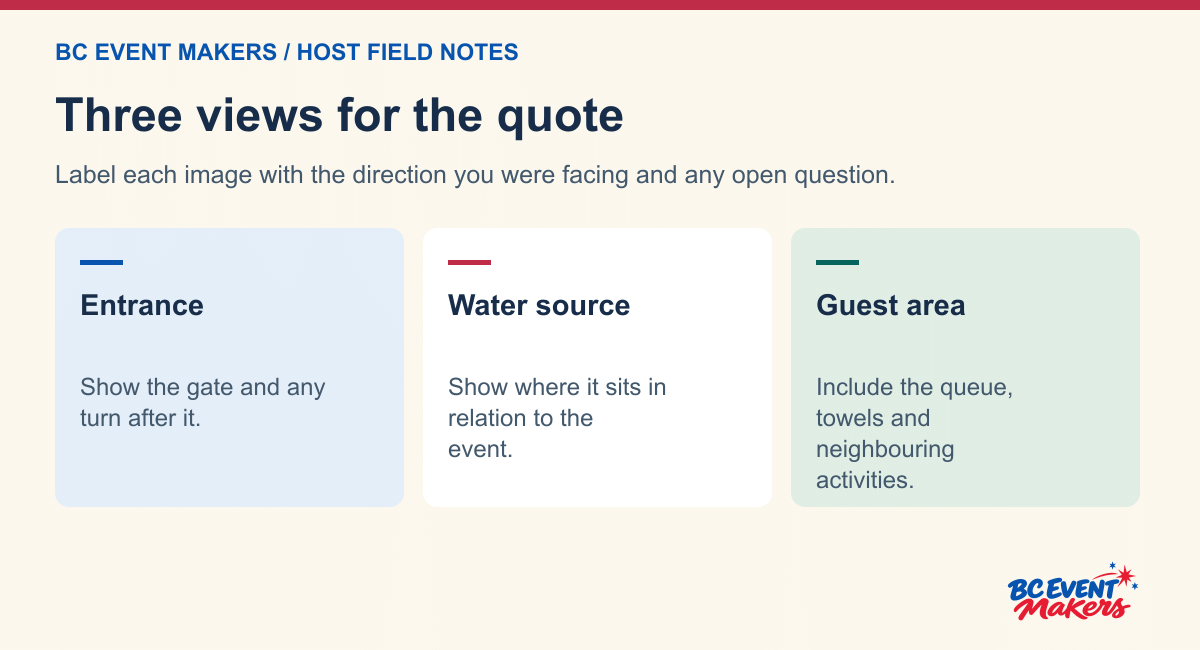
Give BC Event Makers the venue address and photographs of the proposed location. Describe the surface and delivery route, including any access restrictions. Ask whether the site is suitable and what the exact tank requires before advertising the attraction.
1. Confirm the water plan for the dunk tank rental
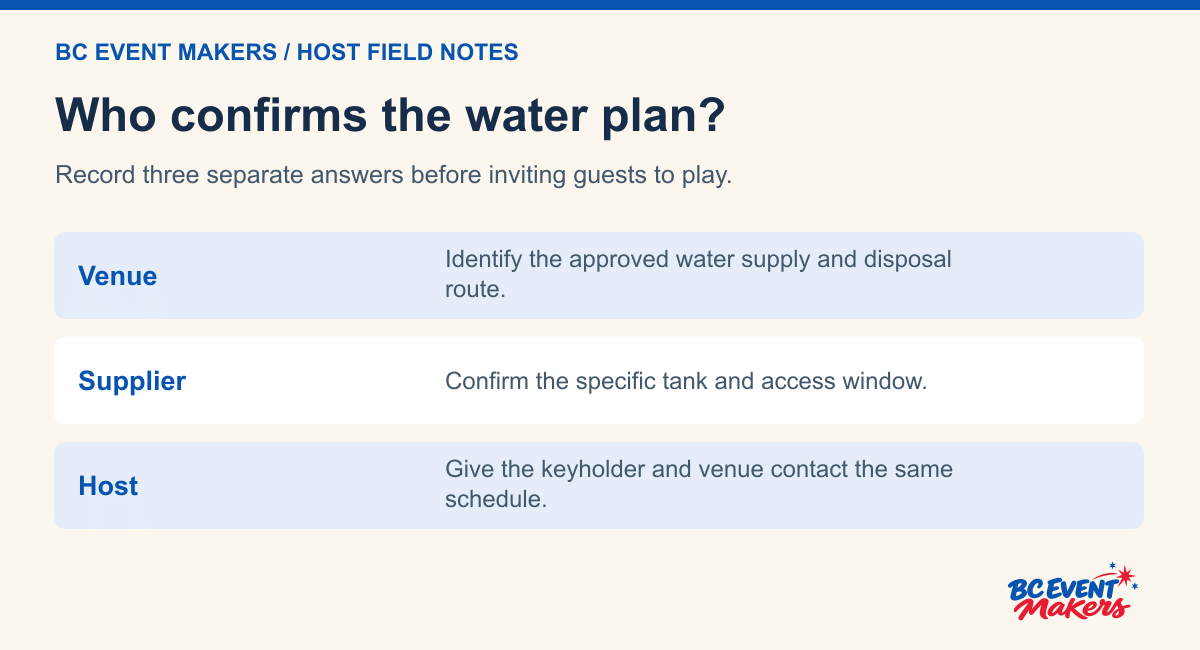
Discuss the water supply and how filling and emptying will be handled. Obtain the venue’s approval for the proposed use and drainage arrangement. Ask what timing is needed so the tank is ready before the activity opens and can be removed within the venue’s access hours.
Plan the wet area separately from refreshments and other games. Guests should be able to walk around the attraction without crossing the throwing area or crowding the tank. Include somewhere for the dunk participant to leave belongings and change afterward if needed.
2. Ask participants privately about taking a turn
Ask people privately whether they want to take part before putting their names on a schedule. Confirm the equipment-specific requirements with the supplier; enthusiasm does not establish eligibility. Avoid pressuring someone to participate because their name has already appeared on a poster.
Discuss how participants will enter and leave the tank area, and who will manage those transitions. Keep the event plan consistent with the supplier’s operating instructions. Do not create special rules for a fundraiser that override how the equipment must be used.
3. Walk the throwing line and the guest route
Confirm the correct arrangement for throwing and the space that must remain clear. Ask how turns should work and who retrieves equipment or manages the queue. Spectators need a place to watch that does not put them in the line of play.
If the activity is part of a fundraiser, decide who handles tickets or payments and who records proceeds. Keep that role separate from the person responsible for operation unless the arrangement has been expressly agreed. An event organiser needs to know who can pause the attraction if a concern arises.
4. Give the closing handoff a name and time
Ask about weather decisions and the booking terms if the tank cannot be used. Keep another activity available so the event can continue without depending entirely on the dunk tank. Do not assume suitability for a hall or another site if you need to change the location.
Review the rental catalogue and send a quote request with your Richmond site details and proposed operating hours. Confirm the water and supervision responsibilities in writing, along with collection arrangements. Include those tasks in the event schedule so the activity is ready when guests arrive.
Take the site walk before you set the opening time
Take the venue contact to the intended spot for the dunk tank. Walk from the unloading point to that spot, then from the spot to the approved water supply. Finish at the place guests will change or collect dry belongings. It is surprisingly easy for three people to picture three different corners of the same field when discussing the booking by phone.
Write down what each person actually knows. The caretaker may know which connection is available. The booking coordinator may control the hours when the field can be used. The supplier can explain what the specific dunk tank requires. Ask each person the question they can answer. Record who will confirm the remaining details and when you need their reply.
For a City site, start with Richmond’s event applications and approvals. Describe the activity and its location in the enquiry. For a school, private club or other independently managed property, contact its own administrator. Put the actual venue response beside the proposal from the supplier so that both describe the same place, hours and activity.
Draw two versions of the site
The first sketch shows the venue as the delivery team will find it. Mark the entrance, the unload point, the route to the tank and any turn, step or gate that needs review. Include the nearby space that a caterer, another supplier or the public might also use. A wide loading bay on a site plan can be occupied on a particular morning.
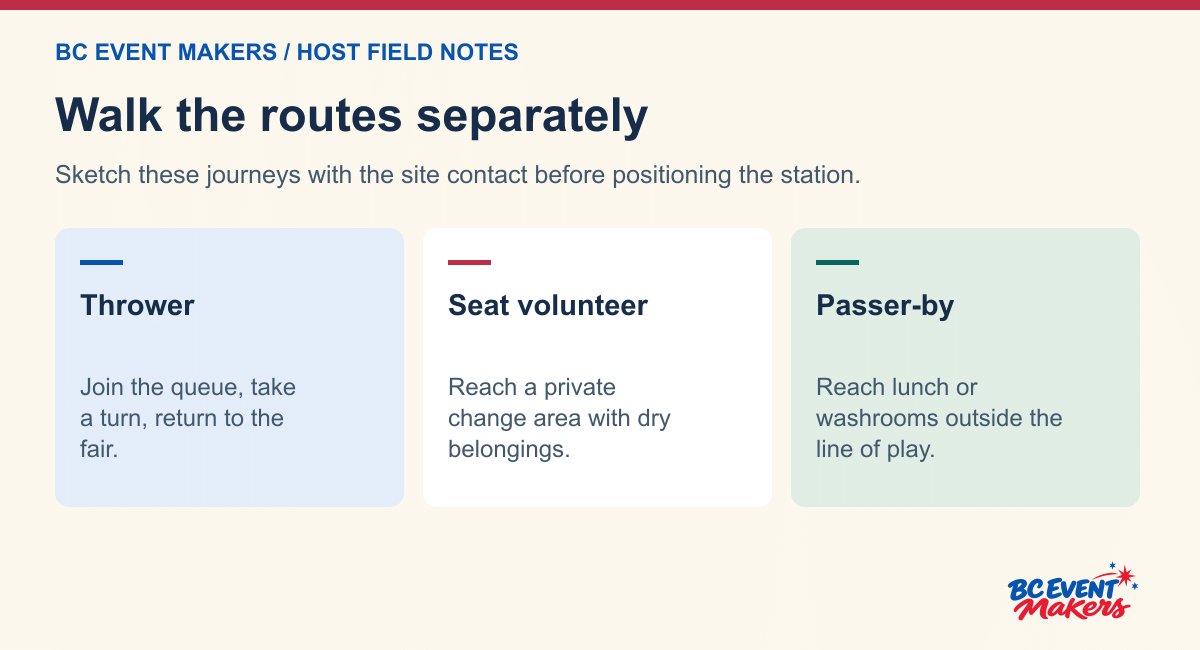
The second sketch shows the venue after the fair opens. Put a line where guests wait, another where a participant can get from the tank to a changing place, and a third for people walking past. Add the food table, seating and washrooms. Ask the supplier to confirm the equipment-specific space and operator positions before you finalise either drawing.
Give both sketches a date. If the school adds a stage or the venue moves the food service, the earlier version may be wrong even though the dunk tank itself has not moved. One dated drawing saves a great deal of discussion about which entrance or which patch of grass someone meant in an earlier message.
Ask a question that produces a usable answer
“Is there water?” can produce a perfectly sincere yes while leaving the hardest part of the booking unresolved. Ask instead, “Which water supply can this activity use, who can provide access, and when can that person meet the supplier?” Ask the venue separately which disposal arrangement it will accept. Give that answer to the supplier so it can assess the proposed plan for the actual tank.
If a question remains open, identify it by name. A note such as “The school has approved the activity in principle. The caretaker is checking access to the water supply before our booking review on Thursday” lets the next person see what to do. “School approved” hides the very detail the delivery team needs.
Work through three site problems before they happen
The water supply is behind a locked gate
Imagine a staff picnic where the venue has confirmed the proposed water use. The planner has taken a clear photograph of the tap. On the day sheet, the supplier is due before the venue contact who holds the key. The photograph answered a location question, while the run sheet exposed an access question.
Ask whether an authorised contact can meet the supplier during the agreed access period. If the venue offers another water supply, send its location and route for a fresh assessment. Let the responsible people review any effect on the opening time. A longer hose, a different tap or a helpful volunteer with another key is not something the host should assume will resolve the issue.
Write the confirmed meeting point and time into the handoff. Someone arriving at a large complex may need an entrance name as well as the street address. Share the keyholder’s details on the private staff sheet with the people who need them. The invitation to guests only needs the public entrance, confirmed activities and guest hours.
The throwing line crosses the route to lunch
Suppose a food truck arrives later than the tank. It parks where everyone expected, but its queue extends much farther than the organising team drew. Guests waiting for lunch now stand where the team had planned the throwing line. Neither activity has changed, yet the two queues have created a different site.
Ask the venue and activity contact to review where guests can wait. A sign pointing towards another part of the fair may help people find lunch, but it cannot make an overlapping guest route suitable. Decide how the lines should be separated and who will be stationed at the joining points. If that decision is still under review, give guests a clear update about what they can do right now.
Trace the route a third time from the viewpoint of someone who wants to pass both queues. Can they reach the washrooms or meet their family without crossing the throwing area? If a route only works when everybody stands exactly where the diagram says, it needs another look. Leave the equipment’s operating arrangements to the people responsible for them.
The volunteer has changed their mind
A teacher or manager may agree to take a seat and later decide against it. Give the participant lead a simple response they can use in private. “Thanks for letting us know. I’ll update the rota and take your name off the sign.” There is no need to explain the person’s reason to colleagues, families or the queue.
If someone else offers to step in, have the activity contact confirm the applicable requirements and let that person make an informed choice. Avoid recruiting someone over a microphone while a crowd is waiting. A host can announce a pause or another confirmed activity while the team reviews the next appearance.
Check the other roles on the timetable before accepting a replacement. A willing person may also be the keyholder, the only volunteer handling a different station or the person scheduled to thank the sponsors. A change that solves the dunk tank rota but leaves a second station unattended has only moved the gap.
Build a handoff that works at closing time
It is easy to spend a whole planning meeting on the opening throw. The venue also has a closing time, and guests still need somewhere to go after play ends. Work backwards from the agreed handback and keep the supplier’s collection access available. Ask how filling, operation, emptying and collection fit the particular booking. Do not publish a fixed opening or closing promise until the responsible people have checked those timings.
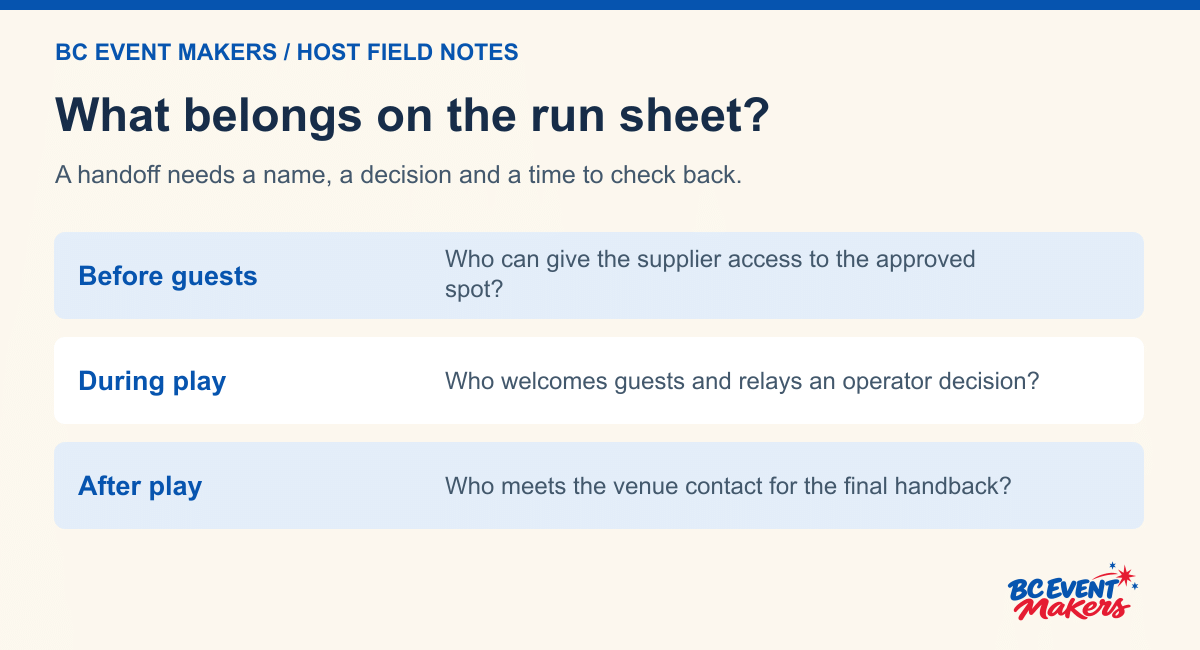
Put a named contact beside each of these decisions on the private run sheet. You need the person who can grant access, the person who leads the activity under the agreement, the host who updates guests, and the contact who accepts the venue back. If one person holds two roles, check whether the jobs fall at the same time. A phone number helps only if the person carrying it is available when the decision falls due.
Sample handoff table
| Moment | Question for the staff sheet | Result the guest should see |
|---|---|---|
| Supplier arrives | Is the agreed entrance open and is the site contact present? | Delivery can proceed along the reviewed route. |
| The queue opens | Has the activity contact confirmed the opening arrangement? | Guests can see where to join, watch or walk past. |
| A participant changes | Who checks the next confirmed volunteer and updates the sign? | Guests see the current programme, with personal details kept private. |
| The station closes | Who calls the last entry and keeps collection access clear? | People arriving late know what remains open. |
Use a handoff table to capture decisions. Keep the operating instructions with the people responsible for the specific equipment. A host who has volunteered to welcome the queue needs to know whom to call if something changes. That role is different from deciding when a person may throw, how the seat should be used or when play should restart.
What to put on the guest sign
Write the sign for someone approaching the activity for the first time. Name the activity, point to the agreed waiting place and explain where to ask about taking a turn. If a guest has no interest in throwing, the sign should also leave a clear way to watch or pass. Keep the words short enough to read before reaching the front of the line.
If you are charging for turns or collecting contributions, add the arrangement confirmed by the organisation handling them. Ask that organisation to approve the wording. If the station is purely for entertainment, say how a guest joins the activity and leave out fundraising language. The person managing the throwing line should not have to explain a different offer to every guest.
Prepare a second sign for a pause or closure. “Play is paused. The host will give the next update at [time]. The picnic area remains open” works when those details are confirmed. Replace a sign that still invites people to queue after entry has closed. A family arriving five minutes later will not have heard the earlier announcement.
Compare two sites for the same Richmond event
One site may have a convenient water supply beside the tank but a difficult delivery route. Another may have excellent access and no approved disposal arrangement. The question is which missing information the responsible person can resolve before a decision is due. A compact comparison helps the host avoid choosing the site with the prettier photograph and the harder handback.
For each proposed site, record the water supply, the approved end-of-day arrangement, the unloading route, the place for dry belongings and the guest route past the station. Include the open and close times of the venue. Add a column for who confirmed each answer. Leave a visible question mark where an answer is still required rather than copying an assumption from the other site.
Ask the supplier to review the differences that matter to its equipment and crew. “Location B has a separate vehicle gate, but access to the water supply is still under review” is a more useful comparison than “Location B is easier”. If neither location has enough confirmed information, keep the dunk tank provisional and continue planning the other parts of the gathering.
An enquiry you can adapt
We’re considering a dunk tank rental for [date] at [Richmond venue]. The event runs from [guest hours]; supplier access is [access hours]. The venue has confirmed [water supply and site details], and we still need an answer about [open question]. Attached are the delivery entrance, the proposed tank area and the route past the throwing line. Who should review the remaining requirements, and what should we clarify before advertising the activity?
Include the total guest count and the busiest expected period. A school whose classes arrive together creates a different waiting pattern from the same number of people visiting a summer picnic throughout the afternoon. Ask what the confirmed equipment and staffing arrangement can support. Avoid promising that everyone will have a particular number of turns.
A quick check before the invitations go out
Read the invitation as the colleague who does not want to get wet. Can they tell what else is happening and when the shared meal begins? Read it as a volunteer who is still considering a seat. Does it give them a private way to ask questions? Read it once more as the venue contact. Does it describe the location and activity that were actually reviewed?
A good invitation leaves room for a guest to choose. Give the confirmed event details, avoid naming participants without their consent, and share any change through the same channel guests used for the invitation. A clear message about an approved activity is worth more than a detailed timetable built on an unconfirmed water supply or access window.
Compare the BC Event Makers Dunk Tank with the site you have in mind, then send your Richmond event details for a date-specific review.