
Hawaiian shaved ice depends on an ice supply that lasts through the serving period. For a West Vancouver event, BCEM lists a machine that uses cubes. The product page states that ice cubes are not included. Assign the ice purchase, storage and refill job before telling guests the station will be open.
BC Event Makers’ catalogue lists a Hawaiian Shaved Ice Machine that uses cubes, along with a separate shaved ice supplies entry. Confirm the machine offered for your date and its requirements. Ice cubes are not provided for that listed machine, so include them in your event plan rather than assuming they arrive with the rental.
1. Hawaiian shaved ice: confirm the equipment you are booking
Review the rental catalogue and ask for the exact item to be named in your proposal. Plan the serving area around the cube machine and its working requirements. Share a sketch of the proposed station so the equipment and supplies have a suitable place within the food area.
Ask about electrical requirements and the working surface needed. Check those details with the venue, together with permission for the proposed food service. If you are planning outdoors, discuss weather conditions and what protection the selected equipment needs.
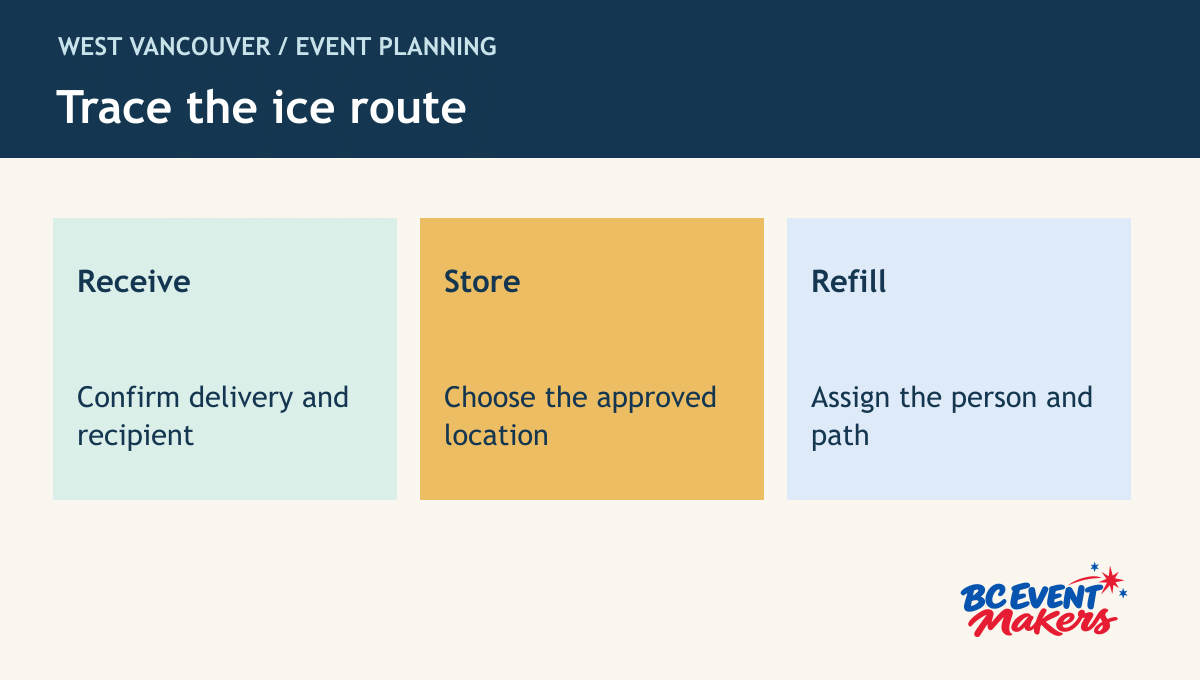
2. Give the ice a route to the station
Decide who obtains the ice and how it reaches the operator. Confirm suitable storage and handling arrangements with the people responsible for food service. Keep deliveries or replenishment out of the guest queue so supplies can be managed without interrupting collection.
Ask what serving materials and syrups are included in your quote and which are separate. The catalogue’s supply listing is a starting point for that conversation, not proof that a particular package has been added to your booking.
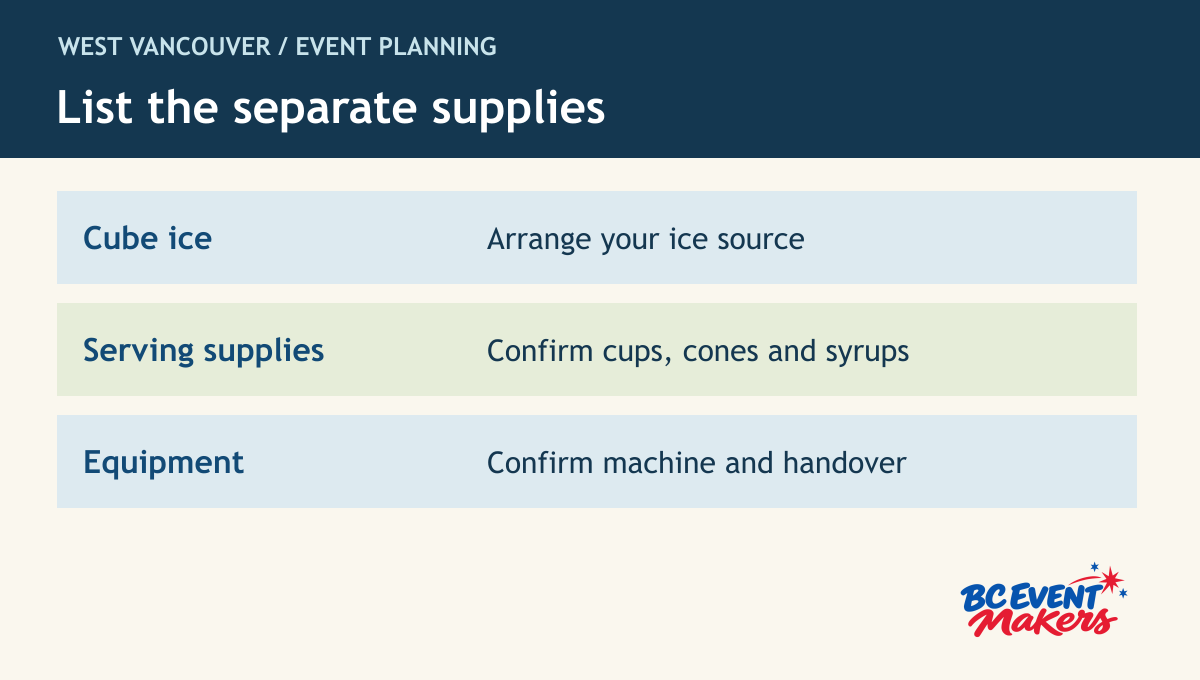
3. Organise the guest side
Place the queue where it will not obstruct other attractions or venue access. Allow guests to move away after collecting their treat. Keep waste collection convenient and assign someone to monitor the area during the serving period.
Make flavour and ingredient information available for the products in use. Avoid assuming a syrup meets a dietary requirement without checking. If your event offers several refreshments, give guests enough information to choose between them.
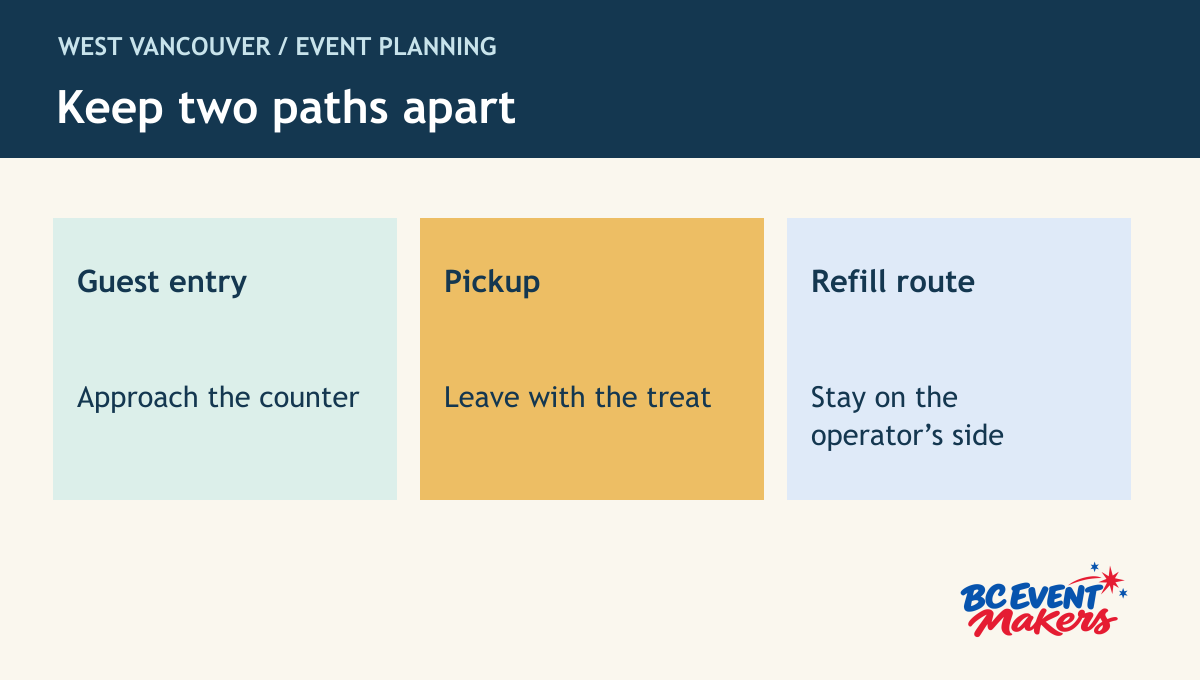
4. Clarify who operates the station
Ask whether the proposal is for equipment rental or an operated service. If your own team will run it, arrange the instruction and handover before the day. Plan coverage so the operator is not also responsible for an unrelated activity across the venue.
Send your West Vancouver address, event date and serving window through the quote form. Include guest numbers and the venue’s access hours. Confirm the machine and supply scope in writing, with ice responsibilities clearly assigned, before adding shaved ice to the final menu.
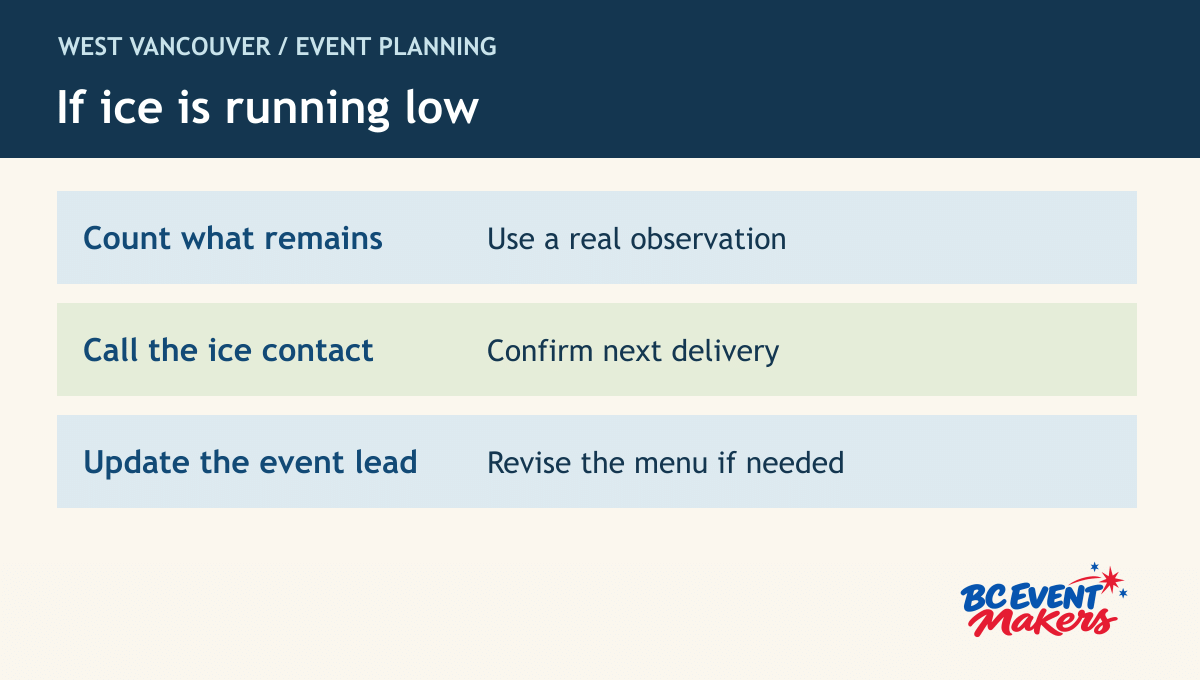
Rehearse the refill without an audience
A well-stocked machine at opening can still run short later if the next bag of ice is on the wrong side of a busy crowd. Trace the route from the delivery point to approved storage and then to the operator. Ask who can move the refill while the first helper stays at the counter.
Confirm the specific cube-ice machine and supplies for the booking. Shaved ice and sno-cone equipment are separate catalogue entries; a picture of a different machine would not settle what your operator will receive. Ask the supplier for the actual requirements and the venue for a suitable working area.
Trace the ice from the vehicle or delivery point to the agreed storage location. Then trace it again to the operator’s side of the serving counter. These are two separate moves, and the person responsible for one may not be responsible for the other. Confirm both with the venue and ice provider.
In the handover, record the actual remaining supply and the next confirmed delivery time. If those details are uncertain, ask the event lead what the team should tell guests. A clear pause while the supply is checked is better than telling a growing line that service will restart at a time no one has confirmed.
Questions to settle before the event
Does the shaved ice equipment come with ice cubes?
The Hawaiian Shaved Ice Machine (Cubes) listing says ice cubes are not provided. Arrange a source, receiver and storage plan. Confirm syrups, serving materials and equipment separately in the quote.
Can the operator also leave to buy more ice?
Plan for someone else to handle replenishment during service. If you do not have that person, discuss whether the station needs a scheduled pause rather than leaving the operator’s role uncovered.
How much ice does our event need?
Give the supplier the model, serving window, estimated demand and other refreshments offered. Ask for guidance based on that arrangement instead of assuming that one volume works for any event.
Where can the organizer check public food-service requirements?
Describe the proposed menu, service format and event to Vancouver Coastal Health. Ask which requirements apply and who will coordinate any necessary arrangements. A rental confirmation covers the agreed equipment and services; it does not settle the venue or organizer’s responsibilities.
A message to send with the venue details
We would like Hawaiian shaved ice for [date and venue]. We will arrange our cube ice. Please confirm the machine, the serving materials and syrups, the operator role and the space or power the venue needs to approve.
Write the ice supplier’s contact on the service sheet and note who can authorize a change if a delivery is late. Guests should hear an accurate update from the event lead, not a promise from a helper waiting on a delivery.
Check the end of service as carefully as the start. Who handles unused ice and leftover syrups? Where do serving materials go when the operator finishes? What must be cleared before equipment collection? Write the answers next to the storage and refill contacts. A Hawaiian shaved ice station is easier to hand back when the closing helper knows which items belong to the supplier and which belong to the event.
A shaved ice station worksheet for the event team
Use this worksheet when the host, venue and ice provider are different people. Its purpose is to put their answers on one page. Fill in the blanks with actual names and times after each person confirms their part. A machine reservation, a bag of ice on the shopping list and a venue booking are three separate commitments.
1. Decide when guests will actually want shaved ice
Write down when your programme releases the largest group. For a school fair, that might be after a performance. For a company gathering, guests may arrive at different times but all finish lunch together. A station open for several hours can still experience a single short rush. Tell the equipment supplier about that rush rather than giving only the total attendance.
Separate three figures: how many people attend, how many may choose the treat, and how many may arrive in the busiest period. If you do not have a reliable estimate, say that. One useful planning exercise is to compare a quiet scenario with a busy one. Ask the supplier what each scenario would mean for ice, serving materials, space and staffing.
| Moment | What the host knows | Question still open |
|---|---|---|
| First possible serving | [time the station can open] | Will the machine and ice both be there? |
| Largest group release | [activity and approximate time] | Who will watch the end of the queue? |
| Last planned serving | [time announced to guests] | When does the operator switch to pack-out? |
2. Follow a bag of ice from the vehicle to the operator
Start where a delivery vehicle can actually stop. Ask the venue who controls that point and whether your receiver needs to meet the driver. Follow the path to the place the venue approves for storage. A nearby door on the floor plan might be locked during the event or used by another group. Get the usable route from someone who knows the building.
Next, walk from storage to the serving counter. Consider what happens when the guest queue is full. If the refill person would have to walk through waiting guests, move the storage point or give them a different route. Draw the two routes in different colours on your sketch: one for ice, one for guests. The solution should still work when guests stop to watch, ask a question or collect treats for someone else.
Finally, decide how the operator requests a refill. A shouted message across a noisy school gym can go unheard. Give the operator a named person and an agreed way to reach them. Ask the refill person to acknowledge the request and tell the operator when they actually have the next supply. That distinction avoids promising service based on ice that is still on the road.
3. Compare three possible service arrangements
Example A: a short family gathering. Guests arrive in small groups, so the station may have time for conversation between servings. The host still needs someone to receive the ice and someone who can cover the operator’s break. Consider opening the station for one defined period rather than relying on a relative to be available whenever someone wants a treat. Confirm that arrangement with the supplier for the actual machine.
Example B: a school event with a single release. A group of families comes out of an activity together. Give them a visible place to join the line and a different place to leave it. Put someone where the line starts who can explain what is being served and whether there is a pause. The operator should have a clear working space without people reaching past them for cones or syrups.
Example C: a public gathering with several food stands. A shaved ice queue may be influenced by a neighbouring counter just as much as by the machine. Walk the shared space with both providers. Agree which direction each line grows and where guests carrying food can stop. If neither provider has room to replenish supplies during the rush, revisit the layout before asking them to arrive earlier.
4. Compare written offers without losing the ice question
Put the offers side by side. In one column, list what each provider physically brings. In another, list the work the event must do. One supplier might deliver equipment and serving supplies while the host arranges ice and operation. Another might propose a different service arrangement. Do not compare the headline prices until you have written down those remaining responsibilities.
| Line item | What to ask | Who records the answer? |
|---|---|---|
| Machine | Which model is confirmed for our date, and who handles the operating handover? | The person receiving equipment. |
| Cube ice | Who orders it, receives it and arranges any further supply? | The event’s ice contact. |
| Serving supplies | What flavours, cones or cups are actually in the written offer? | The person maintaining the menu. |
| Site | What position and access does the venue approve? | The venue contact. |
| End of service | What must be ready for collection, and at what time? | The closing shift. |
If a price changes after the venue moves the station, ask what changed in the scope. The provider may need a different setup, a different delivery window or another arrangement altogether. Share the revised position with the ice receiver as well. A new room can change where the bags go even if the guest count and menu stay the same.
5. Work through a late ice delivery before the day
Suppose the machine is on site but the first ice delivery has not arrived. Who contacts the ice provider? Who tells the event lead what has actually happened? Who speaks to families at the counter? Assign those jobs separately rather than expecting the operator to handle every conversation. If the team has no confirmed arrival time, say service is paused rather than announcing a restart time.
When ice does arrive, let the person responsible for the equipment follow the supplier’s operating instructions and confirm when the station can serve. A delivery at the door is not a serving-ready signal. Give the queue helper one confirmed update to relay. If the delay cuts into another activity, ask the event lead whether the programme or menu should change.
Record what happened in a short note. The most useful entry says what the team observed, which contact helped, and what needs to be arranged differently next time. Avoid turning one unusually busy or quiet event into a promise about what every Hawaiian shaved ice station can serve.
6. Give each shift a handover it can use
The outgoing helper should show the next person the actual storage location, the supplies remaining and the agreed closing time. Ask the incoming helper to repeat who they contact if stock runs low. If the answer is “someone from the venue,” replace it with the named contact and a way to reach them before the first helper leaves.
“The equipment handover was with [name]. Cube ice is stored at [approved location]. Our next confirmed refill is [time or status]. [Name] handles guest questions, and [name] can authorize a change to the menu. We stop serving at [confirmed time] and meet the equipment provider at [collection point].”
Adapt the note to your event. Do not fill the next-refill field with a guess or list a flavour the provider has not confirmed. Give the host a copy before opening so any announcement matches the counter’s actual offer. At closing, add the final stock and collection details to the same sheet rather than asking the departing shift to reconstruct them later.
What to send with the final enquiry
Attach the site sketch, service window and short description of the busiest period. Identify the ice supplier or state that it still needs to be arranged. Include the venue’s answer about the proposed position and the person responsible for operation. Ask the equipment provider to mark what is included, what is separate and what it still needs from you. That answer is the basis for the booking; the worked examples above are planning tools.
A final check for the guest menu and signs
Read your proposed sign aloud to the person who will actually serve the shaved ice. Can they confirm every flavour on it? Do they know where to locate the ingredient information for the supplies that will be used? If the answer depends on a delivery still to come, keep that part of the sign changeable. A printed menu can lag behind the actual stock even when the supplier and venue have both done their jobs.
Think about guests who reach the front after one flavour has run out. The queue helper can explain the remaining choices before they reach the operator. If a guest asks whether a product meets a particular dietary requirement, refer to the actual product information or the responsible provider. Keep an unconfirmed option off the menu instead of relying on the colour of a syrup or a previous event’s labels.
Ask who can change the public sign and who tells the host. If an announcement still advertises a flavour that the station has stopped serving, the operator will have to correct the same misunderstanding repeatedly. One updated message at the entrance and one to the host may solve the problem more effectively than adding another helper at the counter. Keep the final sign with the handover notes as a record of what was actually offered.