
A Ferris wheel in Whistler needs a supplier who can confirm that exact ride, date and location. BC Event Makers’ catalog lists other fairground options, including the Swing Ride and Tubs of Fun. Use four checks to decide whether only the wheel will meet your brief or whether a confirmed alternative could suit your guests.
You can still use the original event brief to evaluate other attractions. First decide what you wanted the Ferris wheel to contribute, then compare confirmed options against that purpose. A replacement should make sense for your guests and site.
1. Identify the experience behind the Ferris wheel request
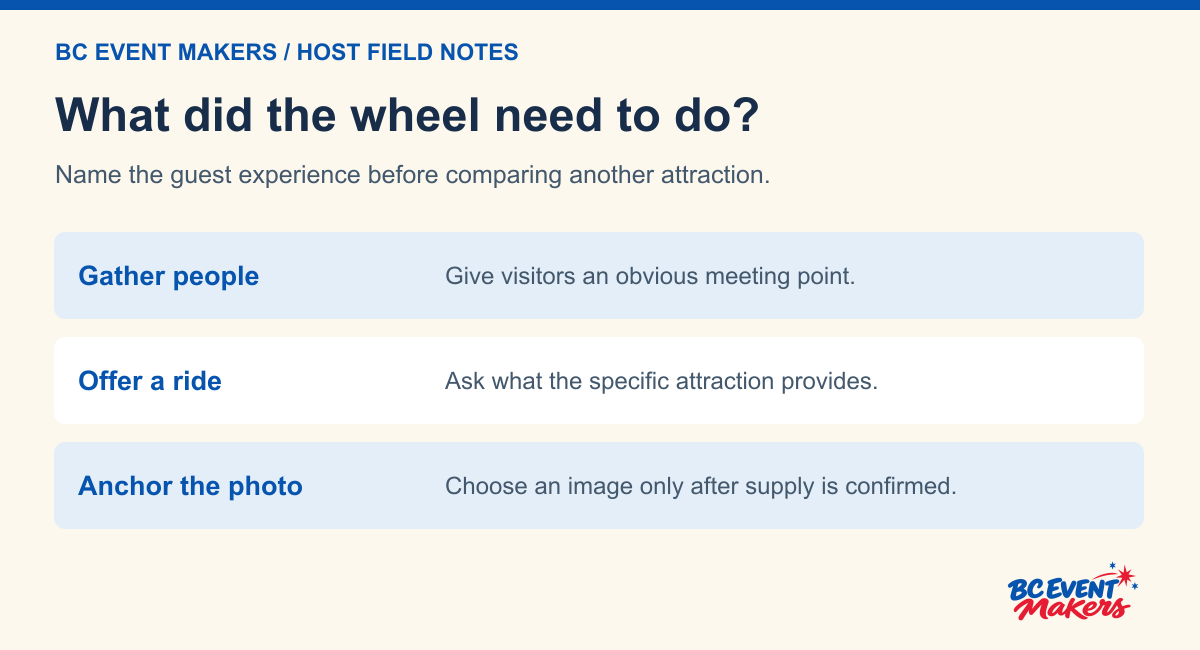
A ride can be the visual centre of an event, a shared experience or one stop among several activities. Decide which role matters most. A proposal focused on a photograph may lead to a different choice from a programme intended to keep guests participating throughout the afternoon.
Tell potential suppliers what you are trying to achieve and the people you expect to attend. Avoid choosing an alternative solely because it is also called a fairground ride. Different attractions have different participant requirements and operating needs.
2. Compare alternatives against the guest experience
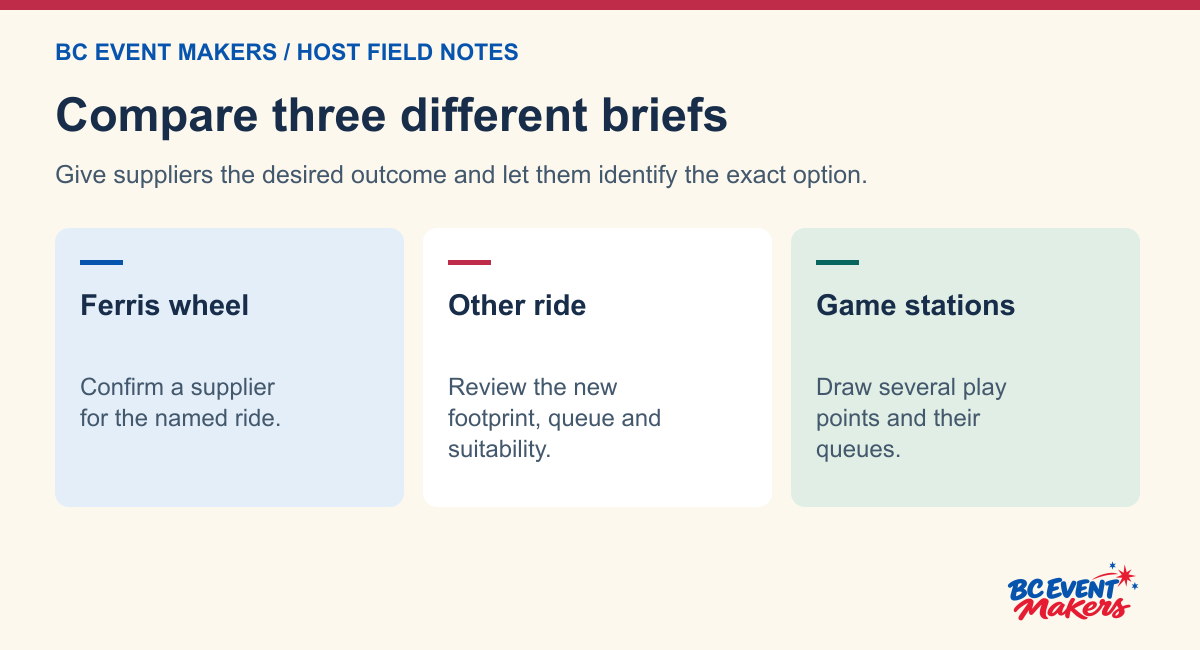
BC Event Makers lists Swing Ride and Tubs of Fun in its fairground range. These are different experiences from a Ferris wheel. Ask about their suitability for the participant group and proposed venue, and request the current availability for your date.
If the event would work better with games, compare carnival activities as another direction. Target games can create a collection of smaller activity points. That changes the event layout and guest flow, so plan the revised programme instead of treating it as a direct equipment swap.
3. Confirm the Whistler location and delivery window
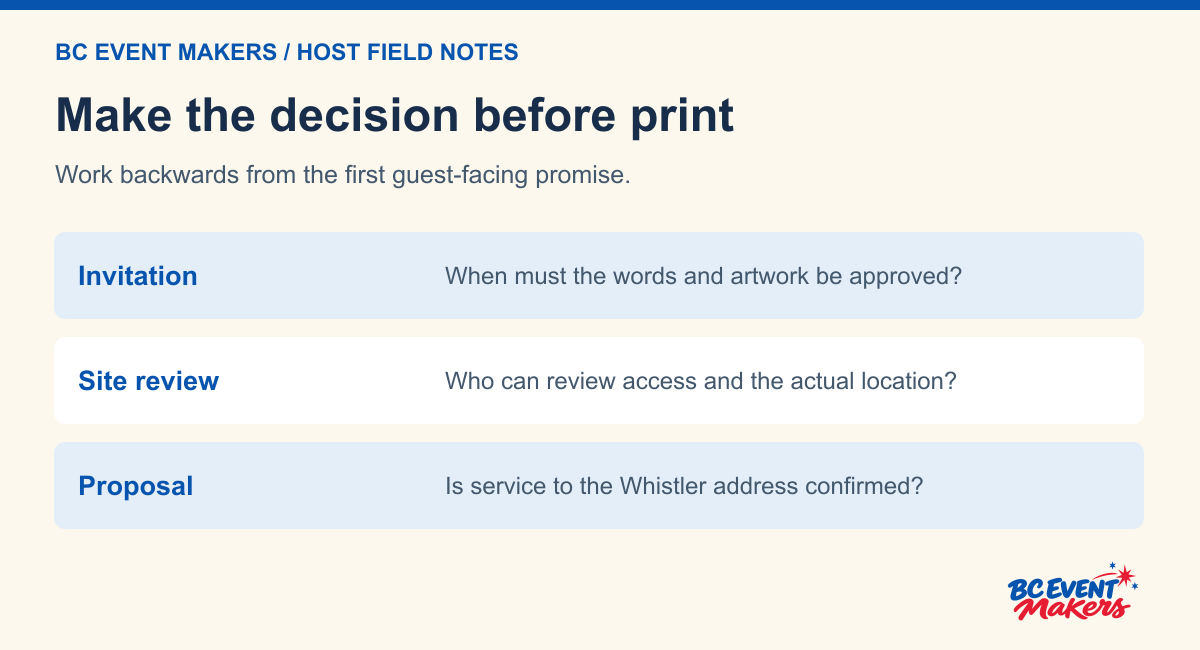
Ask about delivery feasibility and travel arrangements before developing the chosen option in detail. Share the venue address and photographs of the unloading route. Mention restrictions on vehicle access and the times available for installation and collection.
Request the full operating-space requirements for the exact attraction being proposed. Include guest circulation and a place for the queue in the layout. A site previously considered for a Ferris wheel still needs to be assessed for any alternative ride.
4. Release the guest message after the decision
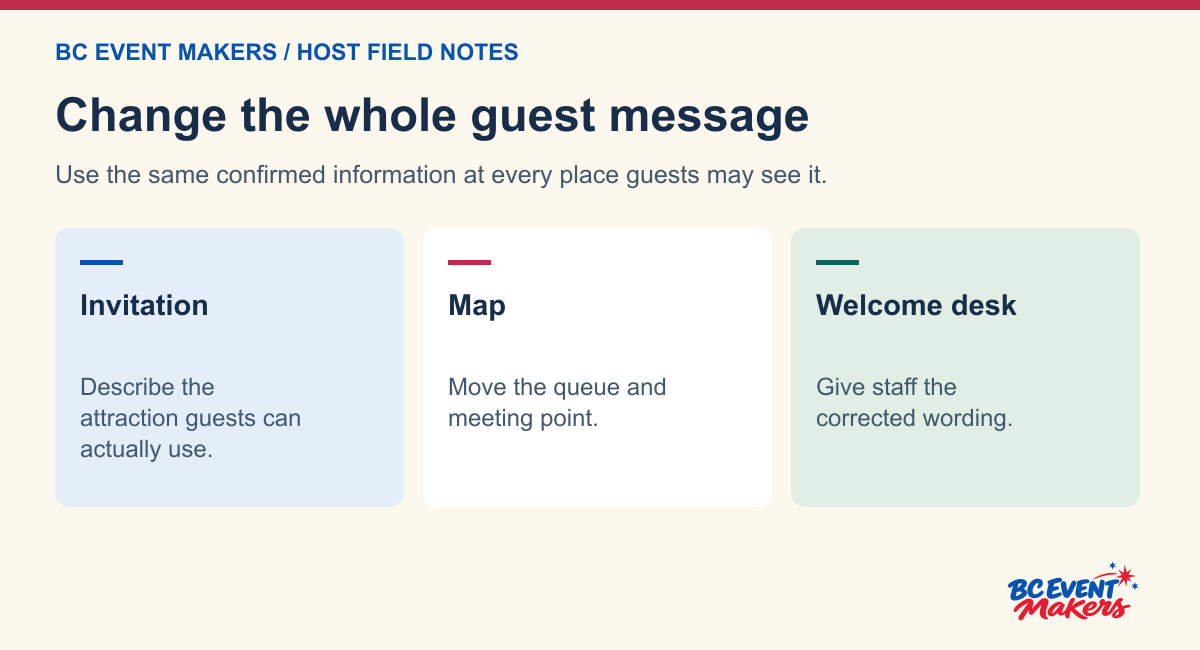
Do not advertise a particular ride until its supply is confirmed. If an attraction changes, update invitations and any public event information so visitors can make plans based on what will actually be there. Review imagery as well as the written description.
See the listed fairground rides or ask about your Whistler event. State that you are comparing alternatives to a Ferris wheel, and request confirmation of the proposed equipment and operating arrangements, including travel to the venue.
The committee wants a wheel. What did it picture?
Ask each person to finish this sentence privately before discussing suppliers. “The Ferris wheel matters because our guests will …” One person might say “spot the fair from the entrance”. Another might say “take a ride together”. A third might say “take a photograph with the mountains behind them”. Those are three different briefs. They lead to different conclusions if the exact ride is unavailable.
Write the answers on a sheet with the date and event address. Circle the one experience the committee considers essential. Put the others in a second column headed “welcome if feasible”. If a Ferris wheel itself is essential, spend the next planning call establishing whether a supplier can provide one for that date and location. If the important part is giving families a reason to gather, a wider range of activities may warrant comparison.
A planner who is clear about that distinction can save a week of unproductive enquiries. A supplier offering Tubs of Fun can discuss its own attraction and what it would need from the venue. It cannot settle whether a different supplier can deliver a Ferris wheel. Ask each party to confirm the equipment and service they actually control.
Write a brief the venue can review
Give the venue the address, intended guest hours and the hours you hope to have access for delivery and collection. Describe who is attending, the kind of experience you want and the equipment under consideration. Mark the proposed area on a drawing that includes food service, existing paths, seating and neighbouring activities. If the equipment choice is provisional, label it that way.
For a municipal site or public event, the Resort Municipality of Whistler’s event-production information is a starting point for the local conversation. Ask which process applies to the actual property and event. A private venue will have its own contact and conditions. Get those answers before relying on a map that shows an attractive open space but leaves its management or availability unclear.
Ask the venue to explain what happens on either side of the event. A hall booking may end at a set hour even if the public programme finishes earlier. A shared access road may be available in the morning and required for another user in the afternoon. The return trip needs the same attention as delivery. Put the collection arrangement on the brief before comparing proposals.
Give a supplier something firmer than “a big ride”
Try this description for a community celebration. “We want an attraction people can see as they arrive, a comfortable place for friends to watch, and an activity guests can join between other parts of the fair.” A supplier can respond with the name of an exact unit, what guests do, what the supplier needs from the site and which parts require review.
Now try a different description. “We want guests to experience a wheel ride together and have already planned the celebration around that specific experience.” That request should go to a supplier able to confirm the named Ferris wheel. Treat a proposed Swing Ride or a set of game booths as a change of programme. Give the committee the opportunity to decide whether the revised experience still meets its aim.
Compare three proposals on one page
Use a brief comparison sheet when a committee receives a wheel proposal, an alternative ride proposal and a proposal for several activities. A list of prices or photographs does not show whether the same work is included. Ask the same questions about availability, site review, people and timing for all three.
| Question | What to record from each supplier | Who confirms an outstanding answer? |
|---|---|---|
| Which equipment is proposed? | Exact name and the activity a guest will experience. | The supplier responsible for that item. |
| Can it reach this Whistler address on this date? | Written service answer, travel assumptions, access and collection windows. | Supplier and venue for their respective decisions. |
| Where do people wait, watch and return? | Site drawing with the guest route and neighbouring activities. | Venue, host and supplier together. |
| Who does what during the event? | Equipment and staffing scope, host tasks and the contact for a change. | The person authorised to agree each part. |
| When can the attraction appear in publicity? | Which decisions are confirmed and when the rest will be reviewed. | The organiser responsible for releasing the guest message. |
Keep an outstanding answer visible. “Awaiting the supplier’s review of the Whistler address” is a perfectly useful result from the first meeting. A blank cell that someone silently fills with last year’s assumption can turn into a promise before anyone notices. Put a name and a follow-up date beside the open question.
If a ride is proposed, ask the responsible operator about the requirements for that device and setting. Technical Safety BC’s operating-permit information helps identify the questions to take to the operator. The venue separately reviews permission to use its site. Keep the written answers with the proposal and refer specialist questions to the appropriate contact.
Example one. The wheel was meant to bring people together
Imagine an afternoon fair where the committee wants friends to find each other easily. The Ferris wheel was selected in a brainstorming session because everyone could picture meeting beside it. If a wheel cannot be confirmed, the underlying goal still makes sense. The team needs a recognisable meeting place close to the action and outside equipment working space.
Compare an alternative ride alongside a clearly named meeting point. Would the Swing Ride provide the kind of activity the group wants? Can a guest find the meeting point without entering its queue? Would several smaller carnival games around an agreed seating area give guests more opportunities to spend time together? Sketch both options and ask the site contact to walk the guest route.
The best choice in this example may depend on what people can do while waiting. A large attraction with nowhere for friends to sit can separate a group that came to socialise. A smaller collection of games with a well-placed meeting point can create a different kind of gathering. Give the committee the actual alternatives and let it choose the experience it wants to offer.
Example two. The poster is almost ready
A designer has prepared a striking image of a Ferris wheel for a Whistler event. The committee would like to post it while a supplier is still checking availability. Put the poster beside the current decision sheet. Does the image promise equipment that anyone has confirmed? Would a family reasonably expect to ride the wheel after seeing it?
Hold the wheel image while that question is open. The event can announce a confirmed date, cause, venue or programme element with its own accurate artwork. If Tubs of Fun is later confirmed, use an approved image of that ride, label it clearly and review the map. Do not leave an old Ferris wheel image next to the revised attraction description and expect visitors to resolve the difference.
Check every place the first version appeared. The invitation, event listing, ticket information, map, sponsor preview and volunteer brief may belong to different people. Assign one person to circulate the confirmed change and another to check the public versions. The person at the welcome desk should use the same name and hours that guests saw online.
Example three. The committee has moved the event to another site
Suppose the original location becomes unavailable and a nearby venue offers a replacement. It may have a more generous field and a shorter public programme, but delivery now uses a narrow shared entrance. The proposed Swing Ride, Tubs of Fun or Ferris wheel needs a new review for the actual location. A larger site on paper does not settle how equipment reaches it or how guests use it.
Send the new address, access hours and photos facing into and back out of the narrow entrance. Include the site contact and the activities happening nearby. Ask the supplier what the change means for travel, equipment suitability and the proposed schedule. Ask the venue which permissions apply to the new space. Make one updated decision sheet and identify the older one as superseded in the event file.
When the team briefs guests, start with the fact they need first. “The celebration will be at [confirmed location] on [date]. The activity programme includes [confirmed items]. Enter at [guest entrance].” If an attraction decision is still due, say when the organiser will issue the next update. A guest can plan around a clear confirmed location while the organising team finishes the remaining review.
Set a practical decision date
Start with the earliest commitment that depends on the attraction. It might be printing a sign, publishing a paid ticket description, sending a school notice or releasing sponsor artwork. Work backwards to identify when you need the venue answer, the supplier’s scope and the organiser’s final decision. The question is when the organisation can make a truthful promise to guests.
Give the committee two viable choices by that date. One can be the desired Ferris wheel if a supplier can confirm it. The other can be an approved alternative programme or a gathering built around confirmed activities already available. A backup that depends on the same unanswered access question as the original idea does little for the schedule.
Ask what the committee will do if the final answer arrives after the publicity deadline. It can issue the confirmed invitation and add an attraction later, or choose the approved alternative now. The decision depends on what is central to the offer guests are accepting. A community picnic can often add an activity later. A ticket sold specifically for a named ride calls for certainty before the promise is made.
Two messages the host can keep ready
For an event whose attraction is still under review, use wording such as “Join us for [confirmed programme] at [venue]. We’ll share the final activity list through [channel] on [date].” Fill in a follow-up date the organiser can actually meet. Avoid putting a Ferris wheel silhouette on that invitation simply because the graphic looks festive.
For a confirmed change, try “The attraction at our Whistler event will be [exact confirmed name]. You can find it at [reviewed location]. Friends who want to watch or meet can use [agreed meeting point].” Check the message against the site plan before it goes public. When guests ask about participation, direct them to the approved information for that actual ride.
What to send BC Event Makers
Our Whistler event is planned for [date and exact location]. We originally considered a Ferris wheel because [specific guest experience]. We are comparing confirmed alternatives. The venue can provide access from [time] to [time], and our proposed guest hours are [hours]. Attached are the delivery route, activity area and guest route. Can you confirm whether you can serve this address and which listed options you would review for this event?
Include the event decision date and anything the venue has yet to approve. If the supplier cannot confirm a suitable option for that address, ask the venue about local supplier routes or revise the programme around an activity that can be confirmed. The purpose of the enquiry is to reach a dependable decision while you still have time to act on it.
What if a sponsor offers to find the wheel?
Treat the introduction as a useful lead and ask for the name of the operator who would supply the Ferris wheel. Give that operator the same site brief used for the other proposals. The committee still needs a written answer about the actual equipment, the Whistler event date, access and collection. A sponsor who can introduce two organisations may have no role in providing or operating the ride itself.
Agree on what the sponsor can say while those answers are pending. A message supporting the celebration can acknowledge a confirmed contribution and use approved event artwork. Save a named Ferris wheel announcement for the point when the supplier and venue decisions support it. If an alternative is selected, show the sponsor the revised guest message and map before they share the event with their own audience.
Browse the listed fairground attractions and ask about the date and Whistler site. Request written service and availability for the precise option you are considering.