
A Swing Ride in Vernon depends on a written answer about the date, delivery route and specific venue. BC Event Makers’ confirmed core area is the Lower Mainland. Start with service availability before asking the committee to choose the ride or prepare a poster.
BC Event Makers lists a Swing Ride in its catalogue. For a Vernon event, confirm availability and delivery feasibility early. The following planning questions are useful once you are discussing the specific equipment and proposed site.
1. Confirm the proposed Swing Ride in Vernon for the actual site
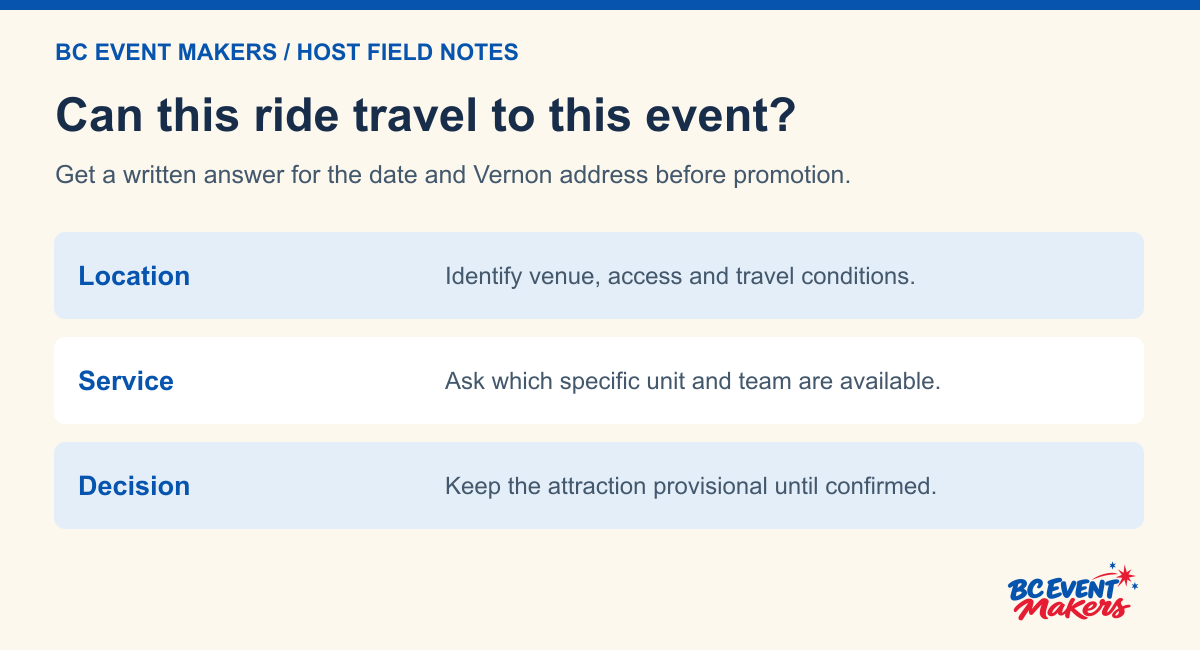
Mark the ride’s proposed location on a site plan showing entrances and the other activities. Ask for the full operating-area requirements, including any required separation. Keep that space distinct from the guest queue and the places spectators will naturally stop.
Consider the route from the queue back into the event. Guests leaving a ride should be able to move on without crossing the line of people waiting. Ask the supplier to review the arrangement before putting neighbouring booths or furniture into position.
2. Walk the delivery route with the venue contact
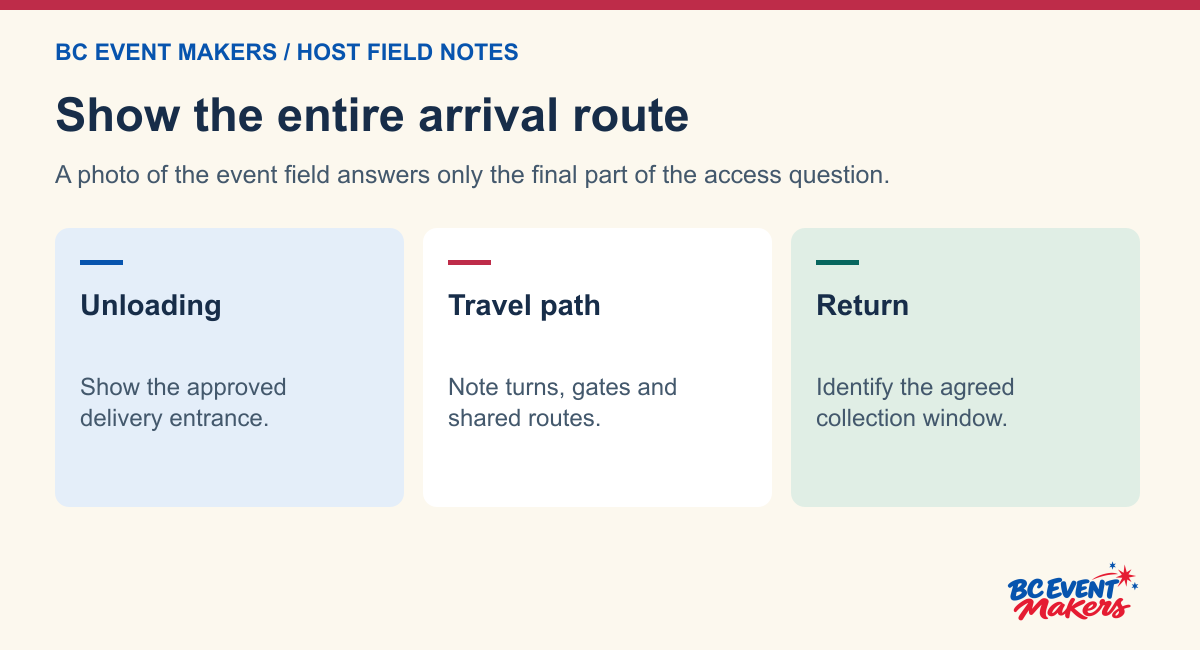
Share photographs of the delivery approach and describe gates or turns. Include surface information and any access restrictions set by the property owner. The setup position is only useful if the supplied equipment can reach it during the available access window.
Coordinate the ride delivery with other suppliers. A vehicle unloading a food booth or a tent installation can occupy the same route. Give the site contact the agreed arrival order and keep the route available again for collection.
3. Give riders and spectators enough information
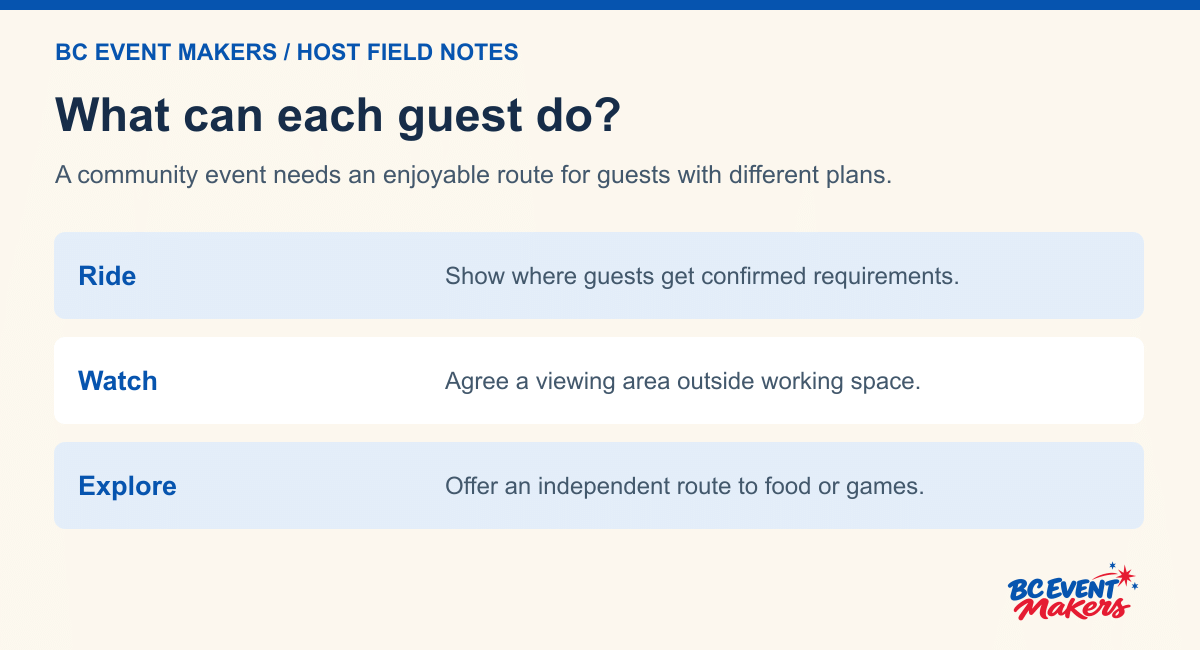
Request the participant requirements and operating rules for the selected ride. Use that confirmed information on event signage and in advance information where appropriate. Do not infer eligibility from a photograph or describe the ride as suitable for every visitor.
Include an activity for people who prefer to remain on the ground. A nearby carnival game can give a group another option, provided its playing and waiting areas fit the site. Plan those activities as independent spaces rather than filling any apparent gap beside the ride.
4. Set the operating window and publicity decision
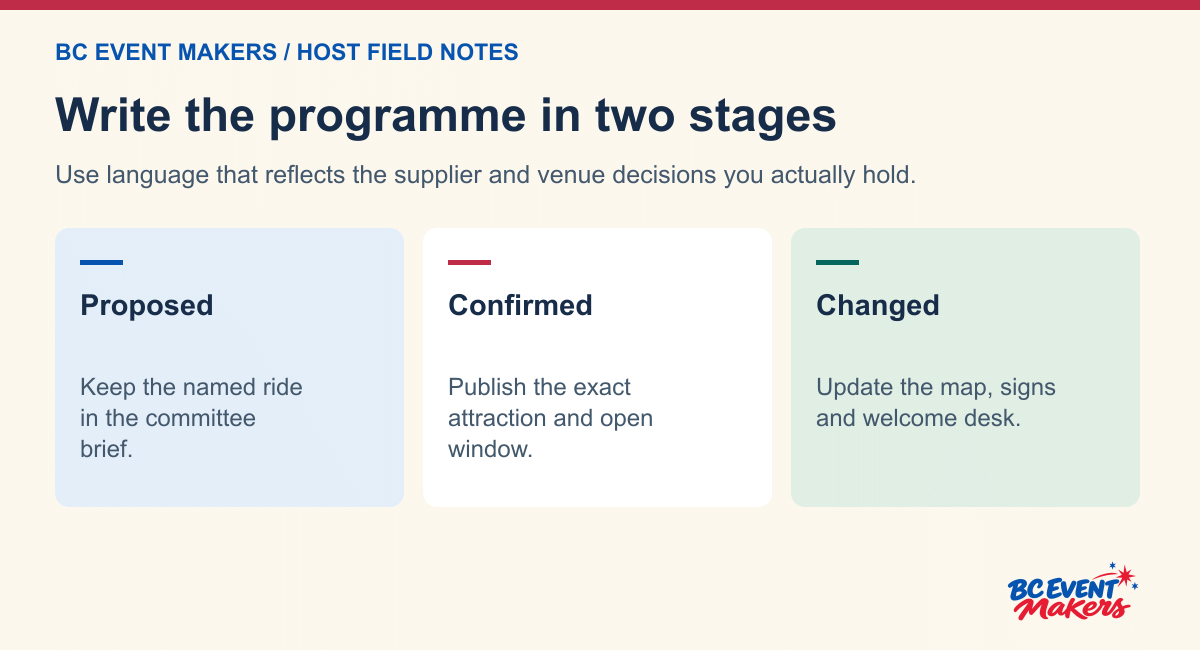
Agree when the ride is expected to open and close and who manages announcements. Ask how a weather or site decision would be communicated. The person coordinating the event should know how to change the programme without sending guests toward an unavailable attraction.
Explore fairground ride options, then send your Vernon event enquiry. Include the venue, schedule and site photographs so travel, equipment and operating responsibilities can be discussed in the same proposal.
Start with a service question the supplier can answer
Give the exact Vernon event address and date in the first message. Include the period when the property is available for delivery and collection. Ask whether a Swing Ride and the team needed for it can be supplied to that address under a written proposal. BC Event Makers’ usual service area is the Lower Mainland, so a Vernon organiser should establish this answer early and allow time to investigate a local operator or another programme.
A supplier may be able to assess the request more quickly if it knows which decisions are fixed. “The venue and event date are confirmed; we are comparing a Swing Ride with a collection of game booths” is clearer than “We might want a ride somewhere in Vernon”. If the committee is open to changing the date, say which alternatives it can genuinely consider. Avoid asking for three different travel proposals when only one date is possible.
Give the supplier the committee’s decision date. This might be when an event listing must go live or when the venue requires the final site plan. The deadline should allow enough time for the actual site review and written service confirmation. A deadline in the message does not guarantee that the requested ride or crew will be available.
Separate travel, equipment and site approval
Keep three questions visible on the decision sheet. Can the provider serve the address on the requested date? Which exact ride and staffing arrangements are being proposed? Can the property approve the proposed use once it has the details? An encouraging answer to any one of these questions leaves the others open.
For a public location, the City of Vernon’s event planning information can help identify the appropriate application or booking contact. Ask the person responsible for the specific property about its requirements. If the event is at a private venue, speak to that venue directly. Tell both the venue and supplier when a decision depends on information from the other.
Write an actual answer next to each question. “Venue has requested the model and access period” is useful. “Permit sorted” is too broad for someone who has not been on the call. Keep the supplier’s equipment or operator information alongside the venue’s property decision so the person finalising the programme can see what each document covers.
Build a route file from the vehicle to the guest area
Start at the point where the supplier’s vehicle is expected to arrive. Take a photograph facing the unloading point and ask the venue how that space is used during the requested window. A shared entrance may be clear for most of the day and busy when a morning class, food delivery or another booking arrives.
Continue along the whole delivery route. Photograph the tightest turn and any change in level from more than one angle. Describe the surface and any restrictions that the venue has identified. Measure a clear gate opening if asked and label it as the host’s measurement so the supplier can decide what else needs review. The event team should not infer that a piece of equipment can reach the site simply because a pedestrian can walk there.
Now take a view from the proposed ride area back towards the entrance. Include the space intended for guests to queue, watch and walk through. Mark catering or stage access if those functions share the site. The supplier and venue should be able to understand what the area will look like after the other pieces of the event are in place.
Example. The direct gate cannot be used for collection
Imagine the venue allows access through a convenient gate before guests arrive. The same gate must close later because another part of the property opens to the public. The event lead expects the supplier to reverse the morning delivery route at collection, but that option will no longer be available.
Ask the venue what collection route it can actually provide and at what time. Send that information to the supplier for a fresh assessment. If the alternative route changes the proposal or makes service infeasible, the committee needs that answer before it announces the ride. Changing a collection plan is a joint scheduling and equipment question, not a last-minute duty for a volunteer with a key.
Put the return arrangement in the same document as the arrival arrangement. Write down which contact will meet the team, which entrance is approved and when the next property use begins. This one step can reveal a conflict that a guest timetable will never show.
Example. A sponsor suggests another venue
A sponsor offers a larger property after the committee has received a preliminary ride proposal. The new venue might be a good option, but its address, access, operating space and guest route differ. Ask the supplier which parts of the original proposal need to be reassessed.
Compare the two sites on the information the provider needs rather than on appearance. Which space has a confirmed access window in both directions? Where will the public queue go after the event’s welcome speech? Which venue contact can answer an equipment-specific question? A smaller venue with clear answers may be easier to assess than a larger venue whose critical details remain open.
If the event moves, distribute one dated site brief and clearly identify the older version. Check invitations, venue directions and any sponsor material that already names the earlier location. An old screenshot in a volunteer chat can send a helper to the wrong entrance even after the main event page is corrected.
Compare a travelling Swing Ride with an available local programme
There are several legitimate outcomes. A supplier can provide a written Swing Ride proposal, suggest a different confirmed attraction, or advise that the date or address cannot be served. A local provider may be able to offer its own equipment and arrangements. Compare the actual guest experience and site requirements for the options that remain available.
| Decision | Travelling ride question | Local programme question |
|---|---|---|
| What is the attraction? | Which exact ride, operator arrangement and date form the proposal? | What specific activity is available, and what does a guest do? |
| What does the site need to provide? | Which access windows, route and property information need review? | Which site requirements apply to the local equipment and setup? |
| How will friends stay together? | Where can guests join, watch and meet when the ride finishes? | Can the group move among the proposed activities without crossing queues? |
| What if the schedule changes? | Who confirms the effect on travel, arrival and collection? | Who can confirm the new programme and availability? |
Ask for a written scope before deciding on price or promoting an option. One proposal may include particular staffing and travel arrangements while another leaves host responsibilities open. Give the committee plain-language answers about what the organiser will have to arrange. A quote with a different set of responsibilities needs more context than its total alone provides.
If a Vernon event is being planned around a sponsor’s promise, check what was actually promised. Support for the community celebration, a contribution towards entertainment and delivery of a particular Swing Ride are different commitments. The event team should contact the supplier who will provide the attraction and let the sponsor use the wording that is currently confirmed.
A sample decision note for the committee
We have confirmed the venue and date. The supplier is reviewing the Vernon address and the delivery route for the proposed Swing Ride. The outstanding decision is [question]. [Name] will follow up on [date]. Until we have the written answer, the public programme will describe the activities already confirmed. If the ride cannot be supplied, the committee will review [specific alternative] before the publication deadline.
Keep this note short enough for a committee member joining the meeting late. Put the site photographs and detailed proposal behind it. A decision note helps people see what they can announce; the signed or agreed supplier terms belong in the booking record.
Make the guest experience work whichever option is chosen
An outdoor fair has people arriving in different ways. A family may want to wait for a rider, a guest may prefer to watch from a seat, and someone heading to lunch may simply want to pass. Trace each guest route on the drawing. If all three pass through the same narrow point, ask the site contact and supplier to review where the waiting or viewing area can go.
Place the public information where a guest decides whether to join the ride queue. Ask the supplier what confirmed participation information can be displayed and who handles specific questions. A general welcome volunteer can direct guests to the right point. The person responsible for the Swing Ride decides equipment-specific matters under the operating arrangement.
Offer a place to regroup after a turn. A named meeting point is particularly helpful when a family splits into riders and spectators. “Meet at the fair information table” works if everyone can find the same table and reach it without crossing the ride queue. Draw the return trip as well as the approach.
Write the notice in two versions
While the attraction decision is open, use wording like “Join us for [confirmed activities] at [location]. We will share the final programme on [date].” A photograph or illustration of a Swing Ride can make an unconfirmed attraction look like a promise even if a caption is carefully qualified. Choose artwork for what the committee can currently deliver.
Once a supplier and venue confirm the actual arrangement, name the attraction precisely and give the public guest hours. Save delivery instructions and private access details for the staff brief. If a later decision changes the attraction or its timing, update the event page, signs, welcome desk and sponsor materials from the same current note.
Give the host a clear closing cue
Before opening the line, agree on whom the host will ask about last entry and a possible pause. Work backwards from the supplier’s collection window and the venue handback. Do not announce a last turn or restart based on a guessed wait. The appropriate contact needs to confirm what can happen for the specific ride and conditions.
Write two short announcements. One tells guests where to join when the Swing Ride is available. The other tells new arrivals that entry is closed and points them towards another confirmed part of the fair. Put the closure information at the approach as well as beside the operator so a family coming from lunch receives the same update as people who were already waiting.
Send one location-specific enquiry
We are planning a Vernon event on [date] at [exact venue]. Our first choice is a Swing Ride because [guest goal]. The delivery route and proposed activity area are shown in the attached images. Venue access runs from [time] to [time]; guests are present from [time] to [time]. Can your team confirm service to this address, the exact attraction under consideration and anything still required for the site review?
Include the name or role of the venue contact who can answer an access question and the date when the committee needs to decide. If no supplier can confirm the ride, use that answer to choose the next workable programme in time. A clear decision gives the host something better to tell guests than a late sequence of uncertain promises.
Check the packet before forwarding it
Have a committee member who missed the site visit read the enquiry. Ask them to point out the exact Vernon address, the approved entrance and the one question holding up the decision. If they cannot, add a label to the photographs or rewrite the opening sentence. A supplier receiving several images named “field” should not have to guess which image shows the collection gate.
Keep a copy of the sent packet with the event file. When a supplier asks a follow-up question, record the answer against the decision it resolves. This makes it easier to tell whether a new message confirms travel, approves the site or simply requests more information. When all three decisions are clear, the committee can sign off its guest wording with confidence.
Review the Swing Ride and send your event details to BC Event Makers for written availability and site review.