
Fun party rentals in Whistler can turn the time after a conference, group outing or retreat into an easy social, but the programme needs to fit guests who may arrive with different energy levels. Start with the actual room, arrival pattern and finish time. BC Event Makers’ usual service area is the Lower Mainland and Fraser Valley; Whistler service, travel, equipment and staffing require written confirmation for the exact venue and date.
The goal is not to give everyone another demanding activity. A few guests may want a game, others may prefer to watch, and some may simply want a place to talk. Use the following checks to make those choices comfortable and to keep the supplier’s proposal aligned with the venue.
1. Read the arrival pattern after the main event
Write down when the main activity ends, how guests move to the social and whether they arrive together. A conference group leaving the same room may reach the entertainment at once. Guests returning from an outing may arrive over a longer period. The difference affects the welcome point, game instructions and the planned playing window.
Ask the organiser which parts of the earlier programme can run late. If a presentation ends twenty minutes after the timetable, a rental team may still need its agreed setup and closing windows. Do not advertise an immediate opening until the venue and supplier have confirmed that the room can change over in time. Put a realistic pause between the main event and the social when furniture or equipment must move.
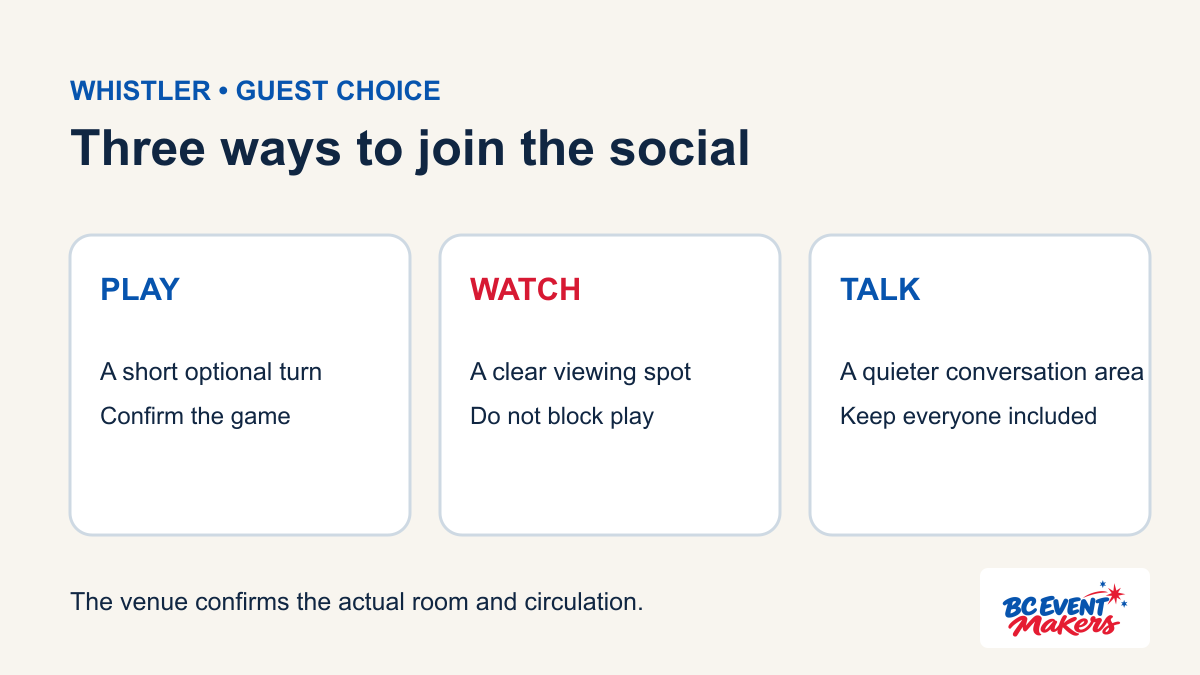
At the entrance, give guests a short choice: where they can play, where they can watch and where they can sit and talk. A repeatable welcome matters when people arrive in waves. A host can point newcomers to the activity without interrupting a game or requiring them to join one.
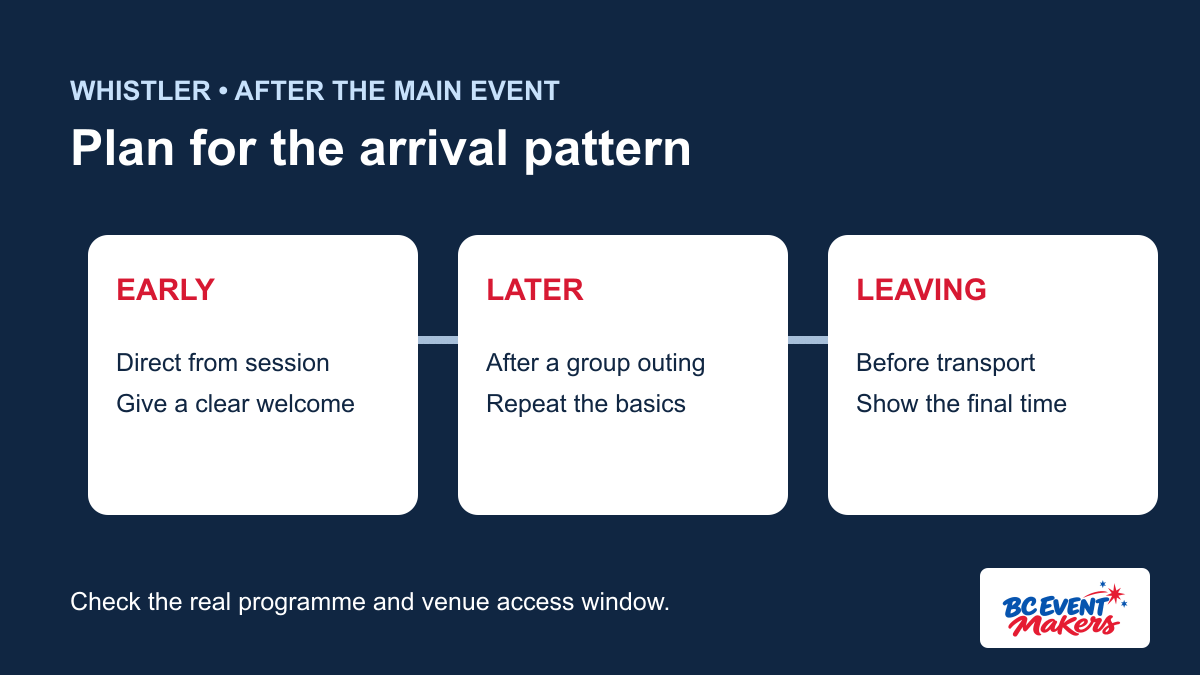
Include transport or departure in the same timeline. A group bus, shuttle or fixed venue closing time creates a real last-play point. Ask who will make the closing announcement and how the supplier will collect equipment without crossing a crowd that is still leaving. A fun party rental can be a brief feature if the window is clear; the event need not pretend it is open all evening.
2. Match the activity to guest choice
The BC Event Makers catalogue includes interactive games, giant games, casino equipment and carnival activities. Giant Connect Four and Giant Jenga can be discussion starters for a casual social. Casino tables are a different format and may need dealer staffing, guest instructions and play-chip arrangements. Ask which items are available for the date and what the exact quote includes; a broad catalogue category does not guarantee the combination.
Consider the time a guest is being asked to give. A quick optional turn can let someone join friends again. A longer game may suit a smaller group that wants to settle in. A structured team competition requires a start, rules, a person to explain them and a finish. If the main event has already been long, confirm that a second compulsory programme is actually what the group wants.
Leave a comfortable conversation area. People who do not play should still have a reason to stay at the social. Place seating so it remains connected to the gathering without being so close to a game that conversation becomes difficult. Ask the venue about noise, furniture and the routes that must remain clear.
For a casino option, describe it accurately as recreational entertainment using play chips without real-money wagering. Confirm the table list, staffing and chip handout in the written proposal. Do not assume that every casino game or activity can be offered at the Whistler venue. For giant games, check the actual footprint and whether the organiser must provide a person to keep pieces together and explain turns.
Ask the supplier what happens when a guest arrives late or prefers to watch. These questions reveal whether a proposed format can support a rolling reception. The host can use the answer to write a clear invitation: optional activities during a stated window, with conversation and seating available. Avoid promising a tournament or prize method until its rules and responsibilities are confirmed.
3. Test the shared room with the venue
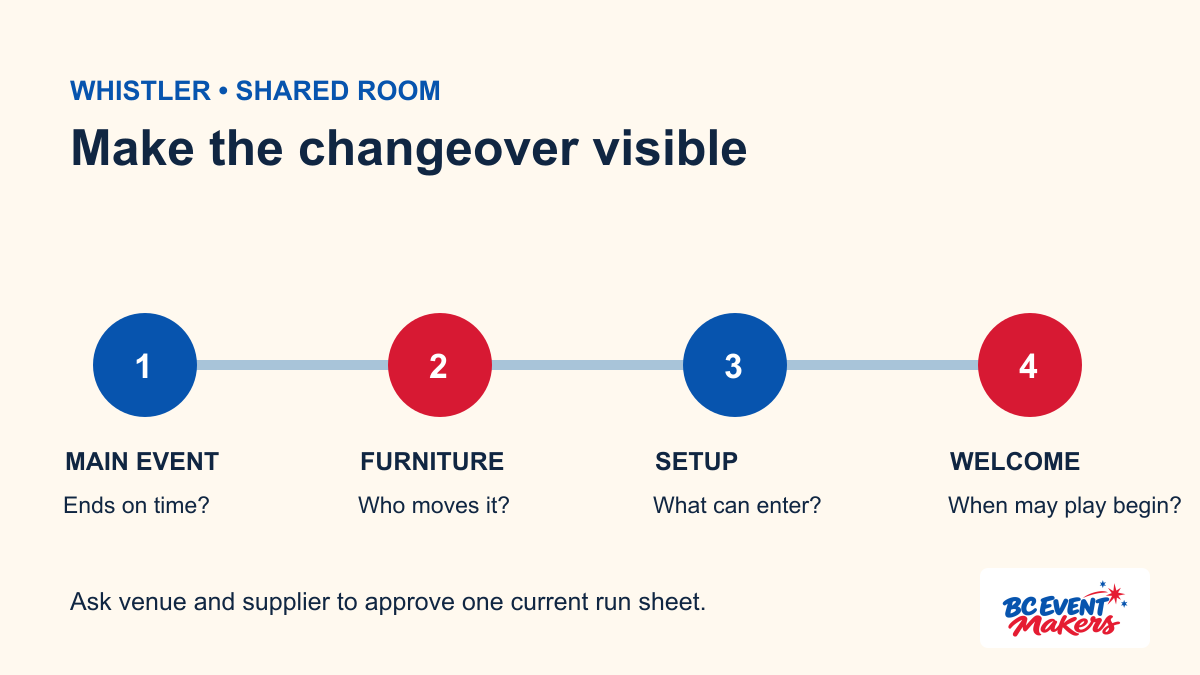
A function room may serve the conference, meal and social in sequence. Draw each use on the same room plan. Mark the entrance, accessible routes, food or drink service, seating, activity zones and the equipment route. Ask the venue which furniture it will move, what the rental team may move and when the space is released for setup.
If a dinner finishes in the room, the changeover is a real stage of the event. Someone must clear tables or create the game area; the supplier needs access; the host needs to know when guests can re-enter. A promise that games open when dinner ends may be impossible if the reset takes time. Put the handoff between dinner lead, venue contact, rental lead and host on one schedule.
Whistler venues can differ greatly in loading and room access. Send the exact address, unloading point, lift or stair route, and restrictions on arrival and collection. Ask the supplier whether the proposed equipment can travel through that route and fit the room. The venue should confirm power or other site needs for the actual item, rather than relying on a generic product picture.
Check the route from one activity to the next. A game queue should not block the way to seats, food, washrooms or an exit. A viewing area should be outside the working space of the game. The W3C event accessibility guidance recommends checking accessible venue routes and giving participants useful route information. Use that as a prompt to review the real room with the venue, including how people move from the main programme into the social.
If the planned room changes, repeat the test. A larger room may have a tighter delivery route or less suitable furniture. Send the revised drawing to the venue and supplier, and ask whether the quoted activity mix still fits. Do not treat the room change as only a guest-direction edit.
4. Confirm the Whistler proposal before announcing rentals
Whistler is beyond BC Event Makers’ usual Lower Mainland and Fraser Valley service area. Give the exact venue and date early, then ask for written confirmation of service reach, travel costs, the proposed equipment, staffing, setup and collection. If the supplier cannot confirm the location, this planning brief can still help the organiser compare a suitable provider closer to the venue.
Read the proposal line by line. Does it name each item and its quantity? Does it say who sets it up, explains it to guests, operates it and closes it? Are arrival, playing and removal windows clear? Is travel included or separately quoted? A phrase such as party rentals does not settle those details. Ask about any blank field before basing the public programme on it.
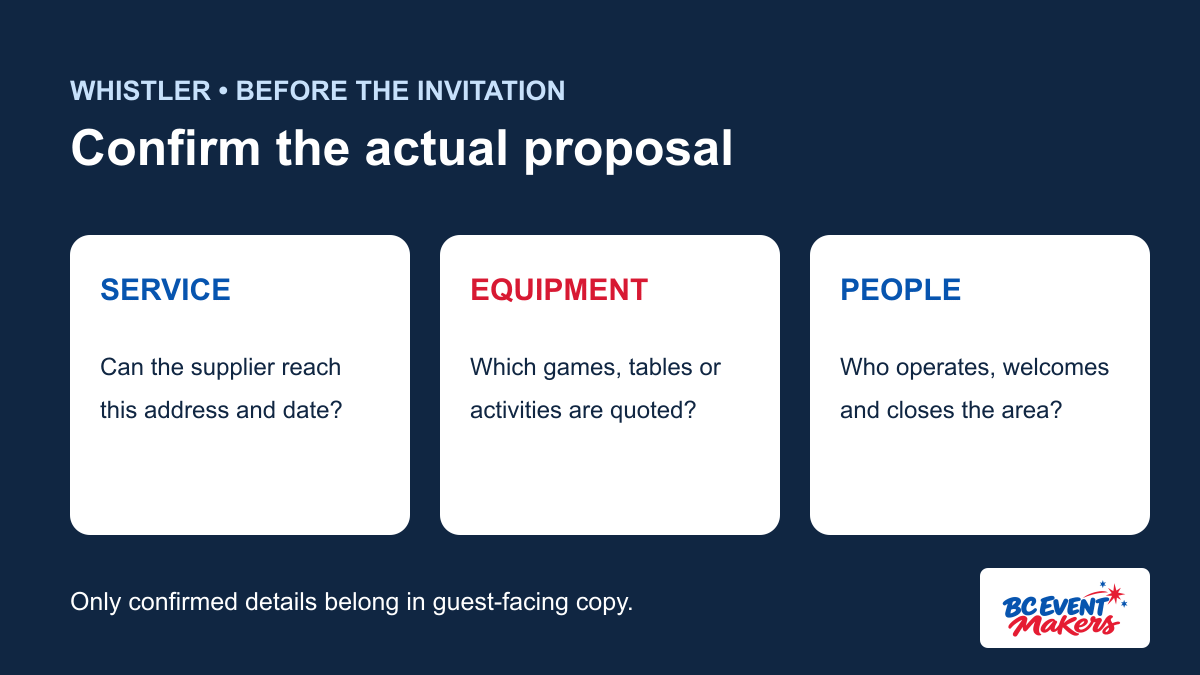
Give the venue contact the supplier’s actual equipment and access requirements. Give the supplier the venue’s actual loading and closing windows. The organiser should resolve a mismatch between those two answers before accepting the plan. A supplier can confirm equipment generally while still needing to assess travel, staffing or a particular venue.
Once the quote is accepted, compare it with the invitation. Name only confirmed games and hours. If the social is optional, say so. If there is a formal activity, provide the true start time and a way for late guests to understand whether they can join. Keep food, transport and the closing announcement consistent with the same run sheet.
Worked examples for two Whistler socials
A conference reception with rolling arrivals
Imagine an afternoon conference where some attendees stay for networking while others leave to change before the social. The organiser wants fun party rentals, but the guest flow is uncertain. A casual mix of one or two confirmed optional games may be easier to explain than a competition with a single start. The host can welcome people as they arrive, show where they may watch and keep a separate conversation area open.
Ask the venue when the conference room is released and whether the reception uses that room or a different one. If furniture must move, put the reset on the schedule. Ask the rental supplier for the exact items, footprint, delivery route and operating period. The number of games should be decided after those answers, not from an idealised empty-room diagram.
Suppose the first activity becomes busy while another remains quiet. A host can point guests toward the available option, but should not promise a particular wait or add an unquoted staff role. If people would rather talk, the seating should remain usable. The organiser can review the next event using observed guest choices instead of assuming every conference group wants the same level of play.
A team outing followed by dinner and games
Imagine a team returning from an outdoor outing, then having dinner before games. Guests may need time to sit, eat and talk. A scheduled game opening after dinner gives the venue a clearer furniture and setup window. Ask whether the supplier can enter while dinner is still in progress or must wait for the room to clear. The host should not tell guests play will begin immediately if equipment setup has not been allowed.
If the team wants casino entertainment, ask what dealer-led format, table mix and play-chip instructions are actually proposed. If it wants a simple social, giant or interactive games may be a better discussion. Neither format is automatically available in Whistler. Get the written travel and staffing decision, then use the confirmed answer to set the invitation and closing time.
When the outing returns late, the organiser may choose a shorter social or a revised meal sequence. Ask venue and supplier what can move within their actual agreements. An extra half hour of play cannot be promised simply because the group had a late start. Give guests one accurate update through the host after the responsible people confirm the change.
Compare two real proposals without losing the purpose
Suppose one proposal offers giant games with delivery and another offers a staffed casino area. Put both beside the same guest brief. The giant games may require the organiser to welcome players, explain turns and keep the pieces together. The casino area may include dealers under a defined playing window, while the organiser still handles the room, invitations and food. Ask each supplier to identify precisely what is included and what the host must provide. The lower quote alone does not say which plan will be easier to run after a full day.
Check how each proposal changes the room. Giant games need enough space for play, watching and a safe guest route; a casino table also needs dealer working space and a chip welcome. The venue should review the actual dimensions and circulation for the chosen items. If dinner occupies the same floor area, identify the furniture move and the earliest realistic setup. Do not assume that the venue can accommodate two versions of the social without a new room review.
Then compare the schedule. What time can the supplier arrive, what time can guests join, and when must the equipment leave? Ask what happens if the main programme overruns. A Whistler travel quote may depend on those access windows, so record any change before the booking is final. The organiser should choose the proposal that fits the real room and guest purpose, not the one with the longest list of possible activities.
Prepare a calm change message
Many event changes are small until they reach guests. If the room moves, the host should know the new entrance and the supplier should receive the new equipment route. If one game is replaced, the signs and invitation should name only the confirmed replacement. If play opens later, give guests an accurate time and a place to wait or talk. Put one person in charge of releasing the update so different volunteers do not give conflicting answers.
A useful update separates what is settled from what remains under review. For example: the social is still in the hotel function room, the games will open at the confirmed revised time, and the final activity list will be shared when the supplier confirms it. Do not describe an unconfirmed game as delayed or guaranteed to arrive. When a new decision is made, revise the host sheet, room plan and public message together.
After the event, note which activities people chose, whether guests found the watching and conversation areas, and whether the room reset took the planned time. Those observations can improve a future enquiry, but they do not prove that the same rentals, staff or Whistler travel arrangement will be available again. Begin each new event with the actual date, venue and programme.
Questions to settle with the team
Does a catalogue listing mean BCEM serves our Whistler date?
No. The catalogue describes items that can start a conversation. Ask for written confirmation of delivery to the precise Whistler address and date, plus travel, access, staffing and the items that will be supplied. Do not advertise the activity until the real proposal is accepted.
How many activities should we request?
Start with the guest purpose, room plan and usable playing window. Ask the supplier what can be operated within the space and time. More items may create more queues and staff needs without making the social easier. A smaller mix with seating and clear guest routes may serve the evening better.
Can guests watch instead of playing?
Plan a viewing position and a conversation area so the answer can be yes without blocking play or circulation. Tell the host how to welcome someone who wants to observe before joining. The event should feel optional unless the organiser has deliberately booked and explained a structured group activity.
Who ends the activity?
Name the host who announces the last round, the supplier contact who closes the equipment and the venue contact who receives the room. Confirm that those people share the same time and transport plan. A clear end is part of a good guest experience, especially after a long main event.
Give the host one current handoff sheet
The final sheet should show the Whistler venue and room, supplier contact, confirmed activities, arrival and playing windows, welcome wording, optional watching route, conversation space, room reset, food service, transport and collection. Mark who owns each handoff. Keep unresolved items labelled as questions, not public commitments.
Before printing signs or sending the invitation, compare the sheet with the written supplier proposal and venue plan. If an activity or time changes, update all three together. Remove photographs of equipment no longer proposed. A guest should be able to read the final message and know where to go, what is optional and when the social ends.
For an enquiry, share the actual date, Whistler address, group size, arrival pattern, room access, desired activity style and latest finish. Browse the current rental catalogue, then send the event outline and ask what can genuinely be offered for that venue. Keep the answer in writing before the organiser makes a promise to guests.