
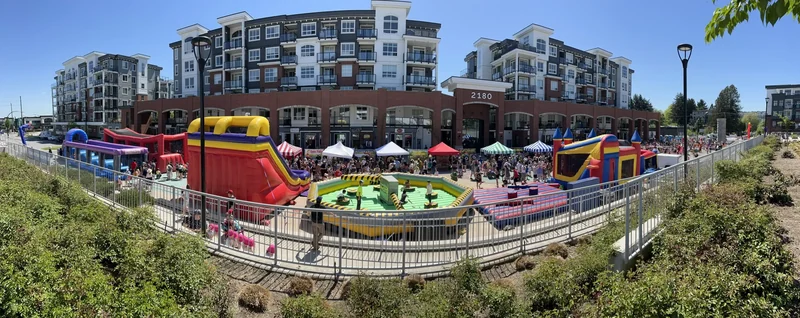
An event rental enquiry can start before every detail is settled. You do not need every detail settled before contacting an event supplier. A few practical details help the team ask better questions and suggest a useful next step.
Event rental enquiry: the seven details to start with
- Date: include any flexibility if you are still choosing.
- Location: name the venue or the community you are considering.
- Event hours: distinguish guest arrival from the time activities should be ready.
- Audience: give an approximate guest count and relevant age groups.
- Space: describe indoors or outdoors, the surface and any known access restrictions.
- Activities: list favourites, or describe the experience you want help creating.
- Budget: share a working range if you have one, and explain what it needs to cover.
Turn the seven details into one clear message
Here is a fictional starting brief: “We are planning a school celebration in Burnaby on a Friday in June. Guests arrive at 4 p.m.; we would like activities ready before then and expect roughly 120 people, mostly families with primary-school children. The event is outdoors on a paved courtyard. We are interested in two games and one inflatable, subject to the site rules. We can share a loading route and power plan after a venue walk-through. Our working budget is for equipment, delivery and any staffing needed; please tell us what each option includes.”
The example gives the rental team a basis for questions without pretending the item choice, site fit or price is settled. If the venue changes, reply with the revised access, surface, dimensions and power information instead of simply forwarding a new address. A short note about what is unknown is more useful than a confident guess.
Ask what is included
Equipment hire is only one part of the conversation. Depending on the event, you may also need to discuss delivery, setup, power, staffing and collection. Ask the team to explain the line items in your quote.
How do we compare a bouncy castle, carnival games and a mechanical ride?
Compare quotes for the same guest-use hours and service scope. The lowest listed item price may leave out services your event needs.
- Bouncy castles: shortlist the exact inflatable, then confirm its operating footprint, access, power and participant limits.
- Carnival games: list each station, who will run it, how guests will rotate and whether you plan prizes. Allow for playing space and queues.
- Mechanical rides: identify the selected ride and confirm operator responsibilities, access, setup and collection windows.
For every option, check which delivery, setup, staffing, collection and applicable charges are included in the written total. Our rental planning FAQs cover cost, space and setup questions.
Can we combine attractions in one event enquiry?
Yes. Send one shortlist with your overall budget, guest ages and venue plan so we can discuss how the activities fit together. For example, a company event might combine full-service casino tables with other activities. Availability, staffing and the final combination are confirmed in your quote; combining items does not automatically mean a package discount.
Say what is still undecided
It is useful to say that your venue is not final or your guest count is an estimate. Those details can affect suitability and availability. Update the team when the plan changes.
If you are considering a City of Burnaby facility, review the City of Burnaby venue rental information for that venue and pass its access and setup conditions into the enquiry. Other venues have their own rules; confirm them with the venue directly.
Use this event rental enquiry checklist to fill the gaps
Think of an enquiry as a shared starting brief. It should help the supplier ask a focused question and help you compare possible approaches. It is not a booking, a site approval or an assurance that a particular item is available. Use this event rental enquiry checklist to separate what you know from what you would like help deciding.

Date and event window
Give the event date or a small range of dates you could consider. If the time is flexible, say what parts may move: guest arrival, activity start, wrap-up or the supplier’s access window. These are different times. A supplier may need to arrive before guests enter and may need the room after the final activity to collect equipment. Your enquiry can state what the venue has confirmed and what is still under discussion.
If you are asking for alternatives, name the first choice and the backups. It gives the team a concrete basis to check without suggesting that all options are being held. If a date later changes, send the new date and ask for a fresh availability check. Do not assume the first answer or price automatically transfers to another date.
Location and site access
Include the venue name and complete address when you have them. If the venue is not chosen, name the community or area and explain that the site is pending. Add the room, field or setup area if known. Mention stairs, loading doors, lifts, long routes, parking or access hours only when you know the facts; mark guesses as questions. The supplier can then tell you which details are needed to review a particular rental option.
A short site description can be more useful than an unlabeled folder of photographs. Say indoors or outdoors, the known surface, approximate usable area if the venue has confirmed it, ceiling constraints where relevant, and whether there is a plan for power. Do not estimate technical suitability. Ask the venue and provider to confirm the details that depend on their rules and the chosen item.
Audience and activity goals
An approximate guest count and relevant age range help describe the experience you want. Include whether guests arrive all at once or across a longer window, and whether people will be moving between stations. Avoid sharing names or personal guest details that are not needed for a rental discussion. If you do not know the final attendance, label it an estimate and say when you expect to update it.
Describe the result you want, not only a catalogue list. “We want casual activities people can join between speeches” gives the team a different planning question from “we need a short centre-stage feature.” List any must-have item separately from ideas you are open to changing. If you already have candidate rentals, link or name each one and ask which information would help assess them.
Budget and inclusions
If you have a budget range, explain what you expect it to cover. Is the working figure only for equipment, or should you use it to discuss delivery, setup, staffing and collection too? You can ask for itemized options that show the scope of each approach. If you do not yet have a number, ask what factors influence a suitable range; there is no need to invent one.
When a quote arrives, compare like with like. Check the event date, guest-use hours, item list, delivery and setup details, staffing responsibilities if any, collection window and stated total. Ask what is excluded or still subject to confirmation. A lower line item may describe a different service scope, so request clarification before deciding which quote is comparable.
Turn a broad idea into a useful comparison
When you are unsure which activity fits, give the team two or three different outcomes to consider rather than asking for an unlimited catalogue. A rental quote request can say that a choice is open, then list the constraint it must satisfy: indoor space, short setup window, quiet conversation, active play or a mix. The final recommendation still depends on the actual venue and item details.

| Planning question | What to include | What to ask |
|---|---|---|
| How should guests take part? | Drop-in, scheduled, hosted, self-directed, or a mix | What staffing or instructions are included? |
| What can the site support? | Indoor/outdoor, surface, access route and confirmed area | Which measurements or permissions are still needed? |
| When can the team access? | Guest hours and any venue-approved setup window | What setup or collection timing is included? |
| What does the price include? | Working budget and desired service scope | Which quote lines are confirmed or conditional? |
Use the table to keep your event details consistent across every option. If two quotes use different event hours, item choices or staffing assumptions, clarify those differences before comparing the totals. Ask the provider to identify the exact item names and whether the selected date is available before planning around them.
Three example enquiries for different events
These examples are fictional. They show how a useful brief changes with the event, without presenting any item, venue, budget or arrangement as a real BC Event Makers booking.
School celebration with a site still being chosen
“We are planning a school celebration in June and are comparing a field with a gym. We expect roughly 120 guests, mostly families with primary-school children. We are interested in a mix of active and watchable games, with one inflatable as a possibility. The venue, surface and access route are not confirmed yet. Could you tell us which details you need to assess those options and what the site must approve? Please show what delivery, setup, staffing and collection would include in each suitable quote.”
This enquiry says what is known and exposes the indoor/outdoor question early. It asks for help with fit instead of implying that one item works in both spaces.
Company gathering with a fixed schedule
“Our staff event is on [date] at [venue and room]. Guest access is 6–9 p.m., and the venue has offered supplier access from [confirmed time]. We expect about [estimate] guests. We want one casual drop-in activity and one sound-led moment after dinner. The venue contact is checking sound and loading rules. Our budget range is [range] for [scope]. Can you outline options and show which service details remain subject to venue confirmation?”
Here the schedule and venue access are separated. A quotation can then explain whether the desired sequence is feasible and what might change when the venue answers.
Community event with several possible activities
“We are organising a community open house on [date] at [address]. Visitors will arrive across three hours, and the guest count is still an estimate. We want activities suitable for mixed ages, with clear space for people to move through the room. Attached is the venue-approved plan; the marked area is approximate pending final measurement. Please suggest a small shortlist and tell us what each option needs for space, access, staffing and cost.”
This message gives the supplier a useful purpose and a site reference, while leaving the unknown measurement open instead of converting it into a guarantee.
Make the follow-up easy to answer
After the first reply, group your questions by decision. If you need an item comparison, ask for the options and their scope together. If site fit is the main uncertainty, ask what dimensions, route details or permissions are needed. If the price is unclear, point to the relevant line and ask whether it includes delivery, setup, operation or collection. A focused follow-up is easier to resolve than a new message that combines unrelated questions.
Keep one current set of event details. If something changes, name the field that changed, state what remains the same and ask whether the existing quote must be revised. For example: “The date and guest hours are unchanged; the venue has moved from the field to the gym. The floor, loading route and ceiling are still being confirmed. Could you review the item suitability and let us know which quote details need to change?” That kind of event update prevents a new address from being mistaken for confirmation of the old setup.

For a municipal space, use the venue’s own current rental page and contact to confirm access and room conditions. For instance, the City of Burnaby venue rental information links to different facility pages. The chosen facility’s details are the relevant ones; do not apply another room’s timing, capacity or conditions to your event.
Keep replies, the latest event rental quote and the current plan together. If several versions exist, label the latest one with its date and note which earlier version it replaces. Before you invite guests or treat the plan as final, confirm the item, date, service scope, venue rules and any remaining conditions in writing.
Fill in the enquiry worksheet before you press send
Use this worksheet when several people are contributing to the event rental enquiry. One person can gather the details while another checks the venue information. If the answer is not known, write “pending” and name who will confirm it. A good rental enquiry checklist makes missing information visible without pretending the plan is complete.
| Field | Write the current information | Source or owner |
|---|---|---|
| Event date and guest hours | [date / flexible alternatives / arrival and activity hours] | [organiser / venue] |
| Venue and setup point | [name / address / room, field or pending choice] | [venue contact] |
| Guest count and audience | [estimate / age groups that affect activities] | [organiser / registration estimate] |
| Access and surface | [loading door / route / indoor-outdoor / known floor] | [venue plan / site walk] |
| Activity goal | [must-have / ideas / open to alternatives] | [organiser or planning group] |
| Working budget | [range / scope it should cover / not set yet] | [event approver] |
| Open questions | [what still needs a specific answer] | [person who will check] |
Review the event details together before you send an event rental enquiry or ask for a quote. If one person has the date and another has the venue rules, note the source instead of blending both into an unqualified statement. The guest count can be a range at the enquiry stage; label it clearly and update it when the organiser has a better estimate. A working budget can also be provisional, as long as you say whether it includes delivery, setup, staffing or other service lines.
If your guest count is not available, explain what is known about the audience and when you may be able to revise the estimate. If the venue is undecided, provide the community or type of space and list the access facts that matter most. If the working budget is not approved, ask for a few scoped options so you can discuss them internally; do not imply that a tentative number authorizes a booking. The rental enquiry checklist is most useful when every open field has either a next step or a clear reason it is still pending.
Before and after: make a vague enquiry actionable
Vague: “We need games for a school event. What do you have?”
More useful: “We are planning a school event in Burnaby on [date], with an estimated [guest count] guests, mostly families. The event will run [guest hours]. The venue is [name or pending], and the event details we have confirmed are [facts]. We want [experience] and are open to [alternatives]. Our working budget is [range or pending] for [scope]. Which additional site information do you need before comparing suitable options, and what does each quote include?”
The second example does not require the organiser to decide every item. It gives the team the event purpose, known conditions and remaining questions in one place. Keep this message consistent with any plan attached to the enquiry. If a photo or diagram is only a draft, label it. If the event details change, send the changed field and explain whether the other information remains current.
Use the same event rental enquiry record when comparing responses. Put each option on its own line; note the named item, requested date, guest-use window, delivery and setup scope, staffing, collection, total and conditions. Leave blank any item that the provider has not answered. Ask a direct question rather than filling the gap with an assumption.
If a quote includes alternatives, write down why each is being considered: indoor fit, simpler guest flow, sound level, shorter schedule or a different budget scope. That keeps your choice tied to the event instead of a generic ranking. Keep your original event rental enquiry nearby so each new option can be compared against the same date, audience and venue facts.
Before confirming
Review the equipment, inclusions, responsibilities, timing and booking terms in writing. Check that your event contact and venue understand the same plan. Availability and a completed enquiry should not be treated as a booking confirmation.
Start your BC Event Makers enquiry with the details you have, or talk to our team if you would like help choosing a starting point.
248 container 249 container wp-word-count 250 248 container 249 container wp-word-count 250 248 container 249 container wp-word-count 250