
A birthday party in a Burnaby hall can give guests room for games and a place to gather around the cake. It also comes with fixed access times and rules about how the room can be used. Choose activities after you understand those conditions so the entertainment fits the booking.
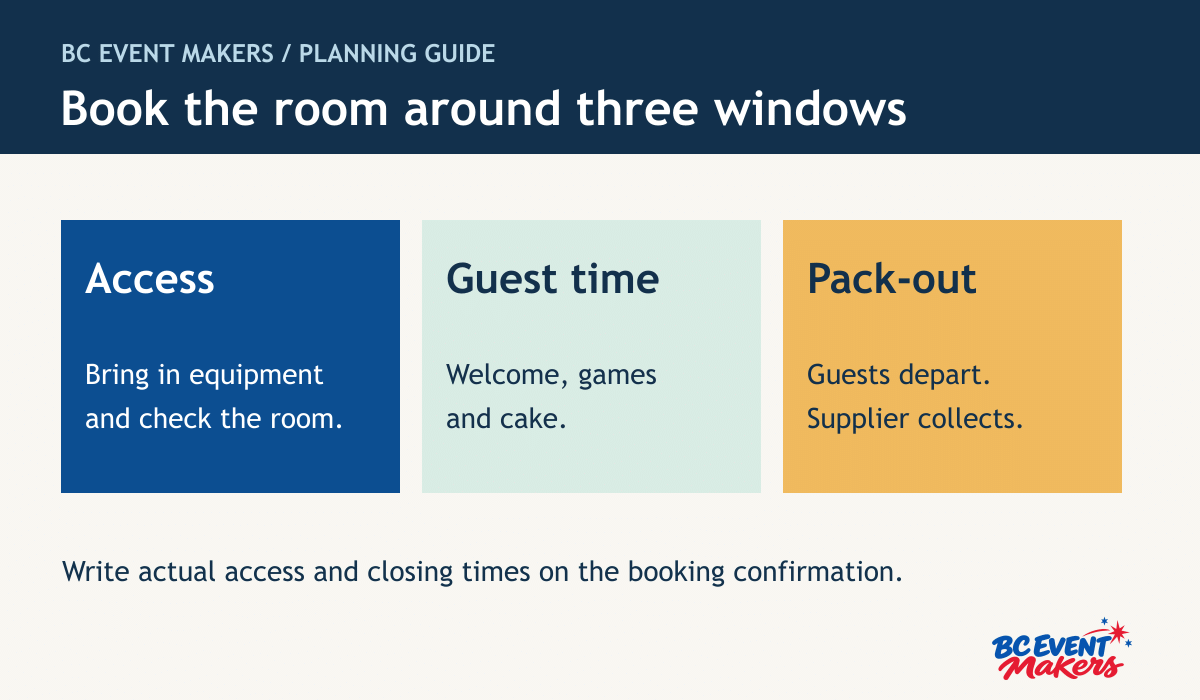
Ask the venue when equipment can arrive, when guests may enter and when everything must be removed. Keep those times separate on your plan. A room booked until the end of the party may leave no time for packing unless you have arranged a later collection window.
1. Choose birthday party activities for the ages coming
Choose a main activity that suits the person you are celebrating, then think about the rest of the group. Older siblings and younger cousins may need different options. Ask about suitability for the actual ages attending and the requirements of each item rather than assuming that all birthday rentals suit everyone.
The BC Event Makers rental collection offers inflatables alongside games and other entertainment. Giant Connect Four or Giant Jenga may be worth considering for a casual games area. For an inflatable, discuss the room and the equipment with the supplier before adding it to the plan.

2. Measure the room’s usable space
Provide the supplier with the room dimensions and ceiling height, along with details of hanging fixtures or other overhead obstructions. Ask for the full space requirements for each proposed activity, including access and the operating area. Confirm the surface and electrical arrangements with the venue.
Draw the cake table and guest seating on the same sketch as the games. Leave clear routes to exits and washrooms. If an activity attracts spectators, include their space too. A room can hold the equipment while still leaving too little room for the party around it.
For a concrete example, the City explains that setup and takedown count toward booked time at Wesburn Community Centre. That matters if a supplier needs the room before the first guest arrives. Ask the hall you actually book to confirm its own conditions and the specific activities it permits.
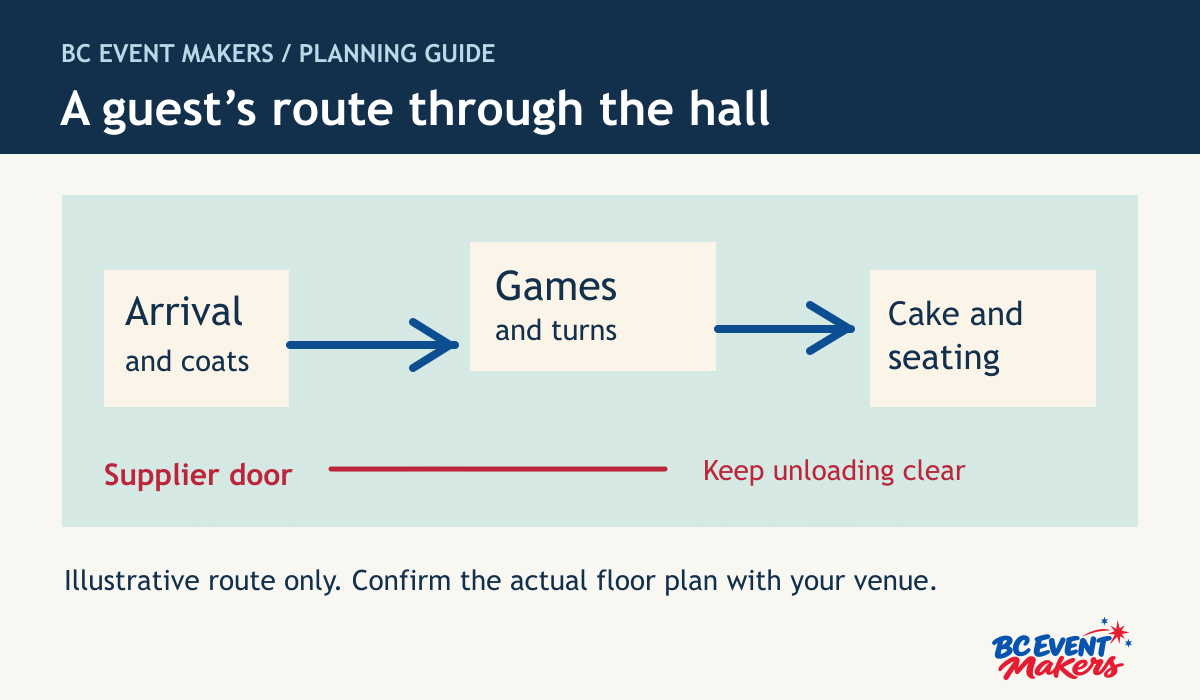
3. Build a relaxed birthday party sequence
Use an easy arrival activity while everyone gets settled. Give the main entertainment a clear place in the schedule, then allow time for refreshments and cake. Avoid stopping an activity halfway through every time another task comes up; ask how sessions or turns should be organised for the equipment you choose.
Keep a quieter place available for guests who want a pause. It can be part of the seating area, provided people can use it without crossing through active games. Participation should feel like an invitation, and guests should have something comfortable to do when they sit out.
Try writing the schedule from the guest’s point of view. On arrival, can a child join something without waiting for the whole group? At cake time, is there a place to put a drink down without crossing the game area? Near the end, can families collect coats without blocking the supplier’s route back to the door?
4. Assign the handoffs
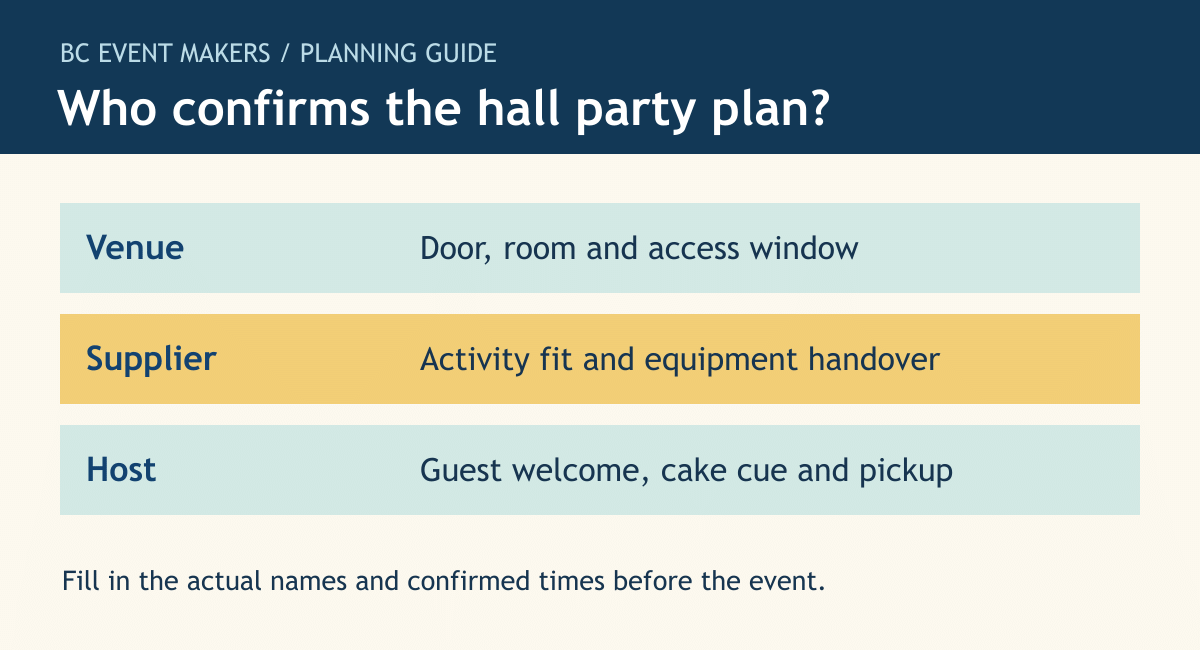
Confirm who sets up the equipment and who supervises each activity. Ask what your own helpers will need to do and who they should contact if a concern arises. Include cleanup duties and collection access in the plan.
When requesting a quote, send the Burnaby venue address, room information and guest ages. A photo of the empty room and a simple sketch can make the activity discussion much more useful.
A birthday party enquiry you can send to the hall
“We are planning birthday activities for [guest ages] on [date]. We would like to use [activity] in [room]. Can you confirm the usable dimensions, any restrictions, when our supplier can enter, and the latest time equipment must leave?”
Keep the reply with the room sketch and supplier quote. If the hall changes, return to the questions about access, power and floor space. Two rooms with the same guest capacity can work quite differently for the same birthday activities.
What if someone arrives halfway through?
A birthday party often starts more than once: some families arrive together, while another child joins after the first game. Give one helper the welcome job. They can point out where coats go, tell the guest what is happening now and introduce them to someone who is already playing.
If the room booking changes, give the supplier the new information before making promises to guests. An activity that fit the original hall may need a different setup in the replacement room. Ask the venue and supplier to confirm the plan for this birthday party rather than carrying the old approval over by assumption.
A birthday party hall workbook you can take to the venue
Take this section on a walk-through or use it when the hall sends you its floor plan. The sample timings are an exercise for the host, not a promise about a Burnaby venue or a supplier. Replace each example with the terms of the actual booking. The aim is to discover the awkward handoff while it is still a pencil mark on a plan.
Start with the part of the booking guests never see
Draw three windows on your page. The first is when someone can unlock the room for the supplier. The second is the time printed on the birthday party invitation. The third is the period between the final guest leaving and the point when the venue needs the room back. If the second window touches both edges of the booking, the supplier has no confirmed time to set up or collect.
Here is an illustrative example. A family wants guests to arrive at two and leave at four. That does not tell the supplier that the room is available at one or at half past four. Ask the venue what access the contract actually includes. Then ask the supplier whether its setup and collection fit those windows. If they do not, change the room booking, simplify the activity or revise the guest times before invitations go out.
| Handoff | Time | Who verifies it? | Question to resolve |
|---|---|---|---|
| Room opens for setup | [time] | Venue contact | Who unlocks the supplier entrance? |
| Equipment is ready | [time] | Equipment provider | Who receives instructions? |
| First guest arrives | [time] | Party host | Where do coats and gifts go? |
| Main activity pauses | [time] | Host and activity lead | How will children hear the cake cue? |
| Final guest leaves | [time] | Host | Is collection access clear? |
| Room is handed back | [time] | Venue and closing helper | What must be removed or cleaned first? |
Example one: young cousins, older siblings and one main game
Imagine a birthday party where the guest of honour wants an active game, but some relatives would rather watch or talk. Start with the main activity and its actual suitability requirements. Then add one quieter option beside the seats. A successful layout lets a child move between those experiences without cutting across the active play space.
Try the plan at arrival. An older sibling may be ready to play as soon as they come through the door. A younger child may need a familiar adult and a few minutes to look around. Choose a place where the host can welcome both without standing inside a game. Ask the supplier how guests join, how turns work and where watching adults should stand for the specific item.
At cake time, decide who gives the cue. If the host is carrying food, someone else needs to close the current turn and guide guests to the table. Agree what happens to a child already taking a turn. The point of the birthday party schedule is to avoid making an abrupt stop feel like a mistake on the guest’s part.
Example two: a booked hall that looks large in photographs
A photograph often shows the room from its widest angle. It rarely tells you how much space is left after seating, a cake table, gifts and a waiting area go in. Draw those pieces first. Then put the proposed activity on the same sketch, including the operator’s space and any requirements the supplier gives you.
Walk the route from the public entrance to the game and from the game to the washroom. Now walk from the supplier entrance to the setup position. A door that looks convenient on a plan may be locked during the rental, shared with another group or unsuitable for the equipment. Get the venue’s answer before deciding which entrance to use in the supplier brief.
If the room still looks generous, test the busiest moment. A family standing to greet friends, two children waiting for a turn and an adult carrying a tray can use the same apparently empty space. Keep a distinction between room capacity and activity suitability. A venue may know how many people a room accommodates, while the supplier must confirm whether its actual item works in the layout.
Example three: a late arrival when the main game is underway
Give one helper the welcome job for the full arrival period, not just the first five minutes. The helper can point out the coat area, explain what the group is doing and introduce the guest to someone who can help them join. A late arrival should not have to cross an active game to locate a parent or ask where to begin.
Choose the message in advance. For example: “They’re finishing a turn now. You can watch beside me, and we’ll ask the activity lead how to join the next one.” That leaves the supplier’s rules with the person responsible for the activity and gives the guest an immediate, friendly next step.
Repeat the exercise for an early pickup. Where does the collecting adult wait? Who makes sure a child can leave the group without walking through a busy play area? Coordinate any family-specific arrangements with the host. The party invitation only needs the actual access and pickup information once the venue has confirmed it.
Compare two activity proposals on the same terms
A familiar tabletop game and an inflatable are not interchangeable simply because both appear in a rental catalogue. Compare what each one asks of the room and the team. The inflatable may need height and access information that a smaller game does not. A quieter game can still require enough space around it for people to take turns without blocking a doorway.
| Question | Option A | Option B |
|---|---|---|
| Which guests is it suitable for? | [supplier answer] | [supplier answer] |
| What room, access and operating space does it need? | [confirmed requirements] | [confirmed requirements] |
| Who sets it up and handles guest participation? | [named role] | [named role] |
| Where will guests wait or watch? | [sketch position] | [sketch position] |
| When must it arrive and leave? | [agreed windows] | [agreed windows] |
Leave blanks in the table until the right person answers them. If only one option will fit the confirmed access window, you have learned something more useful than which one looked best in a picture. If both fit, ask the guest of honour which experience they want. It is still their birthday party.
Make the host’s handover one paragraph
“[Name] opens the room at [confirmed time] and meets [supplier]. Guests enter through [confirmed door]. Coats and gifts go at [place]. The main game starts after [cue]. [Name] invites guests to cake, and [name] covers the entrance for later arrivals. Equipment collection starts at [time], and the room must be clear by [time].”
Read the paragraph to a helper who did not attend the walk-through. If they ask which door, which room or which person, that is a useful edit to the note. Mark the answer on the sketch as well. Give the supplier the parts that affect equipment access, and give the venue contact the plan that affects room use and handback.
What to do if the venue changes the room
Keep the previous plan so you can see what needs checking. Start with the new room dimensions, ceiling and fixtures, the equipment entrance and the times it is actually available. Ask whether the revised room has different restrictions. Send the new information to the supplier and wait for confirmation that the selected activity still works there.
Then walk the guest experience again: where to enter, where to gather, where to wait and where cake happens. Update the invitation directions only after the venue confirms them. If the original activity no longer fits, ask for an alternative that meets the revised brief rather than trying to squeeze it into the old schedule.
A closing question for the planning meeting
Ask the host, venue contact and supplier the same question: “At the busiest point, who needs this particular space and what are they carrying?” The answer can reveal a collision between a guest arriving with gifts, a helper serving cake and someone moving equipment. Adjusting one table or handoff on paper may solve it. Confirm the final positions with the people responsible before treating the sketch as the party plan.
File the confirmed room sketch, equipment quote and timing sheet together. When a helper asks for the birthday party schedule on the day, send the version with the actual door, room and contact names, not an earlier drawing. A simple plan that everyone can use is worth more than a polished one with unresolved blanks.
Decide what guests actually need to know
Your full supplier checklist does not belong in a birthday invitation. Guests need the confirmed venue, the correct entrance, arrival and pickup times, and anything the host wants them to bring. If a game has participation requirements, ask the supplier what information the host should communicate. Keep the detailed setup route with the people receiving the equipment.
Before sending the note, give it to someone who has not visited the hall. Can they identify the right door from the street or lobby? Would they know whom to contact if they arrive after the opening activity? Replace a vague direction such as “come to the usual room” with the actual room name that the venue uses. Clear directions make a better welcome and reduce the number of calls the host has to answer while greeting the first guests.
A short backup plan for a missing helper
If the person assigned to welcome guests is delayed, decide who takes over the entrance without leaving an activity or equipment duty uncovered. If the cake helper is absent, ask which part of the schedule can move rather than stopping a game without warning. A backup plan is most useful when it identifies one person who can make that call and a straightforward message for everyone else.
Keep the revised handover with the original room confirmation. Mark who received the change, particularly if it affects the supplier’s access or the venue’s closing time. A birthday party can feel relaxed to guests even when the host has had to rearrange something, provided the people doing the work all have the same version.