
Booking a water slide in Mission? Start at the gate, not at the tap. A lawn can look big enough in a photograph and still be a poor choice if the equipment cannot reach it, the venue does not allow water, or everyone leaving the slide has to cross the lunch line.
Open the worked examples and planning sheet
Before you pick a model, work through five decisions: how it gets in, where the water goes, how guests move, who is responsible and what happens if plans change. At the end there’s a sample enquiry you can adapt.
1. Can a water slide in Mission get from the vehicle to your chosen spot?
Walk the route someone making a delivery would actually take. Start where the vehicle can stop and finish where you want the activity. A photograph taken from a patio usually leaves out the narrowest part of that journey: the side gate, a step or the turn between two fences.
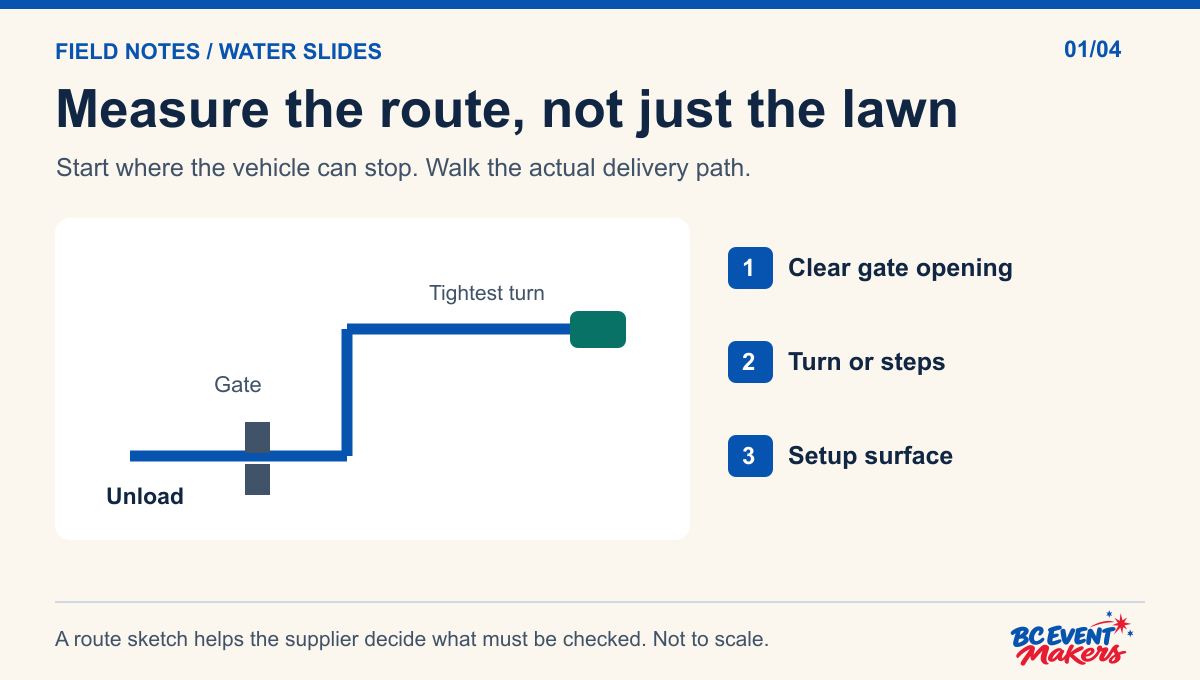
Measure the clear opening with the gate open. Tell us which measurement is yours and what still needs checking. A useful note reads, “The gate opens inward, there’s a turn immediately after it, and I’ve attached a photo facing each direction.” That gives the team something to assess. “Normal garden gate” doesn’t.
Do the same for the setup spot. Show the surface, anything overhead and the space that will remain after tables, tents or parked vehicles arrive. Don’t use an attraction’s catalogue footprint as the operating clearance. Ask us to confirm what the particular unit needs. Leave the equipment choice open if the site has not been reviewed.
2. Has the venue approved water, and where can it go?
A tap tells you that water is present. It doesn’t tell you who has a key, whether you can use it for the event or where runoff is allowed. Get those answers from the person responsible for the property. If that person will not be on site, ask who can open the agreed connection during the delivery window.
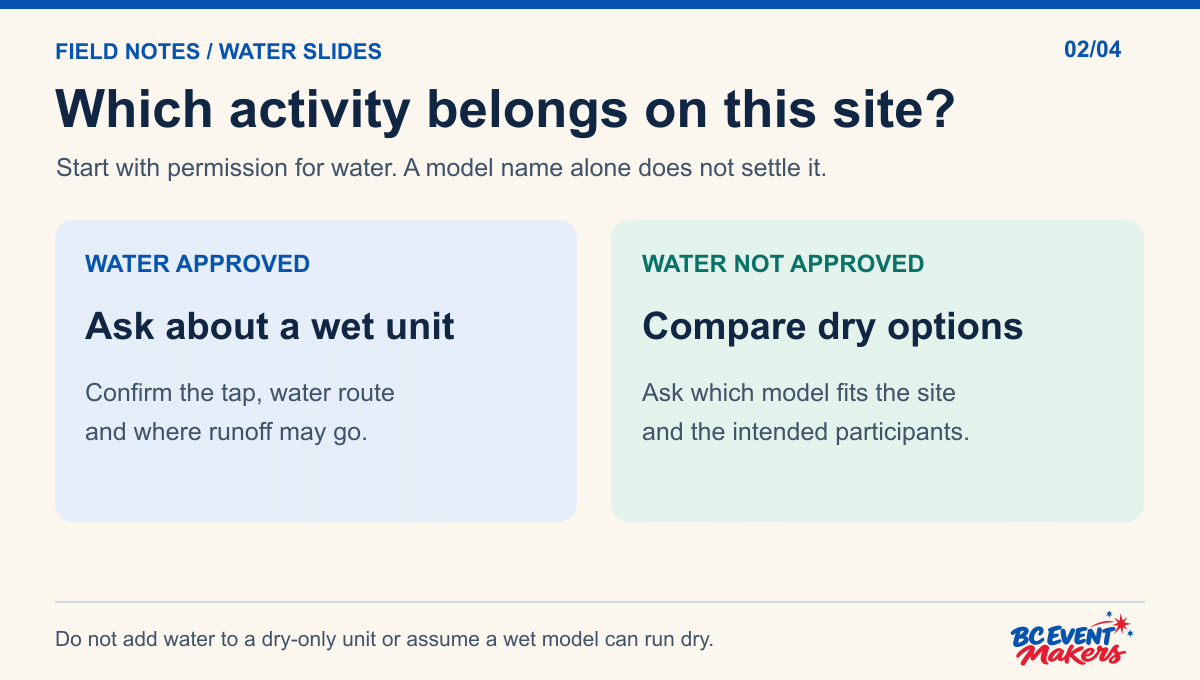
For a public venue, start with the City of Mission’s facilities and booking information. Describe the equipment and water use when you ask about the space. For a school or rented hall, contact the administrator for that property. A room or shelter reservation on its own doesn’t answer the equipment question.
Choosing between activities? The Mission water-slide collection is a starting point for comparing a wet slide and a Slip and Slide. They create different guest routes. If water isn’t approved, ask about an explicitly dry option such as the Giant 18 Foot Dry Slide. Never add a hose to an inflatable simply because it has a slide.
3. Where will wet guests go after their turn?
Walk from the proposed slide exit to the towels. Then walk from guest seating to the food table and washrooms. If both trips pass through the same narrow opening, you’ve found a layout problem before anyone gets wet. Move the towels, food or seats on the sketch and trace both routes again. Ask the operator to confirm the final arrangement.
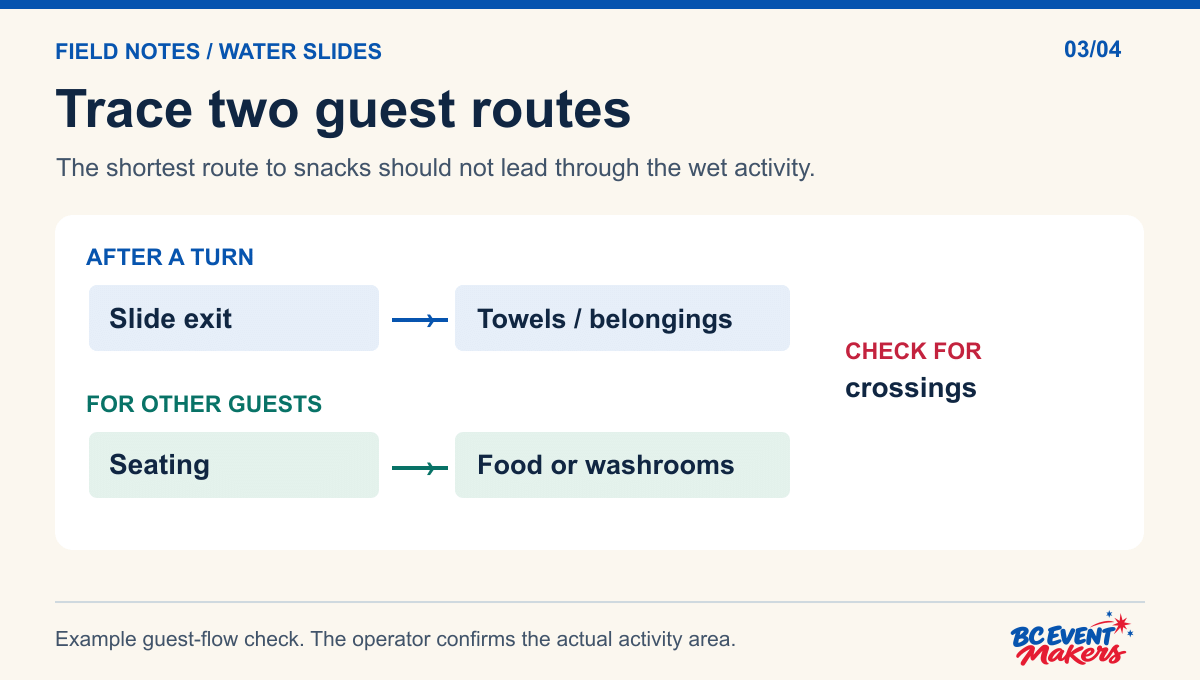
Imagine a backyard party with the slide behind the house and lunch in the garage. Putting the towel table by the garage might send every wet participant through the lunch queue. Moving the towels to an agreed spot nearer the activity could leave the route to lunch dry. That’s an example to discuss, not a universal placement rule.
Plan for the people who won’t take a turn, too. Where can a grandparent watch without standing at the exit? Can a guest move between the seating and washrooms without having to cross a queue or step over equipment? If the only clear route is already occupied, changing the layout is a better answer than asking guests to squeeze past.
4. Who is supervising and who can make a decision?
Participant instructions belong to the chosen unit. Share the ages you expect and ask about suitability, limits and supervision for that model. Do not copy rules from a slide you rented last year. A family booking and a school event can have very different arrival patterns even when the guest totals look similar.
Before the event, write down three roles: the person who can grant access to the site, the person responsible for operating or supervising the activity under the agreement, and the host contact who can move a queue or change the programme. One person might cover more than one role. What matters is that everyone knows which decisions belong to them.
For a school or community gathering, tell the supplier if an entire class will arrive at once. The total headcount alone doesn’t reveal that rush. Ask how to organise the waiting area and what guests should do if the activity pauses. An announcement that names an alternative activity is more useful than promising a restart time you don’t have.
5. What will guests do if the slide cannot operate?
Before booking a water slide in Mission, ask about the weather decision for the selected equipment, when you will discuss it and which written change or cancellation terms apply. A dry alternative may need a different layout and may not be available at short notice. Don’t announce a substitute until both the supplier and the venue have confirmed it.
Write two versions of the invitation note. For the planned programme: “Bring a towel and a change of clothes if you’re taking a turn.” For the fallback: “We’re switching to our dry activities; the start time is unchanged.” Update that second sentence if the time or location really does change. It gives your host one clear message to send instead of several speculative updates.
A backyard access workbook for a water slide in Mission
Start with the awkward part of the delivery route
At a backyard party, the most useful first photograph may be the side gate. A wide lawn does not tell the supplier how a water slide would reach it. Walk the delivery route from the place a vehicle can stop and identify the point that seems hardest to navigate. Photograph the approach to that point and the view looking back out.
Ask the property contact which route is approved and when it can be used. A shared driveway, parked vehicle or neighbour’s gate can make the real route different from the route shown in an old photograph. If a measurement is requested, identify who took it and what opening it describes. The supplier still decides what further information is needed for the actual equipment.
Write the address, date, access window and guest hours beside the pictures. A supplier considering a water slide in Mission needs to know which facts apply to this event. A photograph from last summer may show the same lawn before a new fence, deck, planter or tree branch changed the approach. Date the image set you want the team to review.
Compare two positions for your water slide
Position A might be closer to the water supply and farther from the guest entrance. Position B might offer an easier delivery route while sending wet guests back through the food area. Compare the whole visit and the supplier access rather than selecting whichever photograph looks tidier.
| Question | What to record for each proposed position | Who confirms the answer? |
|---|---|---|
| Delivery route | Entrance, narrowest turn, surface and access hours. | Supplier and property contact for their respective decisions. |
| Water supply | Approved source, who can provide access and where it sits on the drawing. | Property contact and supplier for the selected unit. |
| Guest route | Where people wait, leave belongings and return after a turn. | Host, venue or property contact and supplier. |
| Neighbouring use | Food, seating, washrooms, other activities and shared paths. | The people responsible for those spaces. |
| Change decision | The confirmed contact and what happens if the preferred site cannot be used. | Host, property contact and supplier under the actual agreement. |
Keep a question open if it has not been answered. A clear “water supply access awaiting the property contact” gives the organiser a task. An assumed answer can travel from a text message to an invitation before anyone realises the setup still depends on it.
Example. The neighbour offers another gate
The host realises that the side gate has a difficult turn. A neighbour offers access through a wider opening. Thank them and ask what permission would be needed for the exact route and timing. Send the proposed route and relevant property information to the supplier for review. Do not direct the team across another property because a person casually suggested it might be easier.
If the alternative can be agreed, record the approved route, the person who can provide access and the collection arrangement. Tell the host contact which entrance to use when meeting the supplier. Keep the public invitation focused on the guest entrance so families are not sent down a temporary delivery route.
If the new route cannot be confirmed, ask about equipment or another programme suited to the access you actually have. A water slide in Mission should be selected around the reviewed site. A change in the plan can preserve the party while avoiding promises based on an uncertain gate or a last-minute favour.
Example. The water supply is in a shared part of the property
A tap can be close to the lawn and still be controlled by someone who is not attending the party. Ask the property contact who has authority to approve the proposed use and who can provide access during the supplier’s window. If the agreed water supply requires a keyholder, put the meeting time on the private host sheet.
Show the supplier where the source is in relation to the activity area and the guest route. Ask about the selected water slide’s requirements and the property’s approved runoff arrangement. Avoid solving an unanswered question by proposing a different connection or improvised route yourself. Take the actual site decision back to the people responsible.
If the host is still choosing between a wet activity and a dry slide, name both in the enquiry. The supplier can help identify what changes in the equipment and site review. A dry alternative has its own requirements, so ask for the actual model and arrangement rather than assuming that removing water from the original plan settles the question.
Example. The food table is on the return path
The original plan places lunch on the patio and towels at the back door. After a turn, every wet guest must cross the food queue to reach the towels. The issue may be the towel location or meal arrangement rather than the water slide’s position. Trace the two journeys and take the crossing to the property contact and supplier for review.
Ask where guests who stay dry can sit, watch and reach the washrooms. A person should be able to enjoy the party without repeatedly stepping through a wet route. Identify a meeting point for families that split up and keep the supplier’s reviewed operating space clear. Make the final choice on a map that includes the people around the activity.
Once the arrangement is confirmed, explain it in one sentence at arrival. “Dry belongings go at [agreed place], and lunch is at [location]” gives a family something it can follow. Use the actual property landmarks and update the wording if the plan changes. A guest coming later should receive the same directions as the first arrivals.
Make the weather conversation a booking question
Ask the supplier about the applicable weather decisions and change terms for the selected equipment and site before the party. Name the person who will speak with the supplier or property contact on the day and the channel the host will use to update families. Put the next decision time on the internal plan if one has been agreed.
Keep a confirmed programme element that can continue when a water activity changes, such as the shared meal or another activity actually available at the property. A dry slide may be an option to discuss in advance, but it requires its own availability and site review. Do not tell families a replacement is booked merely because it appeared in the catalogue.
Prepare a short guest update. “The water activity has changed. The party is still at [confirmed location] from [time], with [confirmed activities]. We’ll send the next update at [time] if another decision is still pending.” Tell guests the practical change first. Leave equipment or operating explanations to the relevant contact.
Give the host a water supply and access handoff
The host lead should have the current site plan, the agreed delivery route, the property contact and the supplier contact. Add the water supply decision, guest hours and collection window. A relative who arrives early to unlock the gate needs this specific information rather than a long thread of partly superseded messages.
Before the guests arrive, ask the host lead to point to the waiting place, dry belongings area, seating and path past the activity. Ask what they will say if a guest wants to join, prefers to watch or arrives after the activity closes. Equipment-specific questions go to the responsible supplier contact.
At the end of the party, keep the agreed collection route available and name who will meet the supplier or property contact. Tell families where they can collect belongings without entering the working area. The event may feel finished to guests while the people responsible still have a site handback to complete.
The one detail worth saving for the next party
Write down where people actually walked rather than where the first drawing assumed they would walk. If wet guests repeatedly returned by the food table, a future host knows to review that junction. If the difficult part was coordinating the keyholder, the next enquiry should give the access window extra attention. Keep that observation with the date and actual site plan, then ask the supplier to review the new event on its own equipment and conditions.
A three-photo brief and an enquiry you can copy
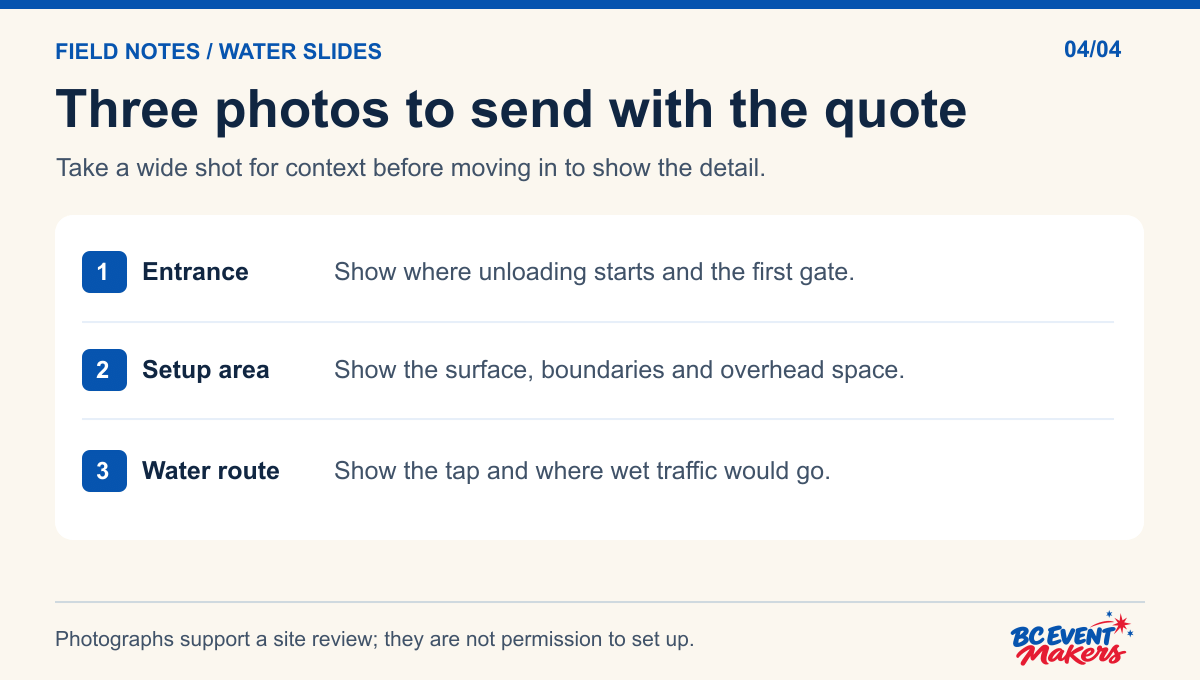
Put the date, address, guest hours and site-access window in the same message. Include the age range, the photos and which details still need an answer. This is especially useful when you don’t have the venue keys yet: marking water approval as “awaiting venue confirmation” prevents a provisional detail from turning into an assumption.
We’re looking for a water slide in Mission for [date] at [venue]. Guests will be there from [start] to [end], and the site is accessible from [time] until [time]. We expect [participants and ages]. Attached are the entrance, proposed setup area and water-route photos. The venue has confirmed [details]; we’re still checking [questions]. Which unit would you suggest, and what do you need us to verify before we book?
Send it through the BC Event Makers quote form. If the venue changes after you enquire, send the new address and photos before treating the original equipment choice as settled. The useful answer is the one that fits the site you’ll actually use.