
A good corporate party gives the colleague who wants to play blackjack and the one who wants to catch up over dinner an equally good place to spend the evening. If the only way into the room is through a team competition, you’ve made the choice for both of them.
For your New Westminster corporate party, make four decisions before you shortlist entertainment: what guests are invited to do, when they can join, where people and food will move, and who takes the handoff. If you already have a room booked, jump to the worked examples and sample run sheet.
1. What does joining the corporate party actually mean?
Write the invitation before you choose the games. If it says “all teams will compete”, someone who doesn’t want to compete has a problem to solve. If it says “join a table, watch a round, or grab a seat with someone you haven’t seen in a while”, they already know how to take part. The invitation sets a useful design test: can a person who never plays still enjoy the whole evening?
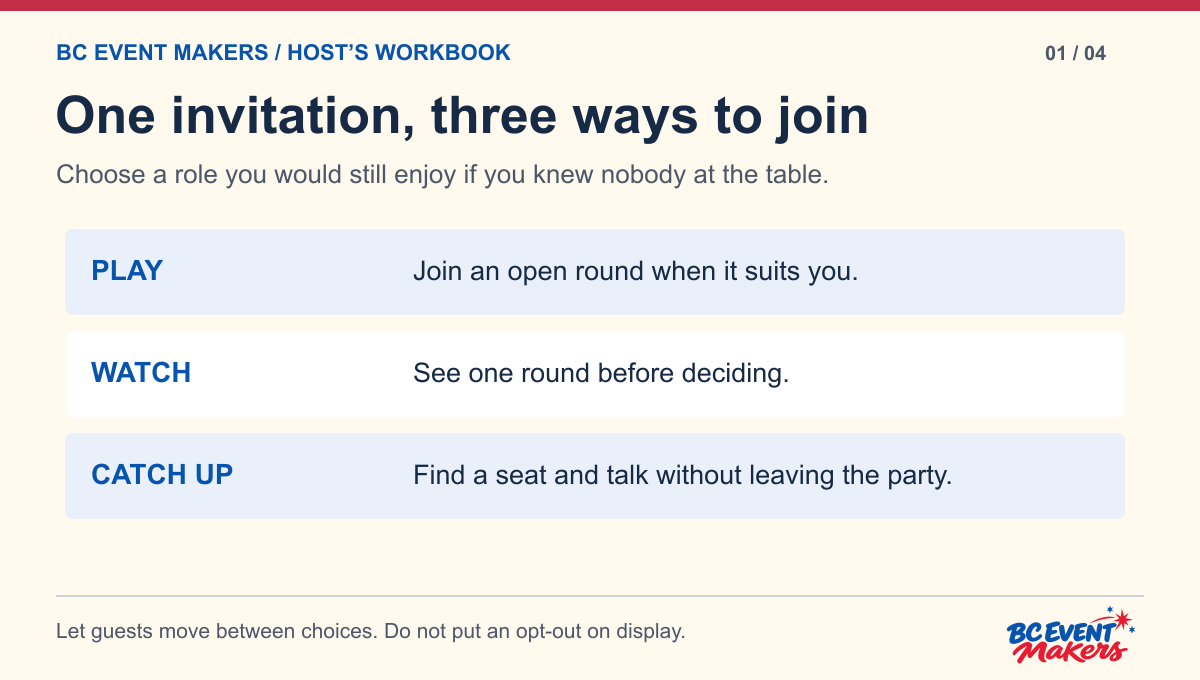
Sample corporate party invitation: “Come for dinner and a catch-up. The play-chip tables will be open after the welcome. You’re welcome to play, watch or stay at your table. There’s no sign-up and you won’t miss the thank-you if you skip the games.” Only promise open play or a particular time if it matches your booking.
A staff appreciation night and a family day need different shortlists. For an adults’ reception, compare the play-chip casino options with a single casual game people can join between conversations. For a daytime event, start with the ages attending and the venue surface. “Family friendly” doesn’t tell you which attraction suits a particular child. Confirm suitability and supervision for the equipment you actually request.
If you’re deciding whether to organise teams, ask what the group should share. A staff milestone might call for one toast together and an informal rest of the evening. A team challenge might benefit from short turns with a clearly explained scoring method. Neither needs a compulsory performance from someone who came to see their colleagues.
2. Which part of the evening needs everyone there?
List the departures as well as the arrivals. A corporate party can have a late shift coming in just as some early guests need to go home. A long tournament that starts at the door and ends at closing may leave both groups out. Open play can be a better fit when people arrive in waves; a fixed round can work when the same people are there for the whole activity.
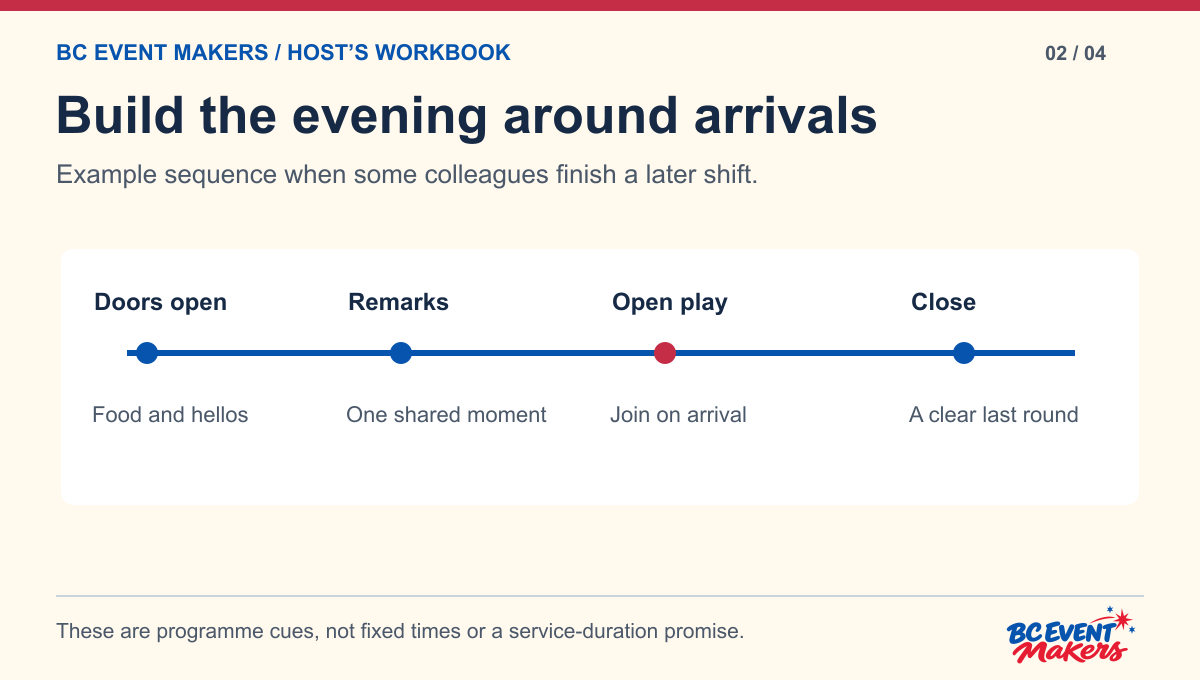
Try this sequence on paper: food and conversation as people arrive; one welcome after the later shift has had a chance to get in; games open after the remarks; last-round cue before the agreed finish. The schedule only needs exact minutes where someone else depends on them. Catering and setup contacts need times. A guest deciding whether to join a table usually needs to know what is open now.
If dinner runs late: decide what shrinks. Cutting five minutes from every announcement sounds fair, but it won’t help if the game cannot open while a speech is underway. The corporate party host should check the fixed finish with the venue and supplier, then tell the room the revised order. Build that decision into the run sheet before the corporate party begins.
If guests arrive after the welcome: pick one person who can give them a short orientation without restarting the programme. “Food is on the left; the tables are open; the thank-you is at seven” is enough if those details are true. The late arrival can then choose where to go. No one needs to explain why they missed the first round.
3. Can two people cross the room in opposite directions?
One person is carrying a plate back to a seat. Another has just left the game and wants to meet a colleague at the door. Walk those two lines on your floor plan. If they both turn through the same narrow opening, moving the start of a queue may do more for your corporate party than renting an extra activity.
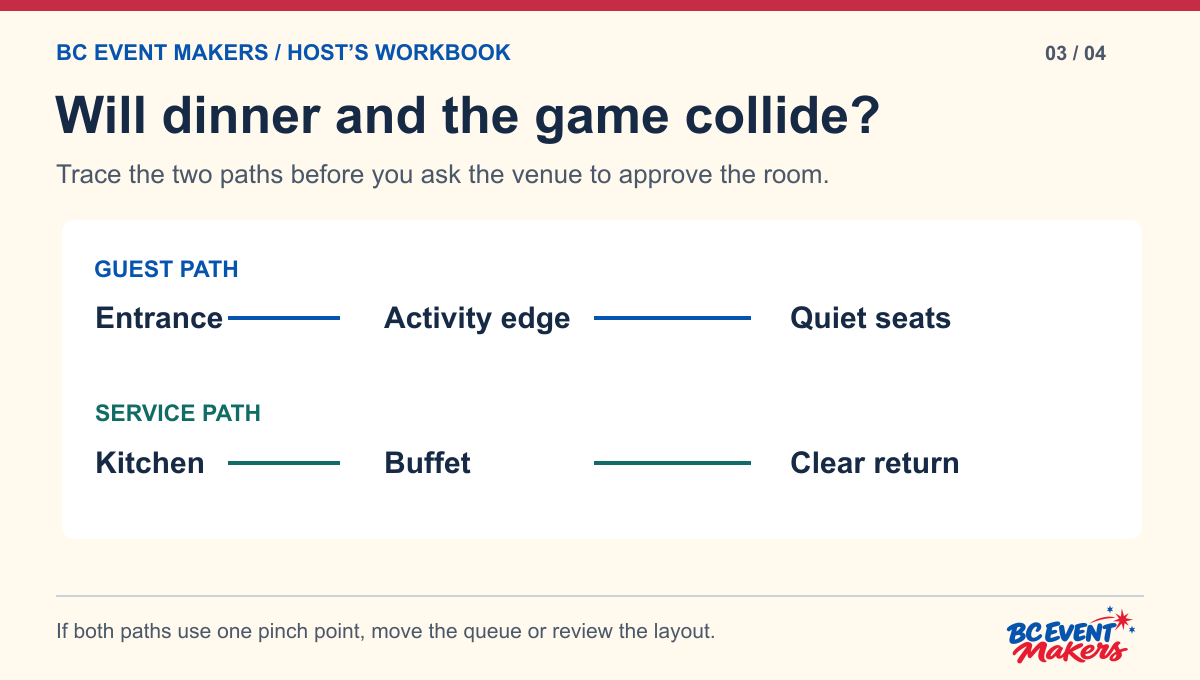
Put the buffet, service access, seating, activity footprint and guest waiting area on the same drawing. Then ask the venue and supplier to review that drawing. A room capacity tells you little about how much usable space remains after dinner tables, an AV station and catering access are in place. Ask about any access needs early enough to make a real change.
If you’re considering a City space, use New Westminster’s facility booking page to find the appropriate rental contact. Give that contact the proposed equipment and operating hours. Don’t assume that hiring a room also grants early delivery access, storage or permission for every activity. If you’re using a hotel, club or private hall, take those questions to its own event coordinator.
Test the quieter seats in particular. Are they inside the gathering or in an empty corridor? Could two people hold a conversation there while the host is speaking? Can someone get there without passing through a game queue? A good alternative to playing should still feel like an invitation to the party.
4. Who can make the next decision?
Use names on the private run sheet. The venue contact confirms the entrance, access window and room conditions. The host calls the welcome or programme change. The supplier confirms the agreed equipment and operating arrangements. The same person might cover more than one role, but “we’ll sort it out when everyone arrives” isn’t a handoff.
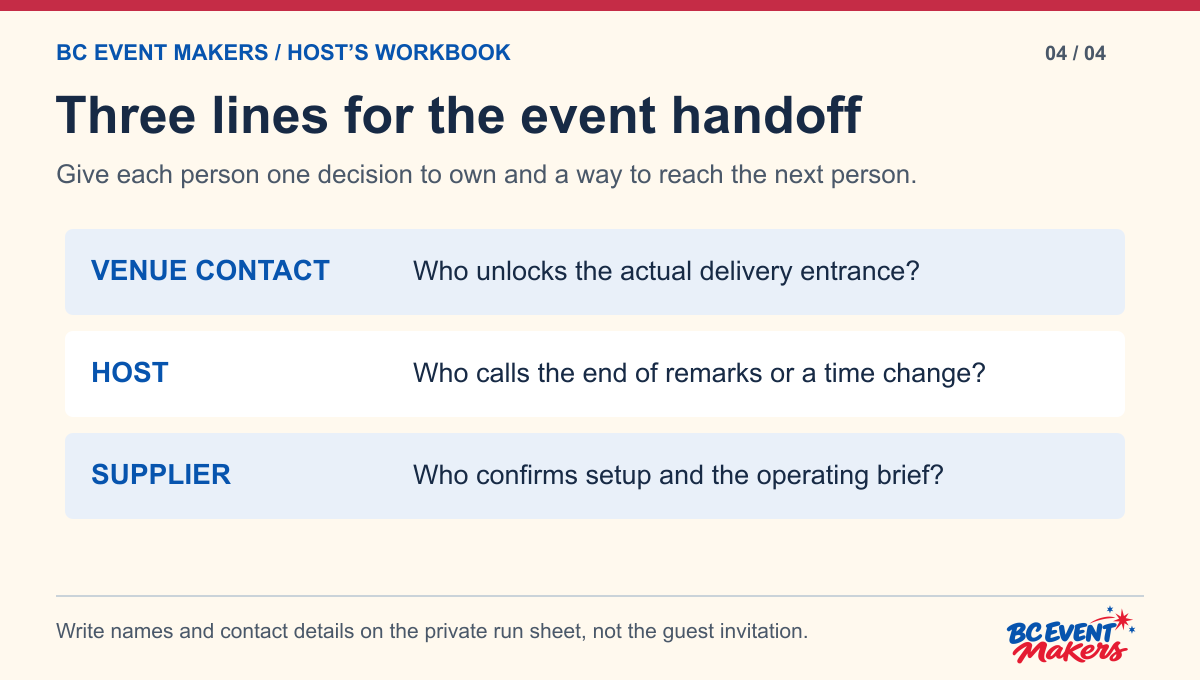
Before the corporate party, send one page to the people doing the work: access time, guest arrival, food service, the shared moment, activity open and close, and collection. Identify anything still provisional. If the venue only opens at the time guests are due, the calendar has exposed a real conflict; discuss access or a different activity before you advertise the plan.
What to ask for in the quote: the equipment and agreed operating window; setup and removal arrangements; any staffing or duties the organiser must provide; and how changes will be handled. A broad description such as “casino package” is not enough to brief a venue. Confirm the selected tables and the role of play chips. Don’t describe an entertainment activity to staff as real-money gambling.
Three corporate party plans for different guest lists
A short guest count can hide the most important detail. “Sixty employees” might mean sixty people arriving together by bus, three shifts arriving an hour apart, or thirty employees each bringing a family member. The corporate party does not need the same format in all three cases. Here are three examples to use when you and the venue review your plan.
The evening crew arrives after dinner starts
Suppose the office team can arrive at six and the service crew will arrive closer to seven. The event committee has proposed a group photo at six-thirty and a scored round starting immediately afterwards. That gives the later crew the leftover roles before they even enter the building. Move the photo or offer a different shared moment. Choose an activity with an entry point after seven if that is when part of the team can actually take part.
Give a late arrival a practical first stop: who can show them where food is available, where to leave a coat and whether they have missed an instruction they need. If a fixed round must be underway, tell them when the next round begins and offer somewhere comfortable to wait. Do not make an employee hunt for a manager to find out whether they are still allowed to join.
Ask the caterer separately what late guests can expect. The host should not promise a hot meal at seven-thirty simply because the room is open until nine. Once you know the answer, add it to the invitation or the arrival note. The colleague reading it on their break needs two facts: whether to eat first and what part of the corporate party will still be open when they arrive.
A thank-you evening after a difficult year
A big competition can sound energetic in a planning meeting and feel like more work to the people it is meant to thank. Start with what the team should take home: time with colleagues, a sincere thank-you and a chance to do something enjoyable. See whether the proposed activity supports those things or takes time away from them.
For example, put the short thank-you before open play rather than making the prize presentation the only moment everyone is asked to listen. Give people who have never played a way to watch a round or ask a question without being called out as beginners. If the organisers want a prize, agree its purpose and the format separately with the appropriate people; never announce a raffle or wagering arrangement just because the corporate party has a casino theme.
“No pressure to play” is only believable when the room backs it up. If the sole alternative is standing outside a closed bar or talking over loud instructions, the message has failed. Allocate some seats with sight of the gathering and enough separation to talk. In your venue walk, ask one person to sit in them while another gives the welcome. Can they hear the parts they need without feeling trapped beside a speaker?
A company family day with adults and children
Plan in terms of who will be together. A parent accompanying a younger child may prefer an activity they can watch without losing sight of a sibling. A teenager may enjoy a game independently. A colleague attending without children may want a reason to stay beyond lunch. Don’t let “the kids will be busy” substitute for thinking about where those adults will spend their time.
Start the shortlist with how each attraction is used, not how much space you expect it to fill. Ask the supplier about age suitability, the selected unit’s operating arrangement and what the host must provide. Mark the activity and its waiting area separately on the room or site drawing. A guest watching a child should have somewhere to stand that is not also the entrance to the next attraction.
Decide how the host will share changes with families. A clear sign or a short announcement can explain that an activity has paused and what is open instead. It should not promise a restart or a replacement until those have actually been confirmed. Keep food, rest areas and a simple drop-in option in the programme so that one pause does not bring the whole corporate party to a stop.
A corporate party run sheet: write the trigger as well as the time
Here’s a small example for an evening reception. The clock times are illustrative, not an estimate of how long catering, a table session or supplier setup will take at your venue. Adapt them to the written access and service windows. The useful part is the middle column: it tells the host what must be true before announcing the next step.
| Example cue | Check before moving on | What the guest hears |
|---|---|---|
| 6:00 · Doors | Venue contact confirms the guest entrance and coat area are ready. | “Come in, find a seat and say hello. We’ll call everyone together for the welcome.” |
| 6:40 · Welcome | Host checks that food service can pause or continue quietly and the speaker is ready. | “A quick thank-you before we open the activities.” |
| 7:00 · Open play | Supplier confirms the agreed activity is ready, including an entry point for new guests. | “Join a round, watch one, or stay for a catch-up.” |
| 8:30 · Last round | Host confirms finish time with the supplier and gives catering a clear route for collection. | “This is the last round. We’ll finish together in the seating area.” |
If a cue has to move, update the one person responsible for explaining it. A revised spreadsheet is no help to the person standing at the microphone unless they know it changed. Put the current version and the time of its last revision on the private run sheet. Keep guest-facing signs simpler: what is open, where it is and what happens next.
How to compare corporate party proposals
For the same corporate party, one proposal might list a collection of games while another describes staffed table time. Comparing the totals alone doesn’t tell you which plan you can actually run. Put the proposals side by side and write plain-language answers to these questions. If a detail is absent, mark it “ask”; do not fill the gap with a guess.
- Access: Does the proposal use the venue’s actual delivery window, including any loading entrance, lift booking or collection restrictions? If the venue changes, who needs the revised information?
- People: Which roles are supplied, and which people must your organisation arrange? Does the named host have enough time to do that job and still look after arriving guests?
- Experience: Is play open, timed, or organised into rounds? Can someone watch first? Ask how the format handles a late arrival rather than assuming every guest will complete every game.
- Changes: What happens to the agreed programme if dinner runs late or the room changes? Ask for the applicable terms in writing. A flexibility promise from a different event is not a term of this one.
Then make one honest trade-off. If the corporate party is for guests arriving in waves, you may value flexible entry more than a second scored activity. If it brings an intact team together for one short session, a simple shared round may make more sense than several open stations. The better proposal is the one that answers your event brief, not the one with more items on the list.
Before you send the corporate party invitation
Read the corporate party invitation as someone who doesn’t work at head office. Does it give the actual entrance, the time they are welcome to arrive, whether food is served, what is optional and whom to contact about access? Keep private phone numbers on the staff run sheet where appropriate; use the agreed event contact in the invitation. If a guest would still have to ask a colleague whether it’s okay just to watch, edit that line before you send it.
A corporate party brief you can adapt
Our event is in New Westminster at [venue] on [date]. Guests arrive between [times]. The one moment we need everyone for is [welcome, toast or meal]. We’d like an optional activity that [stays open for late arrivals / works in a fixed session]. The venue allows access from [time] until [time]. We’ve attached the room layout and marked the food route. Which options fit, and what should we clarify before inviting the team?
Send the outline through the BC Event Makers quote form. If you’re considering another activity alongside the casino tables, use the rental catalogue to name your first and second choices. It is easier to compare two workable options than to plan around six items that all need the same corner of the room.