
Fun game rentals for a Chilliwack team challenge need a clear rule, a reasonable rotation and a role for someone who wants to support their team without taking a turn. Decide what colleagues should share before selecting equipment. Then test one complete station handoff on paper.
Decide whether guests will play freely or move through a scheduled challenge. Free play gives people more control over their evening; a rotation needs clearer instructions and someone responsible for keeping it moving. Neither format should depend on every employee joining every activity.
1. Choose fun game rentals around the team experience

Explore the BC Event Makers catalogue for games with different kinds of participation. Double Shot Basketball and Giant Connect Four suggest quite different experiences. Ask about the selected items’ requirements and suitability before building a competition around them.
Keep your guest group in mind. A workplace team may include people with different mobility needs or comfort levels with physical activity. Offer ways to take part that do not require everyone to use the same equipment. Discuss access and participation questions early with the venue and supplier.
2. Write one short scoring rule per game station
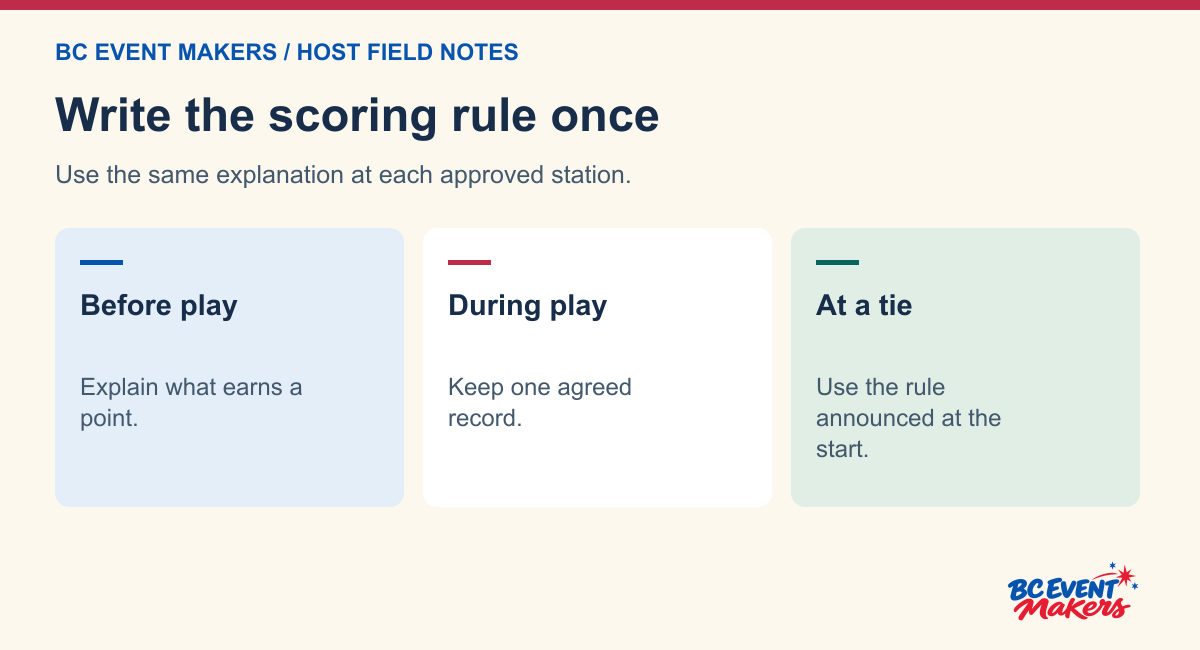
Write the event rules so a host can explain them without a lengthy briefing. Decide how teams are formed and how scores will be recorded if you use them. Keep those rules separate from the operating instructions for the equipment, which must still be followed.
Test the scoring idea on paper before announcing it. Check what happens if someone skips a station or a game needs to pause. A casual company event should not rely on a disputed score to decide whether the evening has gone well.
3. Include the whole changeover in the rotation
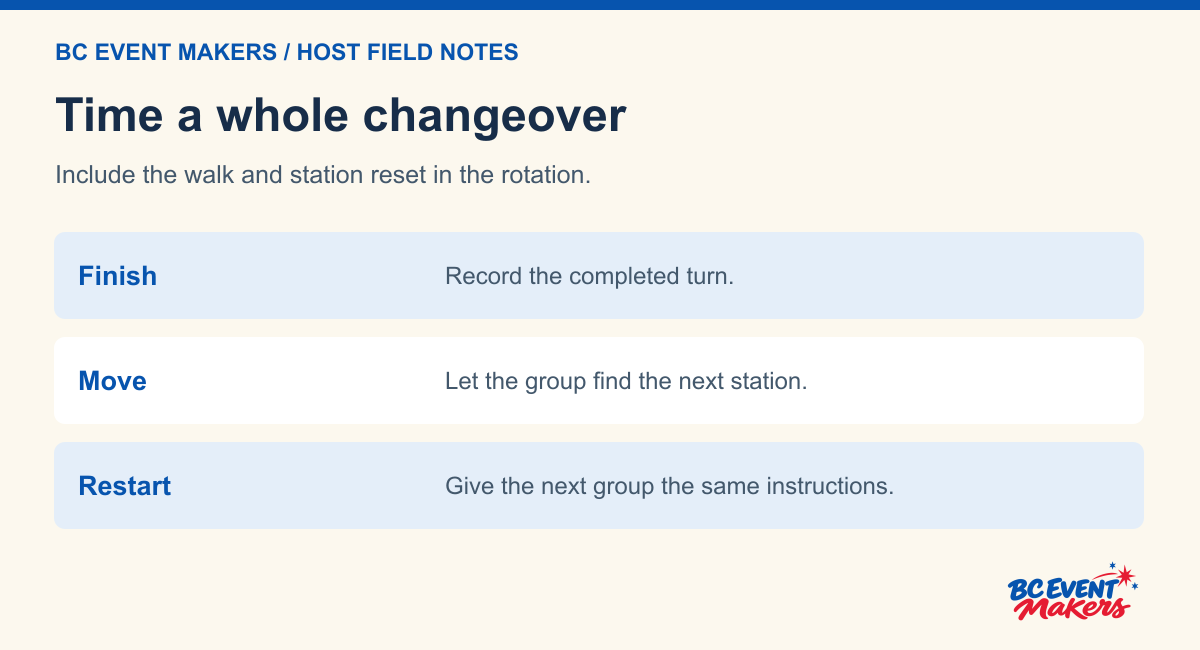
Draw waiting areas and the routes between stations. Keep refreshments outside the active playing spaces and provide somewhere for colleagues to sit and talk. If people rotate as teams, make sure one group can leave a station before the next arrives.
Ask the supplier about each game’s operating arrangement and how it affects your proposed schedule. Avoid promising an exact number of turns until the plan has been discussed. Keep room in the programme for food service and any company announcements.
4. Give the finish a purpose
Confirm whether the rental proposal includes attendants or whether your team must provide helpers. Assign responsibilities for scorekeeping and announcements separately. Name one event contact who can make decisions without pulling several organisers away from their stations.
Send your Chilliwack venue address and event date with the guest count and proposed format through the quote form. Include access times and photographs of the activity area. Ask for the equipment and staffing scope to be clear before printing rules or promising particular games to the team.
Start with the sentence the host will say
Try introducing the challenge before selecting the games. “Choose a role at each station, try a turn if you want one, and help your team collect its score before moving on” promises a different afternoon from “Everyone competes for the best individual result”. Decide which message matches the reason your Chilliwack group is gathering.
If the aim is to help colleagues meet, make conversation easy and give a team more than one way to contribute. If the aim is a friendly competition among people who already know each other, clear rules and a reliable score sheet matter more. If the aim is simply to give people an optional activity during a staff picnic, a formal rotation may add more structure than the gathering needs.
Use the equipment catalogue to start the conversation with a particular game. For example, Pit Stop Challenge gives the supplier a named item to review. Ask what guests do at the actual game station, what space and staffing it needs, and how a team can take part. Current availability and suitability depend on the date and venue.
Give the team three useful roles
One colleague wants to take a turn, another wants to help track the result and a third prefers to cheer or talk through a strategy. Those people can all belong to the same team. The activity becomes easier to join when the host welcomes each role without making anyone give a reason for opting out of a physical challenge.
Set a clear boundary around the support role. A team member can keep its score sheet, read the station instructions or help friends find the next game. Equipment operation stays with the person responsible for the actual arrangement. Agree with the supplier which tasks a host or team member may handle before putting them on a volunteer roster.
Give the non-playing route the same attention as the playing route. Can a supporter stand with their team without blocking the next person? Can someone leave a station for refreshments and rejoin at the next rotation? If a person has to step out of the whole gathering to decline a turn, the word “optional” on the invitation is doing very little.
Work a sample score before announcing the rules
For a company team challenge, use a small example that has nothing to do with equipment operation. Suppose the organiser has agreed that one completed challenge earns one team point, and the team can also earn one point for accurately handing its score sheet to the next station. Team Blue completes the challenge but misses the handoff. Team Green completes both. What should the record show? If the committee gives three different answers, the rule needs another sentence.
Keep any scoring example consistent with the actual equipment, participants and purpose. The organiser may prefer to count completed stations instead of ranking performance. Another event might celebrate teamwork or creative cooperation without assigning points at all. Clearly tell guests whether the score sheet decides a result or simply helps the group remember where it has been.
| Scoring decision | An answer the station host can use | What to settle before play |
|---|---|---|
| What counts? | A defined action that the team can understand before its turn. | Confirm it fits the specific activity and supplier arrangement. |
| Who records it? | One named host or team recorder uses the agreed score sheet. | Decide where the official record goes after each rotation. |
| What happens at a tie? | Use the announced rule or recognise the shared result. | Avoid inventing a tie-break after teams know the scores. |
| What if a station pauses? | The event lead applies the pre-agreed treatment for all teams. | Give the host a way to contact that decision-maker. |
Example. A team arrives with fewer people
A colleague may arrive late, choose to watch or need to leave early. If your score depends on every person taking an identical number of turns, the group format may penalise a team for a circumstance it cannot change. Review the rule with the event lead before announcing the competition.
One approach is a team-level task with useful roles for different numbers of people. Another is a participation passport that records the stations the group explored without ranking individuals. Ask the supplier whether the proposed activity can support the selected format. The goal is to give the host a clear guest explanation within the actual booking, not to organise extra turns the schedule cannot deliver.
If a person joins late, give them the next entry point. “Meet your team at the information desk before the next rotation” is more helpful than asking them to find a group moving through the fair. Tell the scorekeeper how the new participant fits the agreed format. Keep private reasons for a colleague’s late arrival off the score sheet and microphone announcements.
Example. One station is slower than the others
A team may finish a quick challenge and spend the rest of its rotation waiting for a longer station to clear. Time a whole cycle on paper: instructions, a turn, recording the result, resetting the station and walking to the next location. A rotation that budgets only for the turn itself will overpromise how quickly teams can move.
Ask whether the stations should all use the same timed cycle or whether one activity belongs in a separate open-play window. For example, a short-turn game could welcome late arrivals while another station hosts the scored team challenge. Review the choice with the supplier and venue so the queues and staffing follow the actual programme.
Give each host a cue for a slow changeover. It might mean keeping the current group at an approved waiting point while the event lead confirms the next move. Do not ask a team to rush an activity, change equipment instructions or crowd the next station just to catch up with an internal schedule.
Example. Two teams dispute the result
A guest who questions a score may simply have heard a different explanation at the last booth. Ask the station host to refer to the stated rule and the official record. If an exception is needed, the event lead should make it consistently rather than letting each game station change the rule for its own team.
Keep the conversation brief and respectful. A company event can lose its social purpose when everyone waits for a long argument over a point. If the team challenge exists to help colleagues mix, the organiser may prefer to recognise a tie and continue. If a prize is involved, confirm the approved terms separately and tell guests the decision process before the first turn.
Record the issue for the next event. “Teams interpreted the handoff point differently” suggests a better instruction or a clearer score sheet. “Team Blue was difficult” is a judgement that does not help the next host. The most valuable record identifies the decision and the wording that caused confusion.
Draw the team movement between games
Use a venue map with the actual guest entrance, food service, seating and station positions. Mark where each team waits, takes its turn and leaves. Put the starting points on the map as well as the route between stations. Two teams beginning on opposite sides of a room can still meet at the same narrow doorway during the rotation.
For a Chilliwack municipal location, use the City’s facility information to identify the relevant venue or booking contact. Ask about the proposed use and outside equipment. A private venue has its own decision-maker. Give the supplier the actual address, surface, delivery route and access window before treating the game shortlist as settled.
Walk the route with someone carrying a score sheet and someone attending only to catch up with colleagues. Can both reach the next gathering place without walking through a game in progress? Can a person who skips a turn stay with the team? If the answer depends on everybody using the same doorway at the same second, adjust the route or timing with the venue.
A run sheet based on cues
Write the first cue as “teams have heard the same rule and know their starting station”. The host can then announce the start without repeating different instructions to whichever group is nearest. The second cue should confirm where the completed score sheet goes. The third should name who tells the group it can move to the next station.
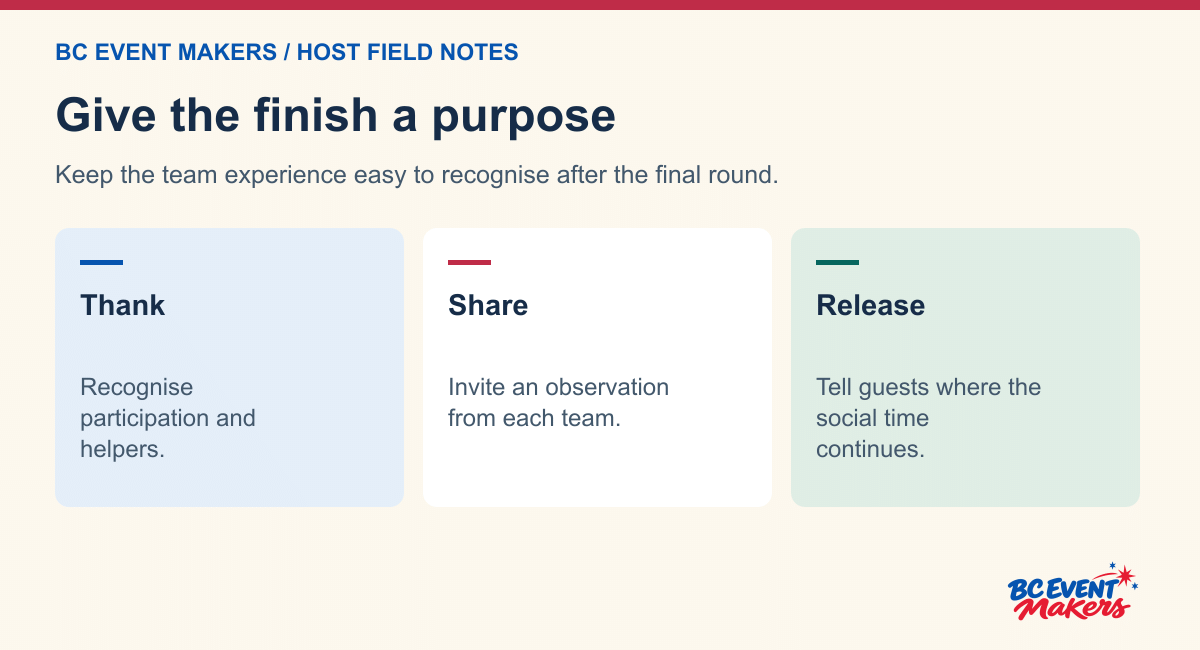
At the end, give teams a social destination. A table for refreshments, a shared thank-you or an optional final activity helps the group finish together. Keep the score announcement proportionate to the purpose of the day. An event designed for colleagues to meet should not end with most of the group standing around while one person recalculates a table of results.
A host script that keeps the challenge welcoming
Try this once the actual stations and rules are confirmed. “You’ll visit [confirmed stations] with your group. At each station you can take a turn, help with the team record or support a colleague. The station host will explain the agreed task. When you hear [cue], go to the next location on your card.” Include the meeting place for anyone who joins after the start.
Give the host a second message for a pause. “We’re holding the next rotation while the event lead checks [issue]. Stay at [agreed location] or visit [confirmed open option]. We’ll update you at [time].” This message avoids promising a restart or revised score until the responsible person has decided what is possible.
Compare the equipment with the programme
Put your first-choice fun game rentals beside the team brief. Which station gives an easy first turn? Which lets people cooperate? Which has a good spectator role? Which requires a longer explanation? A mix of equipment is valuable when it gives groups genuinely different things to do. Several similar booths may simply create several versions of the same queue.
Ask what the supplier provides for each selected item and what the organiser must arrange. Include staff roles, instructions, operating or setup requirements, the delivery window and collection. Check whether volunteers need to reset props or replenish materials and whether that task is appropriate under the agreed booking. Put the answer on the station card before assigning a person to it.
An enquiry for a Chilliwack team challenge
We’re planning a team event at [Chilliwack venue] on [date]. Guests arrive [pattern], and our main purpose is [social participation or a scored challenge]. We’re comparing fun game rentals for [number and type of stations]. The venue can provide access [window]. Attached is the proposed rotation and guest route. Which items suit the group, which responsibilities belong to the host and what else should we confirm?
Send an example of the score sheet if a supplier is being asked to support a particular format. The supplier can review the equipment and guest flow for the actual proposal. Keep any unconfirmed item or role marked as provisional until the venue and supplier decisions are complete.
At the debrief, ask the hosts one practical question: where did the rotation slow down? The answer might be the walk between booths, a score sheet that needed too much explanation, or a team waiting for friends at the finish. Capture the observation beside the actual station name. It gives the next organiser a specific improvement to test while preserving the parts of the event people enjoyed.
If the next group wants a different challenge, keep the original objective with the notes. A format that worked for a voluntary staff social may be a poor choice for a public school fair or a highly competitive club. Ask what guests should experience at the next gathering before reusing the scoring rule or equipment list. That keeps the activity choice tied to people rather than to a spreadsheet left over from the previous event.
Review the carnival game collection and send the event brief for confirmation of the date, equipment and address.