
Mechanical ride rentals in New Westminster become much easier to assess when the venue has the exact equipment name and the hours the supplier can actually enter. Use four checks to turn a broad ride idea into a site brief the venue and supplier can review.
Send the supplier the venue address and details of the proposed location. Include photographs and explain how equipment would reach the site. Access restrictions can matter as much as the space available once the equipment is in position.
1. Ask which unit the mechanical ride rentals proposal covers
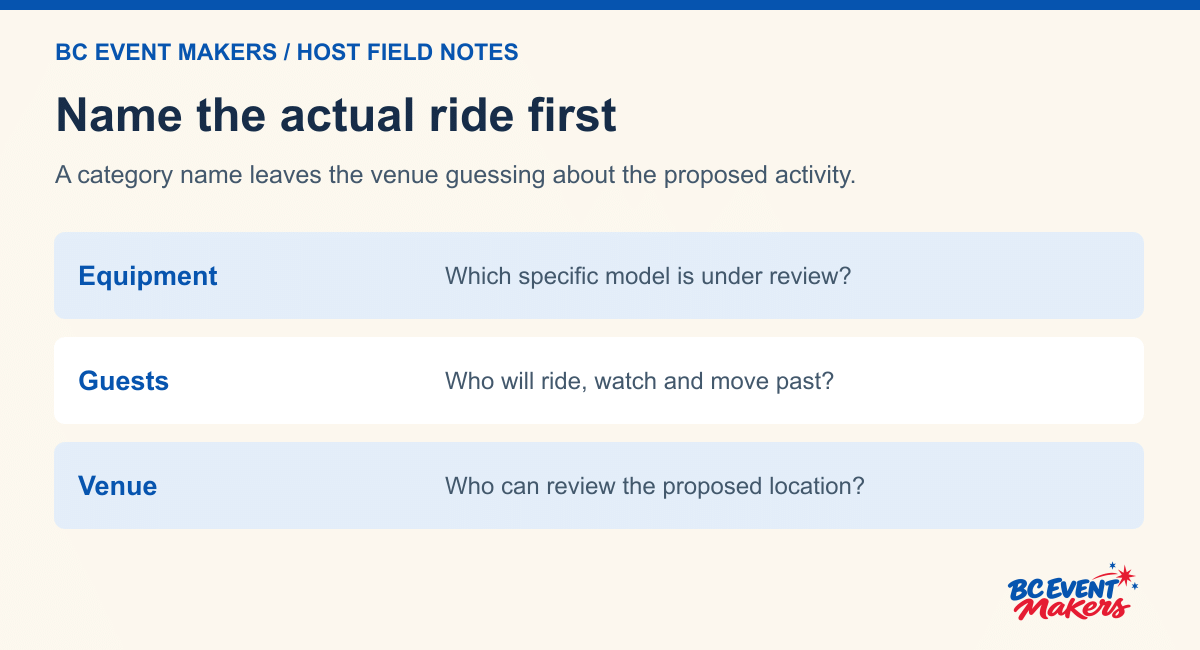
The BC Event Makers catalogue includes attractions such as a Mechanical Bull and a Swing Ride. These have different activities and requirements, so ask about the specific item being proposed for your date. Do not treat “mechanical ride” as a single equipment specification.
Describe the people you expect to participate and ask about suitability. Confirm the restrictions and operating instructions for the selected attraction. Avoid making assumptions about children’s participation or accessibility based on the event theme.
2. Compare the access window with the public event hours
Ask for the full operating footprint and clearance requirements, along with the electrical arrangements. Provide accurate information about the surface and any slope or overhead obstructions. Obtain approval from the property owner for the actual setup being considered.
For a hired hall or other indoor space, confirm suitability with both the venue and supplier before proceeding. A large room alone is not enough information. Outdoor locations also need review of the surface and the conditions under which the ride can operate.
3. Plan waiting and viewing around the rest of the event
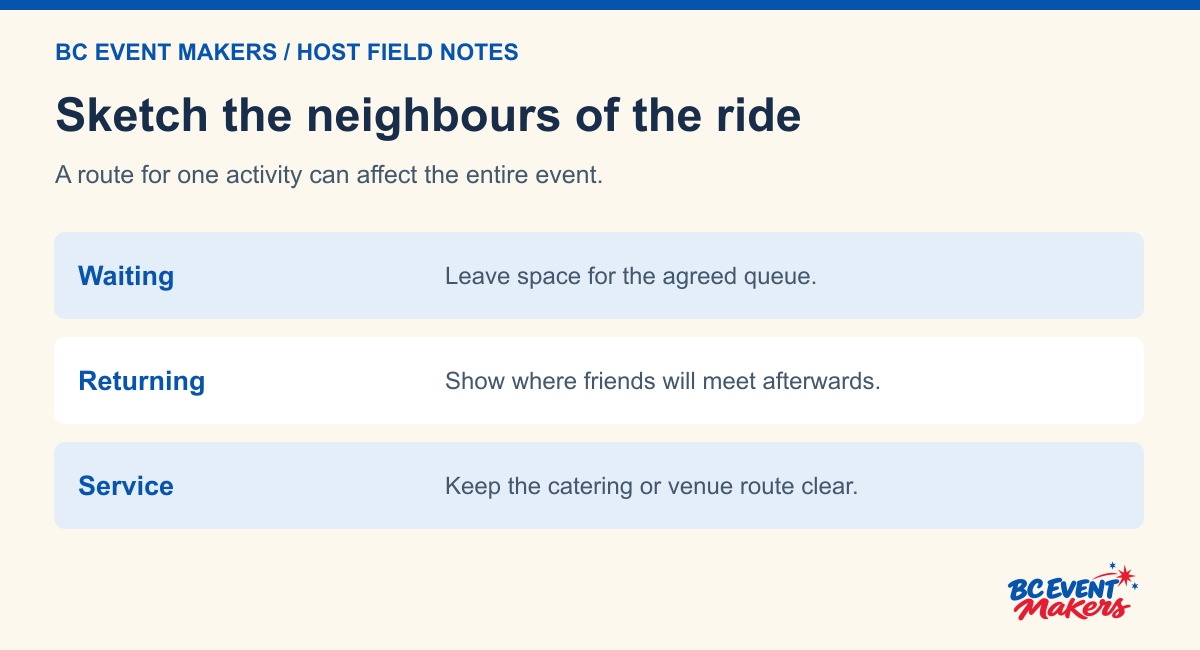
Draw the queue and spectator area on the site plan. Keep access points clear and avoid placing food service where a waiting crowd will block it. Guests who choose not to participate should have somewhere comfortable to watch or join another part of the event.
Ask how turns will be managed and how that arrangement affects your proposed programme. If the ride is part of a company celebration or community event, make participation optional and keep the wider guest experience in mind.
4. Agree on the supplier and venue handoffs
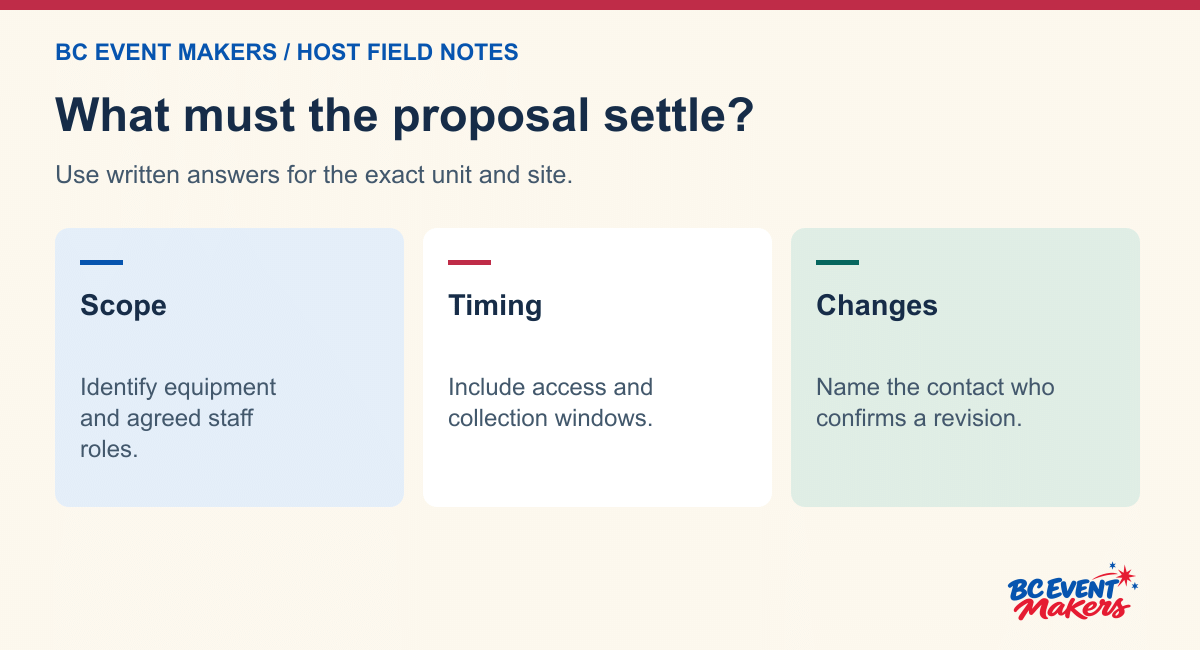
Discuss the staffing arrangement explicitly. Ask who operates the equipment, who manages the queue and what support the organiser must provide. Confirm who can pause the activity and how concerns should be reported during the event.
Review weather decisions and the terms for changes or cancellation. Prepare another activity or programme arrangement if the ride cannot operate; do not assume it can simply be moved somewhere else.
Send your New Westminster site information through the quote form with the event date and operating window. Include delivery and removal access times. Confirm the equipment and staffing scope before advertising a particular ride to guests.
Bring a one-page brief to the first venue call
Write the exact attraction name at the top of the page. If the committee is choosing among mechanical ride rentals, list the two or three specific options still under consideration. Ask the supplier to explain what each option requires and how guests experience it. A venue cannot assess “something like a carnival ride” with the same confidence as a proposal for a named unit at an identified location.
Give the venue contact the guest date, public hours, access window and the point from which a vehicle would unload. Mark the proposed activity area, where it meets other event activity and what is above or beside it. Let the venue and supplier identify which details require specialist review. Leave uncertain equipment dimensions, clearances and operating arrangements marked for confirmation.
For a City property, use New Westminster’s facility and park booking information to identify the appropriate contact. For a private site, take the same questions to its administrator. Give the property contact a real description of the event. A room or site booking can leave equipment, delivery or collection decisions outstanding.
Turn the route into a sequence of photographs
A picture of the event area often leaves out the most difficult part of the arrival. Start at the unloading point and take one view facing the proposed direction of travel. Move to the narrowest gate or turn and take a view from both sides. Finish with a wide photograph of the proposed activity area, including neighbouring uses. Caption the pictures in the order someone arriving at the site would see them.
State which route is available during the actual booking window. A vehicle may be able to use a service entrance on a weekday morning while an evening event has different access. Ask who controls the gate, whether another supplier needs it and what changes after guests arrive. Include the collection arrangements in the same enquiry so a morning delivery plan does not become an assumption about the end of the night.
If the venue proposes more than one location, label the options separately. “Courtyard A, unloading from the service entrance” and “Field B, access to be reviewed” are easier to assess than a folder of pictures named “back of building”. Keep an older drawing visibly dated when a route changes. The person checking access should be able to tell which site they are being asked to review.
Put three clocks on the same page
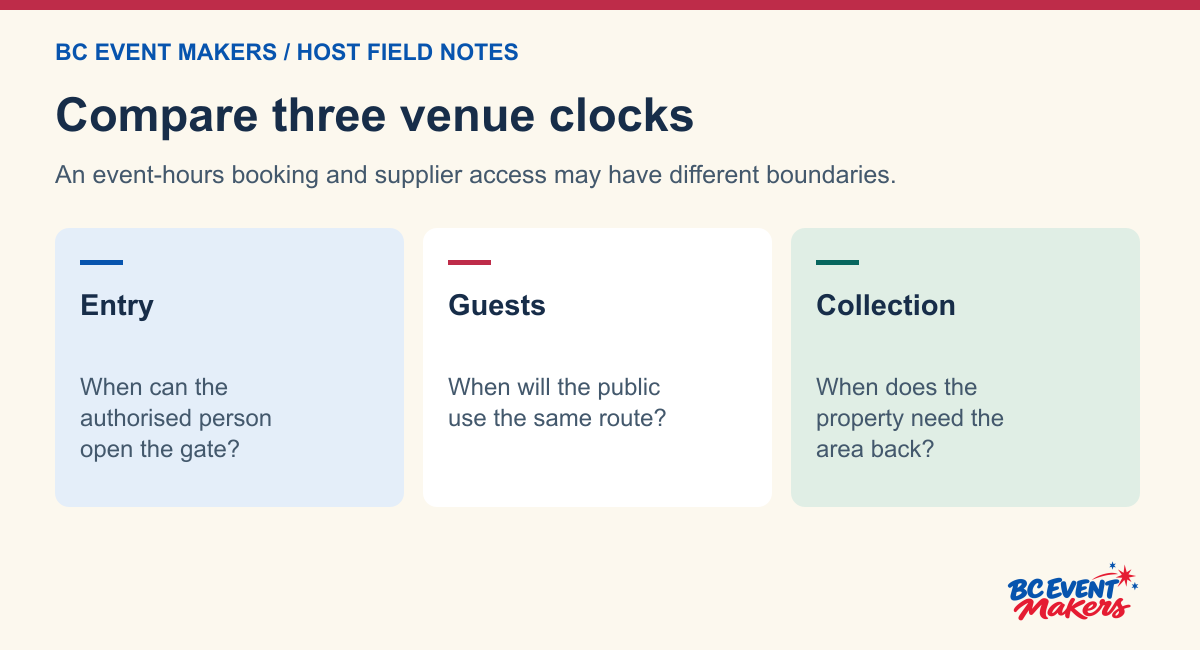
One clock belongs to the venue: when can the event team use the site, and when must the space be handed back? A second belongs to the supplier: which access period is needed for the proposed mechanical ride and its collection? The third belongs to guests: when do they arrive, when do they expect the activity, and when are shared meals or remarks scheduled? Line up all three before printing a programme.
| Moment | Venue contact’s question | Supplier and host question |
|---|---|---|
| Access begins | Who can open the approved entrance and at what time? | Can the proposed team use the whole delivery route during that window? |
| Guests arrive | Which entrance and public paths must stay available? | Where do waiting guests, spectators and through traffic go? |
| A shared welcome starts | Does catering, AV or another supplier need the same area? | Is the activity window compatible with the programme cue? |
| Public play finishes | When must the venue be returned for its next use? | Who calls the last entry and keeps collection access available? |
Ask the event lead to find a conflict in the table. If none is visible, rehearse a late dinner or an early venue handback. Which commitment is fixed and which can move after discussion? A good planning answer names the person who can authorise a change; a weak answer assumes everybody can work faster.
Example. A community event shares the access road with catering
Suppose the supplier has an agreed delivery slot and a caterer expects to unload through the same entrance at the same time. Both bookings can look workable in separate emails. Put the two requests on the venue’s access schedule and ask the venue contact to review the actual route and sequence.
If one supplier can use an alternative window, confirm it in writing with that supplier and the venue. The host should pass the updated arrival information to the person meeting each team. Do not redirect an arriving vehicle along an unreviewed route simply because another vehicle is in the loading area.
Now walk the route as a guest arriving early. Can they reach the event entrance without entering a delivery activity? If the guest route and the supplier route cross, take the crossing back to the venue. The solution may be a different access window, a different guest entrance or a revised event layout. The correct choice depends on the real property and equipment arrangement.
Example. The venue offers a different event area
The replacement space may be larger, closer to the main entrance or more convenient for catering. It is still a new site proposal. Send the supplier the address or precise on-site location, route photographs, surface information and access hours. Ask what must be reviewed again for the specific unit.
Show the public perimeter and the waiting or viewing places proposed for the new area. Do the old queue and meeting point still work? Does a family leaving the ride reach its meeting place before crossing the food line? If the committee changes the attraction as well as the location, revise the guest plan and ask the venue and supplier to assess that exact combination.
Keep the original option described as superseded in the private file. The team needs to know which decision it can rely on when another volunteer forwards an old screenshot. Publish the updated venue or activity details only after the responsible parties confirm them.
Compare the actual work included in each proposal
Two proposals for mechanical ride rentals can contain different services even when their headings sound similar. Read each one as the person expected to open the gate, welcome guests, communicate a pause and hand the property back. Which roles are supplied? Which roles must the organiser arrange? Put an unanswered question in the comparison sheet rather than silently assuming the cheaper or more familiar proposal includes it.
Ask for the exact unit, agreed hours, travel scope, equipment responsibilities, staffing and any host tasks. Ask what happens if the venue changes the access window, the event programme runs late or the named attraction cannot be supplied. Record the applicable written terms. A previous booking at another site is an example to discuss rather than a binding answer for this one.
For a question about an amusement device’s operating arrangements, take the exact device and setting to the responsible operator. Technical Safety BC’s operating-permit information is a reference for that discussion. The venue separately confirms property use, access and any local event arrangements. Keep both types of answers in the booking record.
Give the committee a decision with consequences
Imagine that Option A is a named ride with a reviewed site and a narrow access window. Option B is an available game collection that allows guests to drop in but creates several separate queues. A useful recommendation tells the committee what each choice means on the day. Option A needs the access window protected. Option B needs a plan for managing several guest routes and station roles.
If what the committee actually wants is a shared focal point, ask which option produces an experience people can enjoy together. A ride may draw spectators even when only some guests participate. A group of games may be easier for families to explore at different paces. Give the supplier the guest goal so the recommendation is tied to the gathering rather than to whichever product photograph caught someone’s eye first.
Choose a decision deadline that falls before publicity depends on the attraction. A sponsor may need approved artwork before the public map is printed. The host may need to brief volunteers before the invitation goes out. Work backwards from the earliest real commitment. Record who owns the decision and what the team will do if the missing information is still open.
Walk the guest route with the final furniture in mind
Place the ride, queue, spectator area and way back to the gathering on the same sketch as the seating, food, AV equipment and information desk. A guest route that looks comfortable on an empty lawn or floor plan may disappear once chairs, tables and a food line are in place. Ask the venue and supplier to review the drawing after those elements have been included.
Walk from the public entrance to the end of the queue. Walk from the activity exit to a clear meeting point. Walk between lunch and the washrooms as a guest who never intends to ride. If two or more trips compete for the same opening, mark the conflict and identify who can approve a different arrangement.
Offer an activity or place to spend time outside the ride queue. An invitation that says participation is optional should give guests an appealing way to stay involved. Somewhere to talk with colleagues, watch a family member or try another confirmed game makes the choice meaningful. Do not rely on a service corridor as the only place for non-riders to gather.
A handoff for an interruption
The operator confirms a pause. The queue host needs one current message and the organiser needs to know what other parts of the programme can continue. Write the message around the guest’s next decision. “The attraction is paused. The gathering continues at [confirmed location]. The event lead will give the next update at [time].” Avoid guessing a restart time while the responsible people are still reviewing conditions.
Change the sign at the approach as well as the message at the front. Guests arriving after the announcement will not have heard it. If the site or equipment arrangement changes, update the public map and tell the welcome desk. Keep private staff numbers and technical operating details in the appropriate briefing rather than putting them on the guest sign.
A mechanical ride enquiry you can adapt
We are planning [event] in New Westminster at [exact venue] on [date]. We’re considering [specific ride] because [guest purpose]. Site access runs from [time] to [time], and guests will attend from [time] to [time]. Our venue contact has confirmed [facts] and still needs [open answers]. Attached are the delivery route, proposed activity area and guest route. What does your team need to confirm suitability, scope and availability for this site?
Send the access window and the guest hours even if you are still comparing equipment. A supplier can often identify the question that will decide between the options. If something is still unknown, name it and say who is checking it. Clear provisional information is more useful than a complete-looking brief that contains a guessed measurement or an unconfirmed opening time.
Close the file with a usable venue note
After the event, ask the venue contact which part of the access or handback arrangement needed the most attention. Ask the queue host where new arrivals most often needed directions. Keep those two observations with the actual site drawing. The next organiser can see what happened without treating last year’s approvals as permission for a future date or a different unit.
For example, a note that “the public guest route crossed catering access during cleanup” suggests a specific question for the next site review. A broad note such as “the ride was popular” leaves the next team with little to act on. Capture the location, time and decision that mattered, then let the responsible venue and supplier contacts review the next proposal on its own facts.
Keep the version of the map that staff actually used. If a neighbour moved a food station or the venue changed the collection entrance during setup, annotate the drawing and date the correction. The value of the record is that a future event lead can ask about that specific crossing or access window before drawing a new layout. Keep any private contact details in the staff file and share only the relevant site information with the next supplier review.
Review the listed fairground rides and send your event details to BC Event Makers for written availability and site review.