
Fun game rentals in Chilliwack should help a first-time family find its way through the school fair. An entrance game, a short-turn activity and a welcoming station for friends can give the fair a rhythm. Draw the guest route and give each volunteer an understandable job before printing tickets.
Begin with the expected age range and how attendance will work. Families arriving throughout an afternoon need a different arrangement from a fixed group moving together. Tell the supplier about that pattern when discussing the games you are considering.
1. Choose fun game rentals in Chilliwack around a family’s visit

Choose activities with different actions or levels of involvement. Browse the BC Event Makers catalogue for carnival games and other options. Names such as Peanut Pitch and Double Shot Basketball can start the discussion, but ask about the actual equipment and suitability for your audience.
If you are considering an inflatable or a mechanical attraction as a main feature, review it separately with the supplier. Its operating requirements and supervision needs may differ considerably from a simple game booth. Confirm the specific arrangement before fitting it into the fair layout.
2. Make the guest route understandable
Place signs where guests choose their next activity rather than crowding every booth with information. Show the entry and exit for games that need a defined flow. Keep throwing directions and waiting areas clear of neighbouring stations.
Leave routes to refreshments and washrooms that do not pass through active play. Include seating for families who need a break. A quieter area gives people a way to remain part of the fair without joining every activity.
3. Give each game station a complete volunteer handoff
For each station, identify who is responsible and what they need to know before opening. Use the supplier’s equipment instructions, then add your event rules for turns or tickets. Explain who can resolve questions and when a volunteer should pause the game.
Plan breaks and handovers so a station does not lose coverage. Ask which attendants, if any, are included in the rental proposal and which roles the organising team must fill. Avoid assuming that delivery includes operation throughout the fair.
4. Agree what a ticket promises before printing
If the fair uses tickets, keep the purchase point separate from the busiest playing areas where possible. Decide how guests will collect prizes and who handles stock. Make the system clear on signs and in volunteer instructions so different booths do not apply different rules.
Send the Chilliwack venue address and your draft layout through the quote form. Include the date, opening hours and likely attendance pattern. Confirm the selected games and responsibilities before announcing the attractions. A manageable fair plan is one your volunteers can explain and your guests can follow.
Begin with one family at the school gate
A parent arrives with two children, enough time for a few games and no idea where the ticket desk is. One child wants to try the first booth they see. The other wants to watch for a minute. Can the family understand how to take part without holding up the entrance? That is a good starting question for a school fair committee comparing game rentals.
Give the welcome point three jobs: explain what guests can do, show how participation works and identify a recognisable meeting place. Keep detailed volunteer instructions on the staff copy of the map. A family does not need to see the supplier delivery route to decide where to buy a ticket or find the first game station.
For a Chilliwack municipal venue, use the City’s facility information to identify the correct property contact. For a school site, speak to the administrator who can approve outside equipment, access and guest use. Ask the supplier separately what the selected game rentals require. Keep venue approval and the supplier proposal together in the committee file.
Draw the route as a sequence, not a collection of dots
Start with the guest entrance. Draw the ticket or information point, one easy first activity and a way to reach another part of the school fair without walking through that activity’s queue. Put refreshments, washrooms, seating and the meeting point on the same map. A game station is useful only when the people around it have somewhere to go.
An activity such as Giant Connect Four is one possible reference for discussing shared play. Compare it with a quicker-turn station and ask the supplier about actual suitability, space and supervision for the gathering. A successful shortlist gives families different experiences instead of several games that all create the same kind of line.
Walk the guest route with someone unfamiliar with the school. A sign that says “usual entrance” may make sense to a teacher and mean nothing to a visiting grandparent. Name the gate, door or landmark a new visitor can identify. Check the route another time with the food queue and the game queues drawn at their expected busy points.
Choose a ticket offer volunteers can explain in one sentence
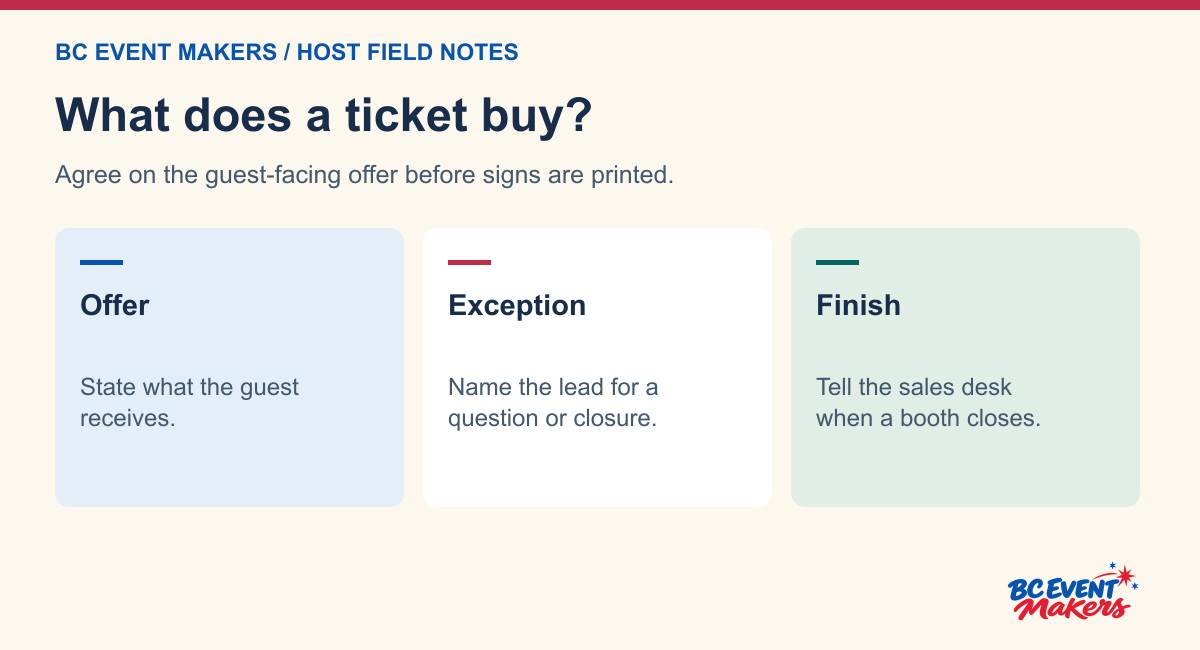
Some school fairs use general tickets across several booths. Others make activities free or collect a contribution separately. Ask the organising body to approve the actual arrangement and tell families what they receive before they join the ticket desk queue. Keep any exceptions or separate prize arrangements with the responsible organiser.
Try a short rehearsal. One volunteer buys a pretend ticket at the desk and takes it to the game station. Does the station host know how many turns the agreed offer covers? What happens if that station closes? Can the ticket be used at another confirmed activity? If the two volunteers give different answers, resolve the wording before printing a large batch of tickets.
| Guest question | What the committee should decide | Who needs the answer |
|---|---|---|
| How do we take part? | The approved ticket, free-play or contribution arrangement. | Welcome desk, ticket desk and station hosts. |
| Where do we use this ticket? | Which activities accept it and which have a different arrangement. | Every volunteer explaining the guest map. |
| What if a station closes? | The authorised response for unused tickets or a guest needing help. | Ticket lead and the person calling last entry. |
| Can we watch or rejoin later? | The reviewed viewing place and current open programme. | Station host and anyone directing families. |
Keep the guest sign short. A station name, simple turn description and the confirmed ticket arrangement will usually do more than a paragraph of rules. Give the volunteer a separate instruction for unusual questions. If a guest asks about a refund, exception or prize, the volunteer should know the named lead who can make that decision under the school fair’s arrangements.
Example. The ticket desk is still selling while a booth closes
An activity has reached the end of its agreed window. The station host stops admitting new guests, but the ticket desk is around the corner and continues describing the booth as open. A family has now bought a ticket with a different expectation from the one the station can meet.
Give the station host a direct route to the ticket lead. At the last-entry cue, update the station sign and the desk information together. If general tickets can be used elsewhere, tell the family which confirmed activities remain available. If an individual decision is needed, take it to the responsible organiser. Avoid asking a volunteer at the queue to invent a new policy in front of waiting guests.
At the planning meeting, ask the desk team to repeat the closing cue. A phrase such as “when the station lead calls last entry, change the desk board and give new arrivals the current options” is an action people can follow. Put any payment or recordkeeping details in the organisation’s staff process.
Plan for the school bell
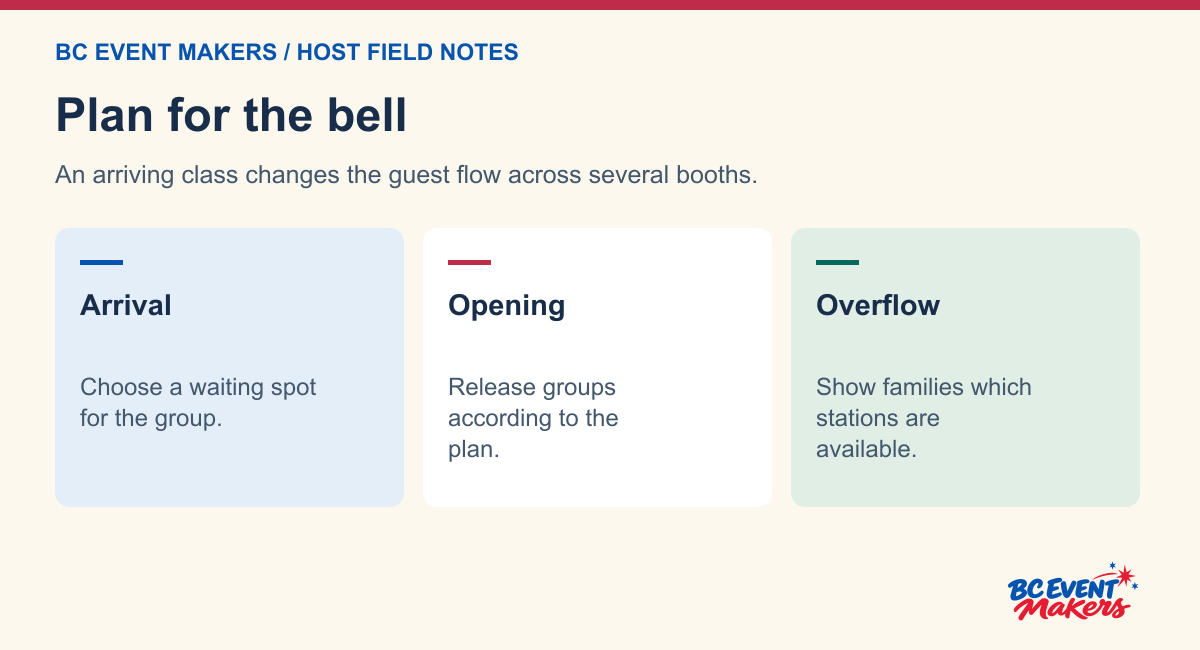
A family visiting on a Saturday and a class arriving straight after dismissal can use the same equipment very differently. Tell the supplier how many groups may arrive together and which activities open at the same time. A headcount without an arrival pattern can hide the pressure on the first game station.
Ask a teacher or class lead where the next group can meet while waiting to be called. The waiting place needs to be reviewed with the school and the people responsible for the activity. Keep class assembly separate from the public queue when the two uses would obstruct one another. A volunteer welcoming the class should not be asked to make decisions about equipment operation.
Example. Three classrooms choose the same first station
The large, colourful game is immediately visible from the gate, and every group heads towards it. Meanwhile two suitable stations farther along the route have no guests. The problem may be how the fair introduces its options rather than a shortage of equipment.
Ask the welcome volunteer to give groups a choice of confirmed starting points. “The shared game is over here, and the quick-turn station is open beside the information table” helps a teacher make a decision without forcing everyone into a rotation. If the school wants scheduled class visits, use a common meeting point and an agreed cue for bringing each group forward.
Update the map as well as the script. A plan printed with a single large arrow towards one game can undo the welcome volunteer’s attempt to spread arrivals. Walk the route from each entry gate and look at the first visible sign. A visitor should see more than one reason to enter the fair.
Example. A sibling wants to wait with their family
Families often move at different speeds. One child may want another turn while a sibling needs a quieter place to watch. If the only place for a non-player is in the main queue, the line fills with people who have no intention of taking a turn.
Identify a reviewed watching place or meeting point and explain it at the approach. Give a family a way to rejoin the wider fair without crossing the playing area. Ask the school contact whether the arrangement works for guests using the paths between games, food and washrooms. The answer may change where a sign, table or queue belongs.
Make the volunteer handover practical
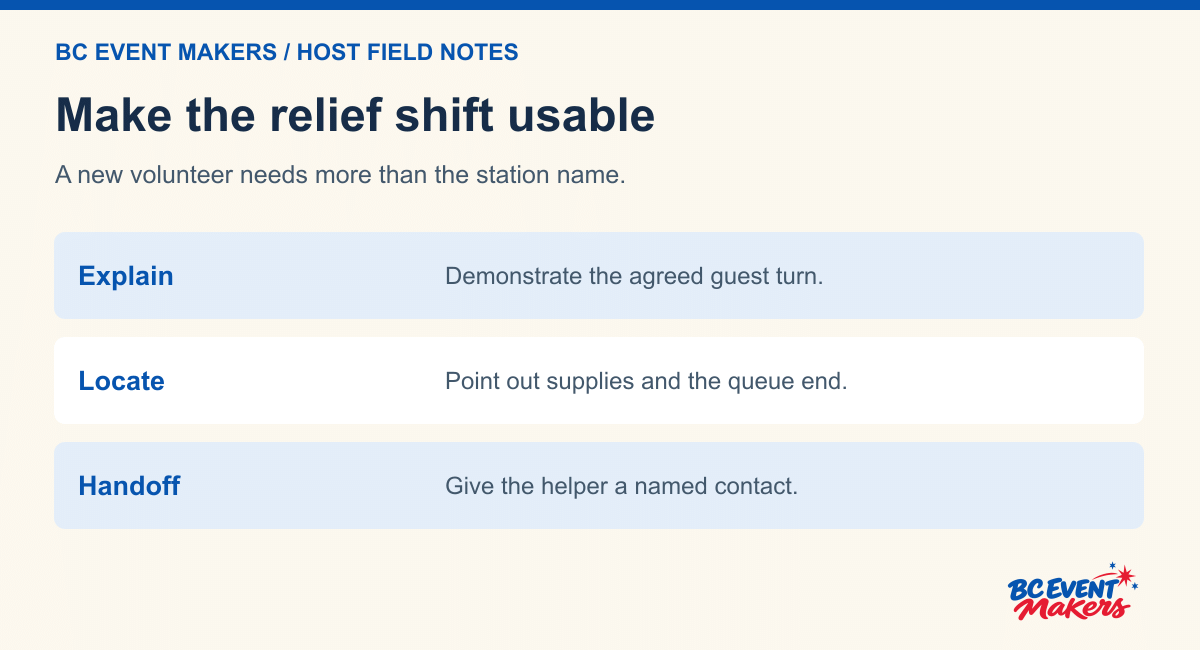
A volunteer starting a short shift needs to see one complete guest turn. Explain how the organiser wants guests welcomed, which activity instructions come from the supplier, where the queue begins and how to contact the station lead. Confirm which setup, reset or operating tasks are assigned under the actual booking before putting those tasks on a volunteer sheet.
Write a handover with four lines: what to say to a new guest; where to find the approved supplies; whom to ask about a ticket exception; and what to do when the station pauses or closes. Keep private contact information on the staff copy. A guest sign should not become a directory of volunteers’ personal phone numbers.
Have the incoming volunteer demonstrate the welcome from the guest side of the booth. Can they identify the right queue and give the same turn explanation as the outgoing person? If the instruction only makes sense to someone standing behind the table, change the wording or position of the sign and brief the whole team.
Example. A volunteer’s break collides with the lunch rush
One host is due to leave at the moment families finish eating and return to the game station. The relief volunteer is also scheduled to collect supplies at the ticket desk. Put these tasks on the same timetable before assigning names. A person cannot cover two locations just because the roles appear in different committee lists.
Arrange a real handover period or change the supply collection task. If a station needs to pause, tell the ticket desk and welcome point which options remain open. A clear short pause is easier for guests to understand than a booth left unattended while each volunteer assumes someone else has it.
After the rush, ask which detail the relief volunteer most needed. It might be the location of replacement game pieces, the approved answer for a child wanting another turn or the route for a question from a parent. Add that specific answer to the next handover instead of making every volunteer read a longer generic handbook.
Bring the school and supplier the same plan
Send the date, Chilliwack address, guest hours, delivery window and collection arrangements. Include the real game station shortlist, expected group ages or arrival pattern, location photographs and the map showing other uses of the site. Keep any question awaiting school approval visible in the request.
We are planning a school fair at [venue] on [date]. Families and classes arrive [pattern]. We are considering game rentals for [quick turns, shared play or other purpose]. The school has confirmed [details] and still needs [decisions]. Attached are the delivery entrance, proposed stations and guest route. Please confirm which options fit the site and which tasks our team should plan to cover.
If the committee changes a game or moves a station, revise the site brief before the equipment is advertised. Another item can have different space or staffing requirements even when it fits the same role in the programme. Ask the school and supplier to review the actual replacement, then update volunteer cards and signs.
The last ten minutes of the fair
Ask each station lead to communicate the last-entry decision using the approved process. Give families who are still arriving clear directions to what remains open. Keep the supplier collection route available and name the school contact who will receive the site at handback. The guest timetable and the site handback belong on the same sheet, with different people responsible for their respective decisions.
At the debrief, collect one observation from the ticket desk, one from a game station and one from the welcome point. The desk might identify a confusing offer; the station might identify a queue crossing; the welcome point might identify an unclear meeting place. Use those observations to decide which part of the next school fair map or volunteer brief needs revision. Preserve the original date, site and equipment context so a future organiser can evaluate the next event on its own facts.
Keep a copy of the actual guest sign with these notes. If families repeatedly asked whether a ticket could be used for a second activity, the sign may have explained the price while leaving the promise unclear. If they asked where to stand, the sign may have been perfectly worded but placed where only someone at the front could see it. These two problems call for different fixes. Let the next committee review the evidence and the new school layout before it orders another set of printed signs.
Review the carnival game collection and send the event brief for confirmation of the date, equipment and address.