
Food rentals in Squamish start with two routes: one for guests coming to collect food and one for the people supplying the counter. Squamish is outside BCEM’s usual Lower Mainland and Fraser Valley service area. Ask for written confirmation for your address and date before counting on a machine.
Open the worked examples and planning sheet
BC Event Makers’ food equipment catalogue includes a Popcorn Machine, Cotton Candy Machine and Hot Dog Machine. Confirm the current options for your date and ask about delivery to the proposed Squamish site. Choose equipment after checking the venue’s food arrangements.
1. Food rentals: draw the guest route
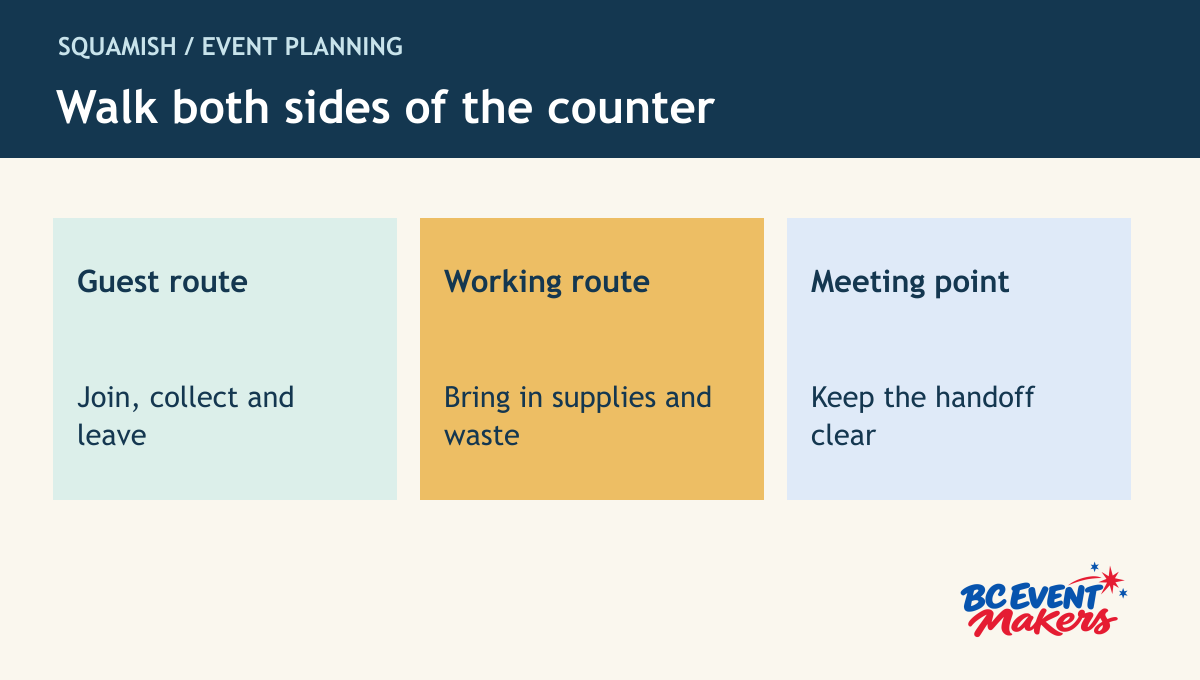
Mark where guests approach, where they order or collect food, and where they leave the station. A queue should not block another attraction’s entrance or the route between the event and its washrooms. Keep emergency and service access clear in the site plan.
If you will accept payment, decide where that happens. Separating payment from collection may be useful, but only if guests can understand the process. Use plain signs that explain what is available and how to receive it. Avoid asking visitors to work out the system while standing at the counter.
2. Give operators a practical workspace
Place stock and serving materials where the person operating the machine can reach them. Plan a replenishment route from storage that avoids carrying supplies through waiting guests. Check what tables or other work surfaces are required and whether they are included in the rental.
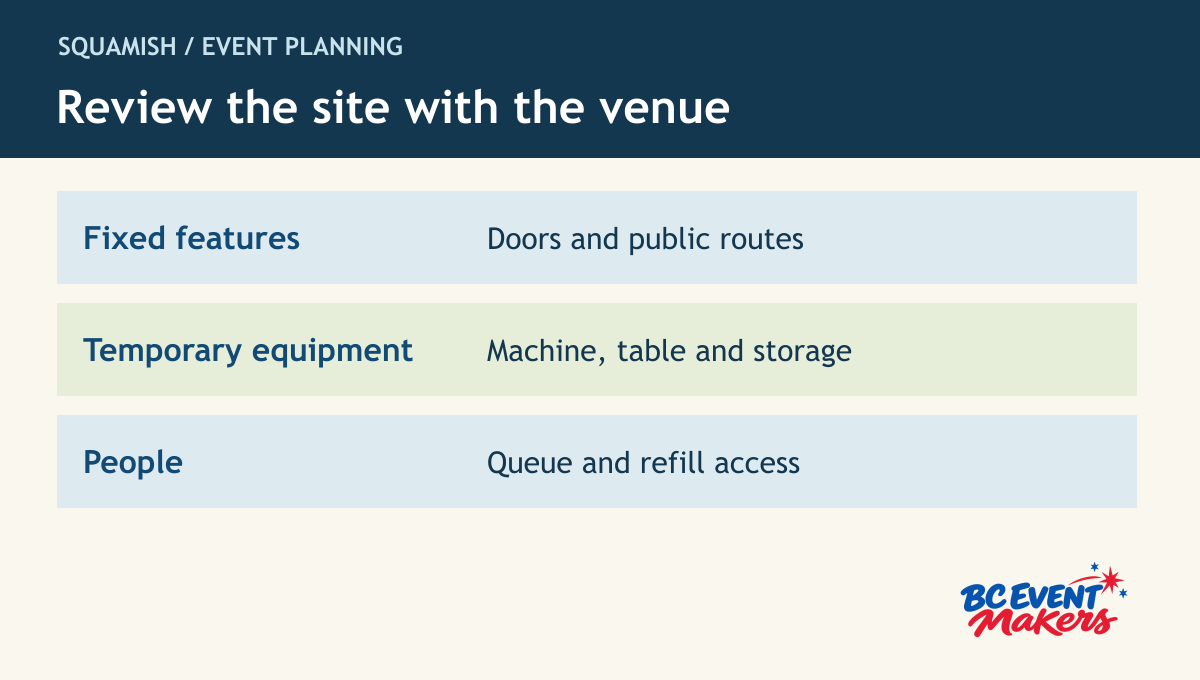
Ask about the electrical requirements for each selected machine. Share other equipment that will use the same area so the venue can assess the proposed supply. Do not assume that a nearby outlet is suitable for every machine or for several machines together.

3. Confirm what the rental covers
Equipment, food supplies and service responsibilities are separate questions. The catalogue lists popcorn supplies separately from the machine. Ask what comes with the particular booking, what quantities are proposed and who will operate the station. Put the agreed arrangement in the event’s supplier notes.
Check food handling and preparation requirements with the venue and the appropriate local authority before the event. Explain what you intend to prepare and how it will be served.
4. Prepare for opening and closing
Allow time for equipment instructions and preparation before the advertised serving time. Agree how the station will pause for replenishment and who will announce that service has finished. Keep a contact available during collection, especially where delivery vehicles have restricted site access.
Browse the rental catalogue and send the Squamish venue details with your serving plan. Include the surface, access route and operating hours so availability and delivery can be discussed together.

Follow an empty hand and a full tray
Draw the proposed counter on the site plan, then mark a guest walking away with a snack and a helper approaching with supplies. If their paths intersect at the same narrow corner, move the pickup point or store supplies on the operator’s side. Do that on paper before the event equipment arrives.
For an outdoor site, ask what the venue allows at the proposed location. Shelter, power and delivery access depend on the equipment and site; the plan should identify the people who confirm each one. An empty patch of grass or pavement does not establish suitability for a particular machine.
A guest arriving at the counter has time to look at the options. A guest leaving it has a snack and may have less ability to move around an obstacle. Mark each path separately. Add a third line for the person bringing fresh supplies. If all three meet at one corner, change the layout and ask the venue to review it.
Moving food rentals to a different part of the site is a reason to check the whole arrangement, not just redraw the counter. The new position can change the delivery route, guest access, operator space and the venue contact who controls nearby doors. Ask the provider whether the revised location changes its setup needs before revising guest directions.
Questions to settle before the event
Can the refill route run through the guest queue?
Walk the proposed route with the venue. A short refill trip can become awkward when families stop at the counter. An alternate position may let the helper reach supplies without crossing waiting guests.
Who reviews the site plan for food rentals?
The event organizer coordinates the layout with the venue and food provider. Ask the regional health authority what applies to the actual food service if the public will be served.
Do BCEM food rentals automatically include Squamish delivery?
The catalogue does not confirm service to a Squamish address. Ask about the venue and date in writing, including travel, access and collection. If those cannot be confirmed, approach a closer supplier.
Where can the organizer check public food-service requirements?
Describe the proposed menu, service format and event to Vancouver Coastal Health. Ask which requirements apply and who will coordinate any necessary arrangements. A rental confirmation covers the agreed equipment and services; it does not settle the venue or organizer’s responsibilities.
Two routes through a Squamish food counter
Draw the counter from both sides
Walk to the proposed food station as a guest, then look at it as the person receiving supplies. The guest needs a clear place to choose, collect and leave. The working side needs the access and space reviewed for the actual service. A layout that shows only the front of the counter leaves half the event plan unanswered.
Mark the collection point, menu information, queue end and route to seating. Behind the counter, mark the approved receiving point, the tasks the provider or organiser will handle and any access needed by the venue. Discuss the arrangement with the supplier and site contact. Keep food-handling requirements with the provider and relevant authority.
For Squamish, ask the equipment or food provider for written service to the actual date and address. BC Event Makers’ core area is the Lower Mainland. A local provider or another confirmed menu may be a practical option if a travel proposal cannot be confirmed. Keep the guest purpose visible so the organiser can compare different offers without losing the reason for the food station.
Compare the work behind two menu options
Suppose the committee is deciding between renting food equipment with a defined host role and hiring a vendor that prepares and serves the food. Put both proposals beside the same drawing. Which tasks does each provider handle? Which tasks must your team cover? Where does a guest ask a question about the actual menu?
| Decision | Question for an equipment proposal | Question for a staffed service |
|---|---|---|
| Supplies | Which ingredients and serving materials are included? | Which menu items and service arrangements are confirmed? |
| Host responsibilities | Who is permitted and prepared to handle the agreed tasks? | Which arrival, queue or venue duties remain with the organiser? |
| Guest information | Who provides current product and ingredient information? | Which provider contact can answer a question during service? |
| End of service | Who closes the station and completes the venue handback? | What access does the vendor need when guests are still nearby? |
Read the answers in the context of the busiest break. A machine listed in the catalogue helps identify the equipment to discuss. Its presence alone does not promise ingredients, serving materials or staff for the event. Ask the provider to describe the actual scope so the volunteer roster and venue plan reflect the agreement.
Example. A delivery reaches the working side during the guest rush
Imagine the food station is open when an additional delivery arrives. The simplest physical path to the counter crosses the queue, and the volunteer greeting guests is asked to leave their position to show the driver where to go. A plan made only for opening time has missed an ordinary mid-event handoff.
Ask the provider and site contact to agree on when and where supplies can arrive. If a delivery is expected during public service, identify the person who receives it and the route the venue will allow. Keep the guest queue and working side understandable to both arriving staff and visitors. Avoid improvising a path through the serving area simply because the delivery is late.
Put the agreed receiving arrangement on the private station sheet. Give the welcome host one current answer about which part of the station remains open while the team handles the delivery. Guests should be able to collect food or choose another activity without trying to work out why a vehicle or supplier is crossing their line.
Example. Everyone wants to stop near the menu sign
A detailed menu sign can become a gathering point where people choose, compare and wait for friends. If it sits at the narrowest part of the collection route, each new group slows the next guest’s exit. The information may be accurate while its location works poorly.
Ask the site contact whether guests can make their choice before reaching the collection point. A second concise menu board at the approach may help, provided both versions show the same confirmed information. Give families an agreed place beyond the counter to meet and decide where to sit. Keep that place separate from the supplier’s working side and service route.
Walk the revised arrangement as someone who wants only a drink or who is passing through to the washrooms. They should not have to join the food station queue to reach another public part of the event. If the same doorway serves all these trips, review the menu layout and timing rather than expecting every guest to wait in the right place without guidance.
Example. A helper leaves before the counter closes
The volunteer roster may end with the guest programme, while the provider still needs a host contact for collection and the venue expects a final handback. Give those later decisions an owner. A helper who has arranged transport home needs a clear finish time and a person to receive their role.
Write down who can answer a provider’s question, who keeps the collection route available and who represents the organising team when the site contact reviews the area. Keep any private records or personal information in the organisation’s approved process. The outgoing helper should know which items and messages to hand over before leaving.
If the event schedule runs late, ask the responsible providers and venue what can change within the agreement. Do not tell guests the counter will remain open while the person responsible for its service is preparing to close. One accurate announcement about the confirmed food offer is easier to manage than several corrections.
Keep ingredient information with its source
Have the current menu and product information supplied by the provider for that event. A changed topping, package or supplier can change a guest’s question even if the station still has the same name. Tell volunteers where to find the confirmed information and who can answer something outside it.
Use supported menu descriptions and avoid broad dietary assurances the provider has not confirmed. The event host can listen, share the information available and refer a guest to the responsible person. Keep any personal circumstances discussed by the guest private. If another confirmed option is available, describe it accurately without making an unsupported promise about suitability.
For public food-service questions in this region, use Vancouver Coastal Health’s event and food-market planning guide and ask about the exact venue, provider and service arrangement. The committee should know which party is coordinating the necessary review before it advertises the food offer.
A site brief the provider can act on
We are comparing food rentals for [Squamish event] on [date]. Guests will reach the food station [arrival pattern]. The site contact has approved [details] and is still reviewing [questions]. Attached are the guest route, working side and delivery access. Can you confirm service to this address, what the proposed equipment or staffed service includes and which duties our team would have to provide?
Ask for a written answer to the travel and access questions before committing to the provider in public material. If the menu or location changes, circulate a revised brief and identify the part that needs another review. A replacement food station can affect the queue, supplies, ingredient information, staff duties and collection even when it occupies the same corner of the hall.
Before opening, read the guest sign with someone outside the organising team. Can they see what is available, where to collect it and where to ask a question? Then have a helper read the private sheet and explain how a provider reaches the working side and who handles closing. These two small checks show whether the plan works for the people who need to use it.
After the event, keep the map actually used and one observation from each side of the counter. The front might reveal that the collection point was hard to identify. The working side might reveal that a delivery arrived at the busiest moment. Those are different problems, and keeping them separate helps the next organiser make a precise improvement.
Check an alternative menu against the same drawing
If the preferred food rentals cannot be confirmed, keep the counter’s job in view. Was it meant to provide the main meal, a quick snack after an activity or a place for people to gather between sessions? Ask an alternative provider how its confirmed menu and service would meet that purpose at the actual Squamish venue.
Review the new arrangement with the site contact. A smaller item may still create a longer guest queue if everyone collects it at once. A staffed vendor may need a different access window, and prepared food may require a different receiving handoff. Record those changes before telling volunteers the replacement is “basically the same”. Once the revised offer is confirmed, update the guest sign, supplier instructions and private station sheet together so everyone is working from the same plan.
A message to send with the venue details
We are comparing food rentals for [Squamish venue] on [date]. Can you confirm service to this address and review our sketch? Please identify the working area, guest pickup, setup time, supply access and collection arrangements for the proposed equipment.
Keep a copy of the agreed sketch with the quote. If the venue moves the station, revisit both guest and refill routes, the power arrangement and the time equipment must leave.
Draw a second version of the site plan with the counter in its alternate position. Compare how each version affects the guest, the helper bringing supplies and the venue contact meeting the delivery. If the alternate location removes a conflict, ask the venue and provider to confirm it while there is still time to change the food rentals plan.