
The Swing Ride queue at a Mission fair starts before anyone reaches its front. Show families where to join, how to find confirmed participation information and where friends can meet afterwards. Use these four checks to plan the waiting area with the venue and the ride contact.
BC Event Makers lists a Swing Ride among its fairground attractions. Ask about the specific ride’s availability and operating requirements for your event. The equipment discussion should cover the queue as well as the space occupied by the ride itself.
1. Put Swing Ride information where guests make the decision
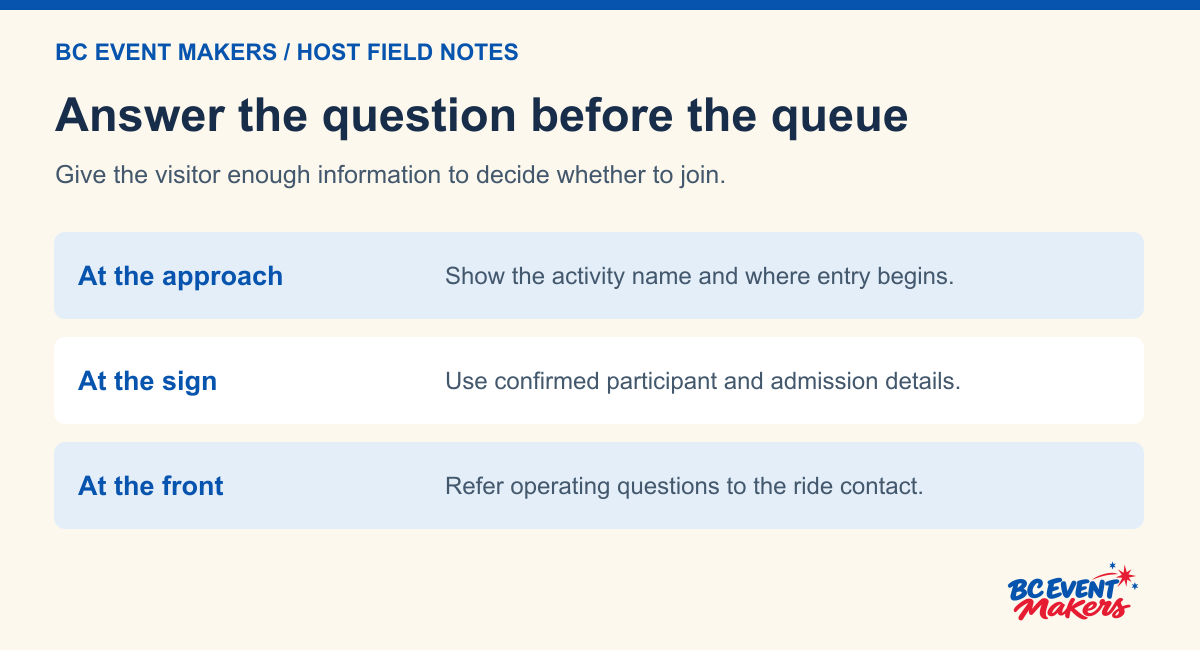
Ask for the confirmed participant requirements and use them where guests decide whether to queue. Visitors should learn about entry conditions before spending time in line. Explain the operating hours and how any event tickets or admission arrangements apply.
Use signs that are easy to read from the approach. A volunteer directing guests can be useful, but confirm their role and keep it separate from the ride’s required operation and supervision. General event helpers should not improvise instructions for the equipment.
2. Give the ride queue a clear end and return route
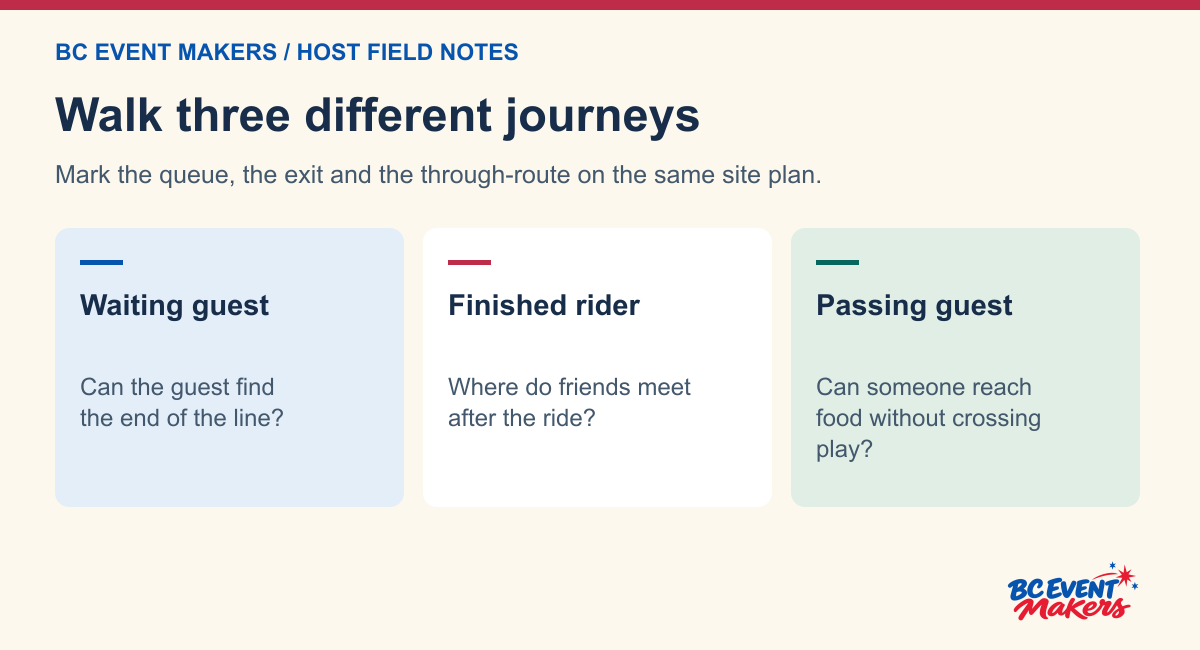
Mark the expected waiting area on the site plan and consider where additional guests would stand if demand grows. Keep the route away from emergency access and other activities’ playing areas. Ask the supplier to review any barriers or queue layout you propose.
Leave a clear path for people who change their mind and want to leave the line. Families may also need to regroup after a turn. Plan a meeting point outside the operating space so people are not waiting at the exit for the rest of their group.
3. Walk the neighbouring activities at their busiest
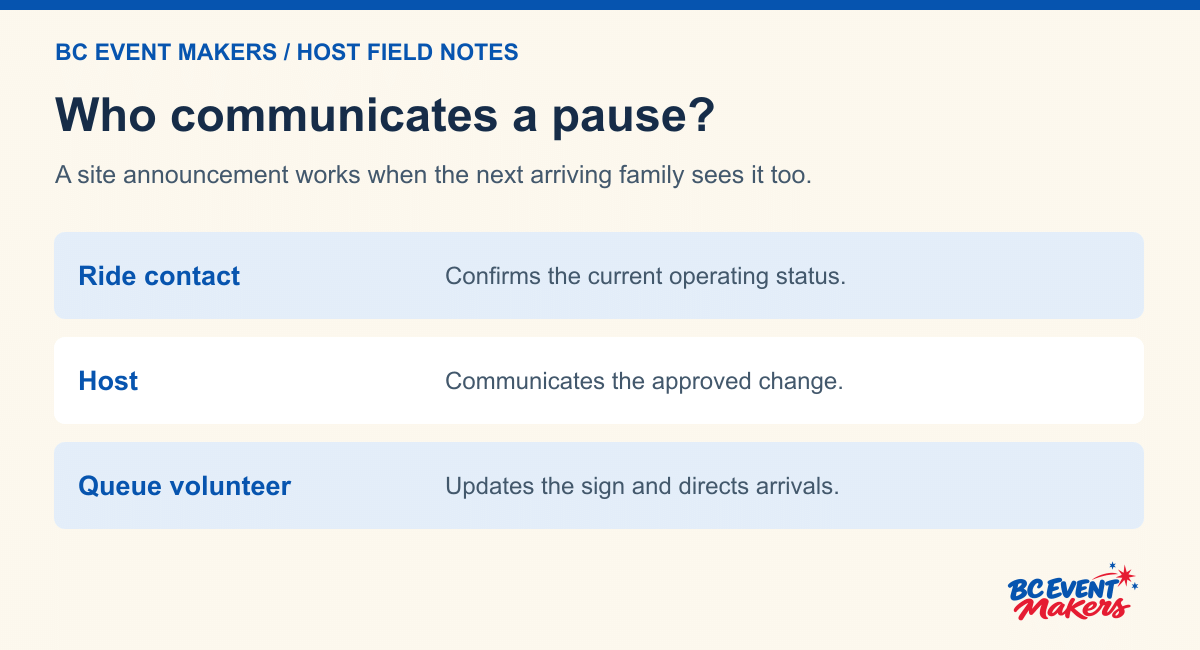
A food stand and a ride can each draw a crowd. Their queues should not merge into one confusing space. Show their entrances and serving points on the same plan so you can see how guests will move between them.
Provide another choice for visitors who do not want to ride or do not meet its requirements. Carnival games offer options to discuss, with their own space and supervision needs. Choose them around the participant group rather than assuming a mixed programme suits everyone automatically.
4. Give the host a cue for changes and last entry
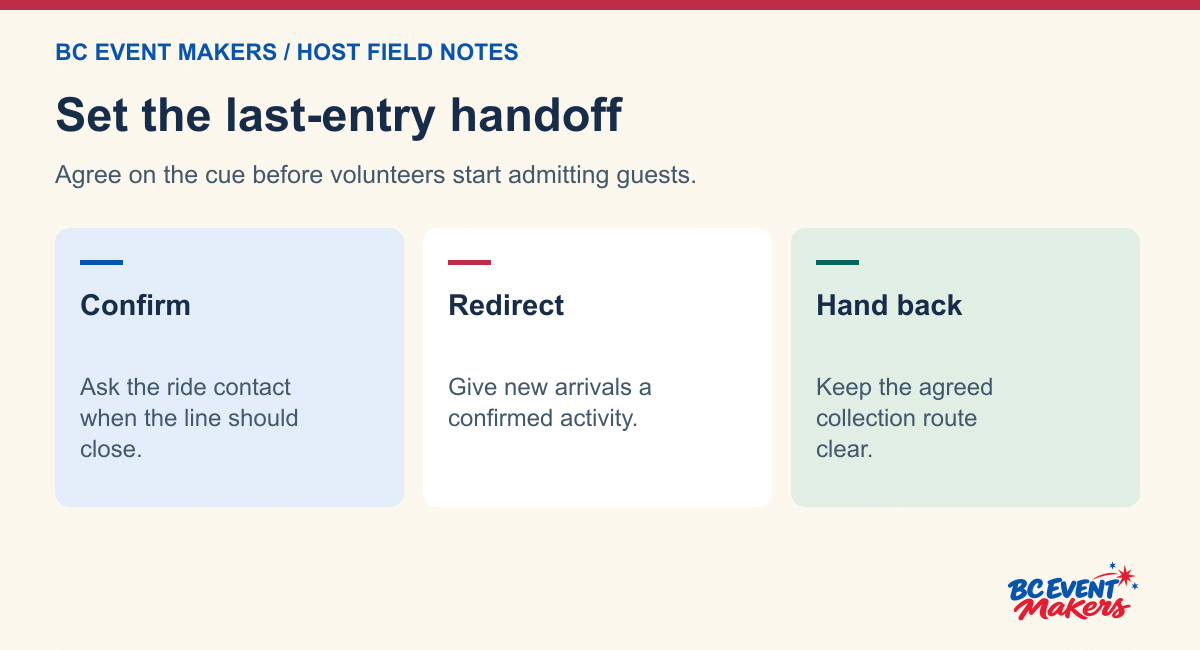
Confirm the opening window and how the queue will close near the end of operation. Ask who communicates a pause caused by weather or another operating decision. Give the event organiser a clear contact so announcements match what is happening at the attraction.
Browse fairground rides, then send your Mission venue details. Include the proposed site layout and event timetable, and ask for delivery, staffing and operating arrangements to be confirmed in the quote.
Make a map from the visitor’s point of view
Print a simple version of the site plan and hand it to a volunteer who has never visited the venue. Ask them to draw the trip to the Swing Ride from the public entrance, then the trip back to lunch with a friend who stayed behind. The gaps in their drawing are the questions your signs and site brief need to answer.
Mark three places before choosing a position for the waiting area. Guests need somewhere to decide whether to join, a clear end to the ride queue, and a place to meet once they leave the activity. These places may be visible from each other while still serving different purposes. Ask the venue and ride contact to review the full arrangement against their requirements.
For a Mission municipal location, start with the City’s facility booking information to identify the appropriate venue contact. A school field, independently run hall or private property will have its own approval route. Give the person responsible the name of the actual Swing Ride, the access times and a sketch showing the people around the equipment.
Walk the site as four different guests
First, walk as a guest deciding whether to ride. Can you identify the attraction and ask about the operator’s participant requirements before entering the ride queue? If admission or event tickets are involved, can you understand the arrangement without reaching the front? Keep personal questions with the responsible contact so a guest can decide privately whether the activity suits them.
Second, walk as someone who wants to watch. Pick a place that the venue and operator can review, then trace the route there from the entrance. A viewing place is useful only if a friend can find it without passing through working space or standing in the line. Ask where spectators can move if that space fills.
Third, walk as a guest who has finished and wants to find their group. Is the meeting point visible or clearly named? Does the exit send everyone back through the waiting area? A simple cue such as “Meet at the fair information sign after your turn” is more useful than “We’ll see you over there”. Use the actual site landmark once the layout is confirmed.
Finally, take the shortest route between lunch and the washrooms as a guest who has no intention of riding. That person has a claim on the fair too. A queue which blocks their route can turn a popular attraction into an inconvenience for everyone else. Bring that specific crossing back to the venue team while it can still change the layout.
Rehearse the busy part of the afternoon
Example one. A class reaches the fair before lunch
Suppose one class arrives together and a second is due ten minutes later. A drawing based on one family arriving at a time will understate how much space a group needs to wait. The issue is where the class meets and how its teacher knows when to bring it forward. The operator remains responsible for the applicable activity instructions.
Agree on a waiting point outside the ride queue. Ask the queue host to contact the teacher when the next group should approach under the reviewed plan. If a child wants to watch or stay with a friend instead, the teacher should know where that choice can happen. Avoid presenting a turn as something everybody in the class is expected to take.
Write the arrangement in the volunteer brief in plain language. “Meet the second class at the agreed point and wait for the queue host’s cue” assigns a clear task. “Get the class on the ride quickly” can encourage a volunteer to make decisions outside their role. When the schedule slips, the first instruction is still useful.
If a class misses its planned window, speak with the ride contact before promising a replacement time. Direct the group to an activity or meeting area that is confirmed. Give the teacher the next reliable update. That protects the rest of the fair schedule as well as the experience of the group that has been waiting.
Example two. The food queue turns towards the ride queue
Imagine that a popular food booth opens halfway through the event. Guests line up in the shortest visible space, which happens to be the approach to the Swing Ride. A queue host can tell two people where to stand, but cannot fix two activities competing for the same public path.
Take the issue to the venue contact and ride contact. Show them the point where the food queue meets the guest route and identify a waiting area they can review. Ask who will change the sign and who will brief the food team. A revised arrow at the ride alone may send guests towards the wrong end of the food line.
Return to the same spot after the change, this time from the perspective of a new arrival. Can they see where each line starts? Is there room to ask a question without blocking people who already know where they are going? The change is successful when the next few guests can follow the arrangement with ordinary directions.
Example three. A weather pause interrupts the last hour
The activity contact tells the host that play is paused. Some families have waited a while, others have only just arrived, and the closing time is getting closer. Give the queue host one current message approved by the person responsible. It should say what guests can do now and when the host will next provide an update.
Do not estimate a restart time from the weather forecast or from how a ride operated at another event. The decisions for the specific Swing Ride belong to the responsible people under the booking arrangement. If another activity is open, direct guests to its confirmed location. If a group wants to wait, explain the arrangement agreed for the waiting area and how they will hear the next update.
When the decision changes again, update all three points: the entrance, the end of the ride queue and the person making announcements. Someone who heard an earlier message should see the current information without having to walk around the site looking for a manager. Keep an older sign off display once it describes a superseded arrangement.
Make the queue host’s shift easy to hand over
Give the first queue host a private sheet with the name of the ride contact, the venue contact and the event lead. Add a simple sketch showing where the public queue begins, where questions go and where friends meet after a turn. The host needs clear guest directions and a route to the operator for specialist questions.
| Cue | What the queue host checks | What to communicate |
|---|---|---|
| Before opening | The responsible ride contact has confirmed the public arrangement. | Where guests can join or watch and whom to ask about participation. |
| During a class arrival | The teacher and station host agree which group is approaching. | Where the next class waits and how it will be called. |
| On a pause | The ride contact has supplied a current status. | What is open now and when the next update is expected. |
| At last entry | The station has an agreed closing cue and the event lead knows. | Whether new arrivals can join and which other activities remain available. |
Run through the sheet once with the relief volunteer. Ask them to show you the end of the line, identify the meeting point and name the person they would call if the route became crowded. If a volunteer has to search through several pages for those answers, put the three items at the top of the sheet.
Keep the guest sign shorter than the private brief. It can show the activity name, public operating window and where to find the agreed information. It should not contain private phone numbers, unconfirmed limits or a promise of a precise wait. Ask the operator to review any equipment-specific wording before it goes on display.
A short conversation at the end of the line
Try a welcoming script that leaves room for choice. “The Swing Ride queue starts here. The activity contact can answer questions about taking part. If you’d prefer to watch, the agreed viewing place is beside [landmark].” A host should be able to say that without evaluating a guest’s suitability or giving instructions for operating the ride.
Now try the script for a guest who asks whether they can finish before a scheduled lunch. “I can show you the current queue and where to check the programme. I can’t promise a particular turn time. The next open activity is [confirmed option] if you need to stay close to lunch.” Fill in confirmed details for the actual site.
A question about waiting often hides a different need. A parent may be trying to keep siblings together. A colleague may need to return for remarks at a particular time. Someone else may simply want a good place to meet a friend. Asking “Are you looking for a turn or somewhere to watch together?” can provide a more helpful answer than guessing how many minutes remain.
Compare two possible queue positions
One position may put the end of the line in a highly visible spot while leaving little space for spectators. Another may give families more room but require a clearer sign at the entrance. Review both with the same set of questions. Can a new arrival find the end? Can someone bypass the waiting area? Can finished guests meet their group? Can the supplier reach the agreed space when the fair closes?
Include the busiest neighbouring activity in each sketch. A booth that looks quiet at setup may draw a crowd after the welcome speech. A delivery route that is clear during opening hours may be needed by catering at collection. Share those timings with the venue and supplier rather than assuming each can see the other’s timetable.
If the location changes after the quote, give the supplier the new route, surface, access window and proposed queue drawing. Mark the previous drawing as superseded in the event file. The people reviewing the new site should not have to work out which parts of the old arrangement still apply.
Send a quote enquiry that includes the guest route
We’re considering the Swing Ride for [Mission venue] on [date]. The guest hours are [times] and the site can be accessed from [time] until [time]. We expect [arrival pattern]. Attached are the unloading route, activity area, ride queue and proposed meeting point. Please confirm availability, site-review requirements and how we should coordinate participation information, queue closure and collection.
Add any schedule feature that could create a sudden rush, such as the end of lunch or a class dismissal. If the organising team is still choosing between two positions, send both sketches with the same labels. This allows the supplier and venue to discuss the real difference between the options without treating a provisional sketch as an approved operating layout.
One question to ask at the debrief
Ask the queue host where guests most often needed help. Was it finding the end of the line, understanding when they could join, meeting friends afterwards or learning about a pause? Write down the observation with the point on the site map where it occurred. Keep any personal or equipment-specific matters with the people authorised to handle them.
An observation such as “families walked back to the entrance after their turn because they could not find the meeting point” gives next year’s team a specific change to test. It may call for moving a sign or choosing a more recognisable landmark. Record who will check the next layout with the venue and supplier before adopting the change.
Keep the most legible version of the site sketch with that observation. Mark the point where guests first looked for directions and the place where the queue host stood. The next organiser can then decide whether a sign, a volunteer position or the actual guest route needs review. A photograph taken after the fair has emptied is useful for identifying landmarks, but it will not show where the crowd formed during the lunch rush.
Review the Swing Ride and send your event details to BC Event Makers for written availability and site review.